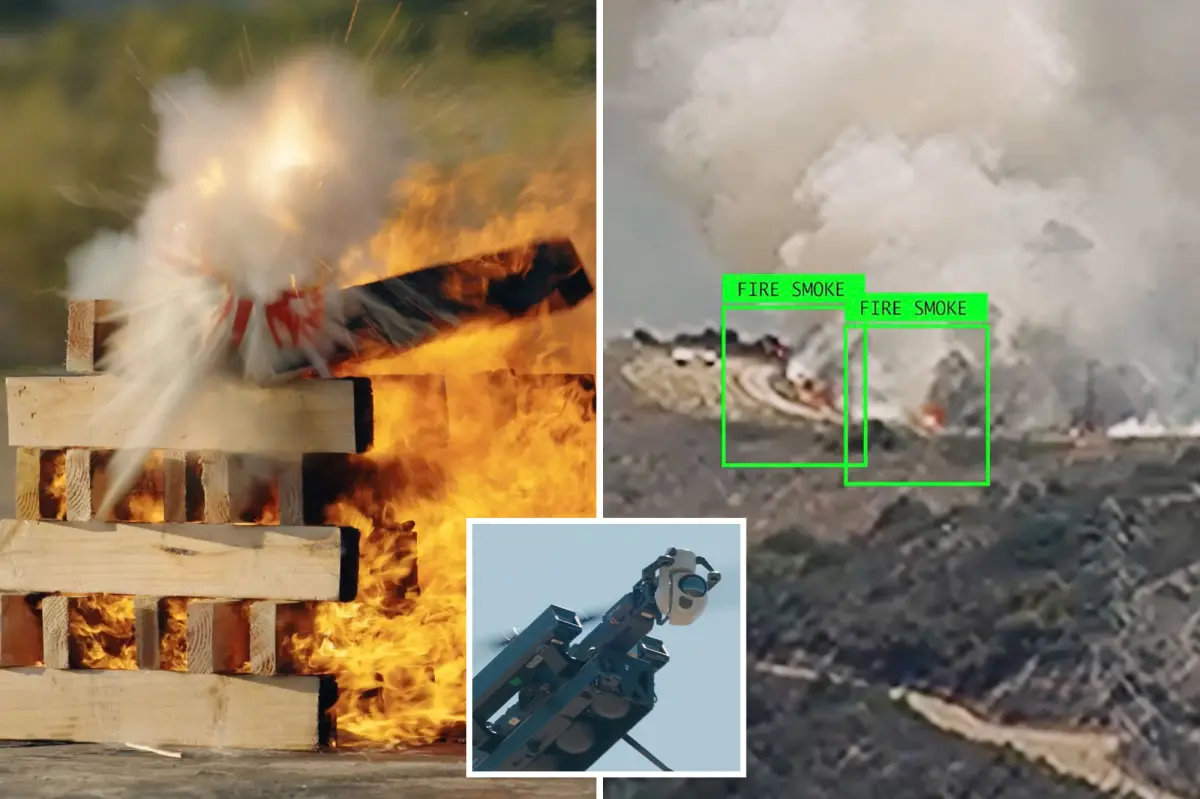

Wildfire response is entering a new technological era as autonomous drones and artificial intelligence-powered sensors are being developed to identify flames and begin suppression before human crews arrive.
Anduril, the California defense-technology company, won the autonomous-response category of the $11 million XPRIZE Wildfire competition. The victory earned the company $1.2 million after its Lattice platform underwent live-fire trials in June.
Anduril also received a $1 million Lockheed Martin prize for detection accuracy, lifting its total winnings to $2.2 million.
Lattice brings cameras, sensors, drones and fire-suppression equipment together in a single coordinated network. The system is intended to identify a wildfire and organize the initial response without requiring people to manually link each step.
The competition centered on one critical advantage: speed.
Each team had to find a high-risk wildfire somewhere within a 1,000-square-kilometer stretch of rural Alaska and fully suppress it in 10 minutes, while avoiding a series of decoy fires.
“We want to be able to have technologies that can detect a fire before it’s detected by anyone else,” Andrea Santy, program director of XPRIZE Wildfire, told Ars. “A 911 call is still the most typical way that we find out about wildfires, and on average, that’s going to be at least 15 minutes.”
During the finals, Anduril’s system detected, engaged and suppressed live fires. The performance expands the company’s work in autonomous operations, which already includes the FQ-44 Fury uncrewed fighter and surface vessels, into the increasingly urgent field of wildfire management.
More than 300 teams entered the autonomous-response track. Their early concepts included robotic dogs, unmanned ground vehicles, lasers and systems designed to use sound to combat flames.
As the competition progressed, the finalists concentrated on solutions that could meet the test’s demanding mix of rapid response, long-range operation and pinpoint accuracy.
The final results underscored how challenging autonomous wildfire suppression remains.
All three finalists located the high-risk fire within the 10-minute window. However, only two sent drones to attack it, and none fully extinguished the blaze. As a result, the track’s grand prize went unclaimed.
Dryad Networks placed second and received $800,000, while AURA Foresight finished third with a $500,000 award.
The competition will now move into a 12-to-15-month Impact Phase aimed at refining the systems and bringing them closer to practical, real-world deployment.
Video released by Anduril on Wednesday shows the technology being tested during a demonstration in California.
Download The California Post App, follow us on social, and subscribe to our newsletters