
King Charles embraced the carnival atmosphere in the Bahamas, dancing and playing a pair of Bahamian hand bells during a lively Junkanoo parade.
On the first full day of his Caribbean engagements, the monarch set aside the sensitive debate over slavery and reparations as he watched the colourful procession sweep through Nassau’s main thoroughfare.
Charles had been expected to observe the spectacle as guest of honour alongside Bahamian Prime Minister Philip Davis. But the energy of the performance proved impossible to resist.
He began by tapping his feet. After being handed the instruments, he moved along to the rhythm before making a playful backward glance towards his police protection officers and laughing his way into the crowd.
The King’s evident delight offered a glimpse of his lighter side, despite his demanding schedule and ongoing cancer treatment at the age of 77.
Junkanoo developed from traditions associated with enslaved people and has since become a major source of cultural pride and friendly competition in the Bahamas. It was therefore fitting that the country’s head of state should be honoured with a parade of his own.
Earlier, Charles was welcomed by the Prime Minister at the House of Assembly on Parliament Square, marking the second major meet-and-greet of his tour. He also spoke with Bahamian students taking part in building programmes run by The King’s Foundation before joining the street celebrations.
David Brown, of Brown’s Restaurant, offered the King the local speciality crab and rice. He said Charles remarked that he hoped there was enough food to go around.

King Charles joined the Junkanoo celebrations, dancing and playing Bahamian hand bells during his visit

The King watched a celebratory Junkanoo parade in Parliament Square during his first full day of engagements in the Bahamas

Charles was swept up in the atmosphere and could not resist joining the performers

Dancers in elaborate, brightly coloured costumes filled Nassau’s main thoroughfare during the energetic parade
The King also paused to speak with Marv Cunningham, owner of Mr Mix Bahamas, about the business’s gin-based cocktails.
With a chuckle, Charles told him: “Save one of those for me later, I could do with one.”
Mr Cunningham showed him a drink made with coconut water, condensed milk, London Dry Gin and a touch of nutmeg. He described it as the perfect beverage for the heat, adding that it had to be shaken rather than stirred, “just like James Bond”.
Charles then took part in an impromptu walkabout, shaking hands with residents who had gathered in Parliament Square to welcome him.
Only four protesters calling for reparations assembled along the parade route, and local police later asked them to leave.
The demonstrators were members of the Bahamas National Reparations Committee. Their handmade signs read: “Pay us what you owe us”, “Run us our money” and “BRIT: Belongers, Receivers, Investors, Traders of Slavery.”
Noelle Nicholls, chair of the committee, said: “At the National Reparations Committee, we want to make sure that both the Bahamian government and King Charles, as head of state of the Bahamas, understand that we have not forgotten he represents a Crown that was responsible for one of the gravest crimes against humanity.”
“We are here to say that, although you are on Bahamian territory as our head of state, you remain a symbol of the atrocity inflicted on our ancestors.”
“We are demanding an apology for those crimes, and reparations for the harm that was done.”
“We believe it is important to be present so that, amid the pomp and pageantry of the celebrations, which are joyful for some people, there is also a sombre occasion for us.”
“This is the King returning in a way that has still not atoned for the sins of the past.”

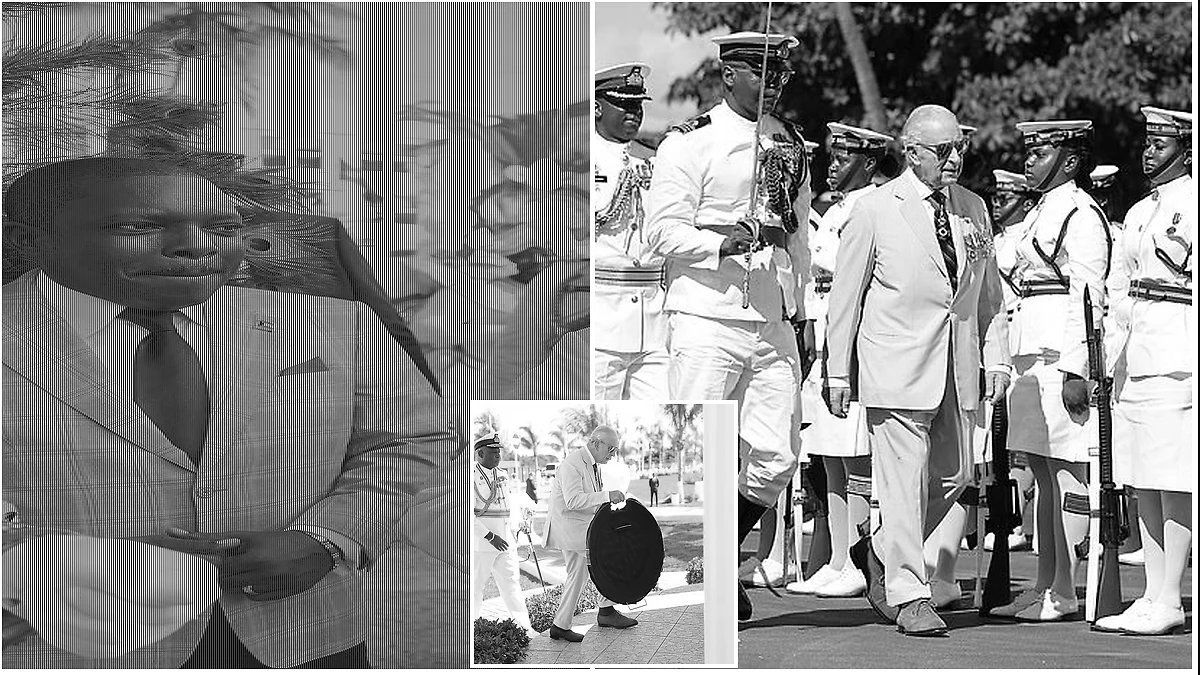
King Charles smiled during his visit to the Royal Bahamas Defence Force base at Coral Harbour on Wednesday

The monarch wore several medals, including the Order of Merit around his neck, as he met dignitaries

The King received a Royal Salute from a Guard of Honour and Colour Party made up of 106 officers and Marines

A 106-member Guard of Honour and Colour Party presented a Royal Salute to King Charles

King Charles met Commodore Floyd Moxey, commander of the Royal Bahamas Defence Force

Charles spoke with hundreds of serving personnel, veterans and other members of the defence force

The King is making a nine-day Caribbean tour of the Bahamas, Guyana and Antigua and Barbuda

Troops in distinctive white uniforms lined up to welcome the British monarch
Asked about the palace position that Charles cannot apologise for Britain’s historic role in the transatlantic slave trade because the matter falls to the government, campaigner Dr Niambi Hall Campbell-Dean replied: “He is part of our government too; he is its head. The King of the Netherlands has apologised.”
“We believe the King has the power and authority to make a statement as our head of state, or in his position as head of the legacy of this family.”
Charles also met Bahamian students enrolled in The King’s Foundation Building Craft Programme for The Bahamas.
The programme was developed by the Lyford Cay Foundations, a Bahamian education charity, and aims to preserve and expand traditional skills including carpentry, stonemasonry, blacksmithing, shingle roofing and lime plastering.
Earlier, the King paid tribute to the fallen while inspecting Royal Bahamas Defence Force troops in a solemn opening to the second day of his tour.
Wearing sunglasses and a row of medals, including the Order of Merit around his neck, Charles spent an hour at Coral Harbour on New Providence speaking with hundreds of serving personnel, women and men, and veterans in the bright heat.
He laid a wreath at the Flamingo Monument, which honours the four Bahamian Marines who died when HMBS Flamingo sank on 10 May 1980.
A handwritten card bearing Charles R’s signature carried the words: “In everlasting remembrance.”
The King was received by Commodore Floyd Moxey, commander of the defence force, and other dignitaries as troops in their distinctive white uniforms stood in formation under the sun.
From a dais, Charles accepted a Royal Salute from the Guard of Honour and Colour Party, made up of 106 officers and Marines.
The band played a Royal Fanfare and the Bahamian national anthem, followed by tunes including “I Vow to Thee My Country” and “Abide With Me”.
DISCOVER MORE: Milwaukee Brewers Win First World Series, Beat Rays in Five Games
Charles also viewed a plaque marking his visit, alongside Coronation Medals that will be presented to Royal Bahamas Defence Force personnel at a later date.
At the Flamingo Monument, the King heard how HMBS Flamingo was attacked by Cuban MiG fighter aircraft, killing Marines Fenrick Sturrup, Austin Smith, David Tucker and Edward Williams.

Jermaine Gibson met the King wearing a black T-shirt featuring a muscular image of Charles in a “gloves up” pose, boxing shorts, a vest and crown

Mr Gibson, right, stood with 12-year-old Sanai Miller, whom he coaches, wearing specially designed shirts created for the royal visit

Charles was given his own T-shirt featuring the distinctive design

The monarch watched young boxers train during his visit to The Bahamas Boxing Academy in Nassau
The King met relatives of each of the Marines who died, as well as surviving crew member Force Chief Petty Officer Gregory Curry.
He later boarded HMBS Lawrence Major, a 56-metre roll-on/roll-off vessel primarily used to respond to natural disasters. There, he spoke with serving and retired personnel about their roles and years of service.
Charles’s programme also included a visit to conservation projects at Bonefish Pond National Park, where he saw efforts to restore the environment and strengthen climate resilience. He also visited The Bahamas Boxing Academy, which uses sport to create opportunities for local young people.
The King laughed when he was presented with a T-shirt showing a muscular version of himself wearing boxing shorts, gloves and a crown.
He watched a youth training session and met athletes and coaches beside the boxing bags, including 12-year-old Sanai Miller and his coach Jermaine Gibson of the All Out Boxing Club, which trains at the academy.
Both were wearing black T-shirts bearing the image of the monarch in a “gloves up” pose, complete with purple boxing shorts, a boxing vest and a crown.
“Ha!” Charles said, pointing at the shirts and laughing. “We made one for you. I had it made last night,” Jermaine told him.
Charles accepted the gift and replied, still laughing: “How generous.” Gibson later said: “We gave him one of his own. He said it was really good.”
The King also met Bahamian boxing champions Steve Larrimore, who competed at the 1984 Los Angeles Olympic Games and won bronze medals at the Commonwealth and Central American and Caribbean Games in 1982, and Jermaine “Chu Chu” Mackey. Mackey’s titles include the Bahamian super-middleweight championship, WBA and WBC Caribbean titles and a Commonwealth championship.
Charles ended the day with a garden reception at Government House, where he met Bahamians recognised for their contributions to the nation.

King Charles smiled as he arrived at Government House in Nassau

Charles stood with Bahamian Prime Minister Philip Davis and First Lady Ann Marie Davis

King Charles III posed with dignitaries during an audience at Government House in Nassau

The King listened to a welcome address from Governor-General Dame Cynthia Pratt at a garden party in Parliament Square

Charles viewed a plaque commemorating his visit with Commodore Floyd Moxey of the Royal Bahamas Defence Force

King Charles laid a wreath at the Flamingo Monument to honour four Bahamian Marines killed when HMBS Flamingo was sunk by a Cuban MiG fighter in 1980

The King met members of the RBDF Rangers Youth Programme aboard HMBS Lawrence Major at Coral Harbour Base

A close view of King Charles’s medals. From left: Queen’s Service Medal (New Zealand), Queen Elizabeth II Coronation Medal, Silver Jubilee Medal, Golden Jubilee Medal, Diamond Jubilee Medal, Platinum Jubilee Medal, Naval Long Service and Good Conduct Medal, Canadian Forces Decoration, New Zealand Commemorative Medal and New Zealand Armed Forces Award

King Charles was escorted towards the Flamingo Monument with Commodore Floyd Moxey

Royal Bahamas Defence Force personnel formed up before King Charles arrived at Coral Harbour Base

HMBS Flamingo sank after being attacked by a Cuban MiG fighter aircraft

The King met the families of the fallen Marines and surviving crew member Force Chief Petty Officer Gregory Curry

Charles walked along a wooden boardwalk through the mangroves at Bonefish Pond National Park on New Providence

The King saw restoration work under way in the unique wetland ecosystem of Bonefish Pond National Park

Bonefish Pond’s mangrove forest, tidal creeks and seagrass provide habitats for fish and shorebirds
King Charles is undertaking a nine-day Caribbean tour at the request of the British government, visiting the Bahamas, Guyana and Antigua and Barbuda. He will be joined by Prime Minister Andy Burnham in Antigua and Barbuda for the Commonwealth Heads of Government Meeting.
The tour has been accompanied by calls from campaigners for a formal British apology over the country’s role in the historic transatlantic slave trade, as well as demands for reparations.
Charles, who acts on the advice of his ministers, addressed the issue within hours of arriving on Tuesday night. “It is only right that we should acknowledge the great suffering of the past, in these islands and beyond,” he said.
Although he did not offer an apology or financial compensation, in line with government policy, aides say the King will not avoid the growing calls for action that risk overshadowing his visits to the Bahamas, Guyana and Antigua and Barbuda.
A royal spokesman said Charles would confront “the most shameful aspects of our past”.
Whether that will satisfy campaigners remains uncertain. The Bahamas National Reparations Committee has already warned him: “Don’t come empty-handed.”
Buckingham Palace says the King is fully aware of the strength of feeling, particularly because he is both Head of the Commonwealth and monarch of two countries on the itinerary: the Bahamas and Antigua and Barbuda. Calls for action from Britain have intensified in both nations. “His Majesty will, as usual, not seek to ignore the past,” an aide said.
Charles is expected to address the wider debate over colonial legacy in several speeches and to visit locations with historical links to slavery.
At the same time, he will remain conscious of the British government’s established position. Ministers acknowledge the “abhorrence” of the historic transatlantic slave trade and its continuing legacy, but reject compensation claims on the grounds that the trade was not illegal at the time.
An official apology from the King could potentially be interpreted as opening the way to billions of pounds in claims against the United Kingdom.


