
Republican President Donald Trump endured a disastrous Tuesday as Democrats captured both chambers of Congress in a result quickly dubbed a “bluenami.”
The midterm rout went well beyond a typical blue wave, sweeping aside so many Republican candidates that the political tide was jokingly upgraded to a tsunami.
Across large sections of the country, voters shifted decisively toward the Democratic Party.
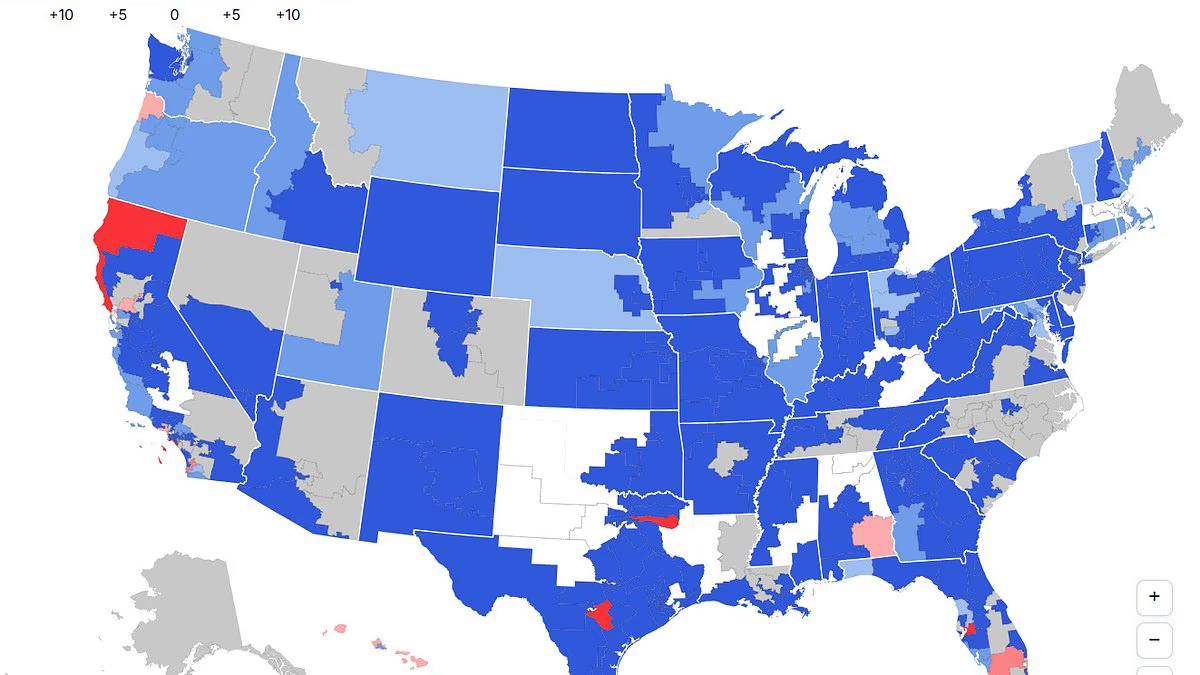
The map below illustrates the scale of that movement, with much of the nation swinging more than 10 points toward Democrats—a remarkable shift.
Pennsylvania, a pivotal presidential battleground, is covered almost entirely in deep blue.
Indiana, West Virginia, North Dakota, South Dakota, Kansas, Wyoming, Missouri and New Mexico also moved into the blue column. Kansas was particularly striking: the state had not elected a Democrat to the Senate since 1932, seven years before The Wizard of Oz reached movie theaters.
Red, signifying movement toward Republicans, appeared only in limited pockets of California, Texas, Florida, Oregon, Alabama and Hawaii.
By Friday, Democrats had secured 253 House seats—well above the 218 required to control the chamber—while 25 contests remained too close to call.

Supporters of Texas Senate Democratic hopeful James Talarico celebrate Tuesday night in Austin as a CNN scoreboard on the Jumbotron displays one Democratic victory after another
Republicans had entered Election Day with a three-seat majority in the House.
Democrats also flipped seven Republican-held Senate seats, exceeding the four-seat gain they needed.
According to the Associated Press, the Democrats’ nationwide House performance represented a 14.7 percent swing compared with recent midterm elections.
It was the sharpest shift since the 2010 midterms, when then-President Barack Obama famously described the Democratic losses as a “shellacking.”
Two years into Obama’s first term, the Tea Party wave propelled 63 Republicans into the House, producing a 17.6-point swing.
Trump also suffered a major setback during the 2018 midterms, held halfway through his first term.
YOU MIGHT ALSO LIKE: Israeli President Tasks Netanyahu Rival Yair Lapid With Forming Government
That election produced a 9.7 percent shift toward Democrats.
Even so, Democrats fell short of reclaiming the Senate.
This time, however, the outcome was different.
Within the first few hours after polls closed, Trump’s campaign received grim results from Georgia, New Hampshire and North Carolina.
Democratic Senator Jon Ossoff held his seat, Democratic Representative Chris Pappas won New Hampshire’s open Senate contest against former Republican Senator John Sununu, and North Carolina voters sent the state’s former Democratic Governor Roy Cooper to the Senate.
South Carolina then delivered an even bigger surprise. Darline, the president’s preferred candidate to replace the late Senator Lindsey Graham, lost the race to Democrat Annie Andrews.
Soon afterward, former Democratic Senator Sherrod Brown reclaimed an Ohio Senate seat previously held by Trump-appointed Republican Jon Husted, whose campaign notoriety included the president complimenting his “a**” on the trail.
Democratic state Representative James Talarico then stunned the political establishment with a victory in Texas.
In another upset in a traditionally Republican state, Democrat Adam Hamilton defeated incumbent Senator Roger Marshall in Kansas.
In Maine, Democrat Troy Jackson unseated longtime moderate Republican Senator Susan Collins.
Michigan was called later for progressive Democrat Abdul El-Sayed, who defeated former Republican Representative Mike Rogers.
Democrats also remained in contention for Senate victories in Mississippi and Alaska, where races had yet to be called.
At the same time, Elon Musk, the world’s richest man, spent at least $445.7 million backing Republican-aligned political action committees and candidates before the midterms, according to U.S. Federal Election Commission data available through October 29.
Musk’s spending accelerated sharply near Election Day, rising by roughly $200 million during the campaign’s final two months.


