
A series of high-profile disruptions affecting critical parts of American life unfolded over the past week, including a nationwide flight ground stop, banking outages at JPMorgan Chase and other institutions, and a Microsoft service interruption. Despite the breadth of the incidents, officials moved quickly to assure the public that there was no evidence of malicious activity.
During the nationwide ground stop, Homeland Security Secretary Markwayne Mullin said both the country and its banking infrastructure remained secure. He emphasized that the disruptions did not appear to be connected to a cyberattack or other deliberate interference.
Director of National Intelligence Jay Clayton delivered a similar assessment, saying intelligence officials had found no indication of a coordinated or state-backed operation. Instead, he pointed to routine maintenance, software patches and system upgrades.

Director of National Intelligence Jay Clayton testified Wednesday that intelligence assessments show the recent outages were unrelated and did not result from a “state-sponsored” attack. (Brendan Smialowski / AFP)
“Based on what we know today … these are separate service outages associated with maintenance and technical changes,” Clayton told the House Homeland Security Committee on Wednesday. “They are not a coordinated or state-sponsored attack.”
Microsoft, JPMorgan Chase and other major companies likewise attributed the interruptions to internal technology problems or software defects, rather than unauthorized intrusions.
Danny Cooper, chief executive of critical-infrastructure security firm SMET, said the speed of those reassurances is itself concerning.
“A blanket statement like ‘there’s no malicious activity associated with any of the outages’ is almost impossible from a probability perspective,” Cooper told News Outlet.

A Chase ATM stands outside a bank as technology problems disrupt banking services. (Ava Palschakov for News Outlet)
After a major disruption, public concern often focuses on one question: Was the incident accidental, or was it an attack? Cooper said skepticism is understandable given that numerous critical systems experienced problems within a five- to six-day period.
“How plausible is it that all these pillars or whatever all suffered major independent technical failures within a five- or six-day window?” Cooper asked. “I think highly improbable. And I understand why the American public is calling this into question and deeply empathize with that. The pattern recognition is there.”
Cooper said that even when officials cite scheduled maintenance or aging equipment, dismissing the possibility of foul play before a full investigation is complete can bypass critical investigative work. That, in turn, could make it harder to identify vulnerabilities and prevent similar incidents.
DON’T MISS: Jennifer Lawrence, 36, and Her Changing Look Through the Years

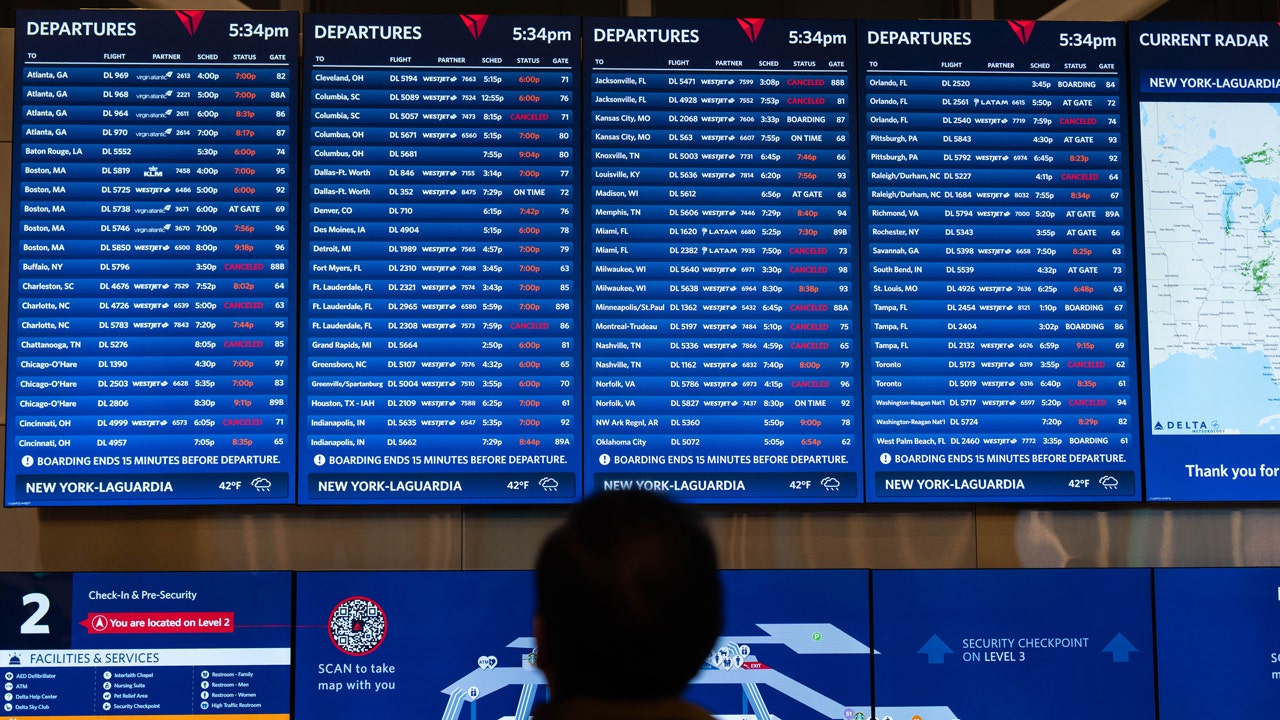
A traveler views a departures board displaying delays and cancellations at LaGuardia Airport on Nov. 13 in New York City. The Federal Aviation Administration ordered a nationwide ground stop for departing flights, one of several disruptions involving critical infrastructure last week that prompted questions about their cause. (Getty Images)
“If a company or the government is making a statement that is as bold as ‘we are certain there is no malicious activity here’ without having the time to actually do an appropriate investigation, in the case of this sort of cyber domain, some cyber forensics and a full audit of what transpired, that’s not quite how it works,” Cooper said.
“On the physical side, being able to fully interrogate what has happened in the environment, who was there, and so on about what is happening in the periphery and what led up to that moment in time, those things take time.”
Cooper also warned that an immediate “nothing to see here” response can fuel public suspicion, especially when several agencies and institutions repeat the same conclusion before independent audits are finished.
The Democratic National Committee also criticized what it described as contradictory explanations from the Trump administration.

A general view of Charlotte Douglas International Airport in Charlotte, North Carolina, on Nov. 13, 2026, as passengers faced delays and cancellations after the Federal Aviation Administration issued a nationwide ground stop for all flights. (Peter Zay/Anadolu via Getty Images)
“The administration has repeatedly offered conflicting statements about the causes of the outages,” DNC Deputy Communications Director Kendall Witmer said in a statement. “Homeland Security Secretary Markwayne Mullin suggested that SI – Trump’s preferred name for Artificial Intelligence (AI) – is responsible for the multiple outages that have occurred in recent days, according to a ‘very smart’ tech guy he talked to. Then, yesterday, Secretary of State Marco Rubio contradicted Mullin and would not attribute the outages to AI.”
Official explanations for the November disruptions largely focused on software updates and broader system upgrades. Cooper noted that companies routinely schedule maintenance, but large-scale changes can trigger downtime, particularly when implementation moves too quickly.
Those maintenance periods, however, can also create opportunities for sophisticated attackers, Cooper warned.
“If companies are disproportionately moving to execute these sorts of upgrades en masse, then yes, it’s possible that you would have a higher number of downtime or outages,” Cooper said.
“But it’s also quite possible that, particularly given the sophistication of cyber adversaries, whether it’s hackers, whether it’s non-state entities, whether it’s nation-state entities, it’s also possible that they are using those software updates or upgrades or patches and in those moments actually injecting malware and exploits and so on.”


