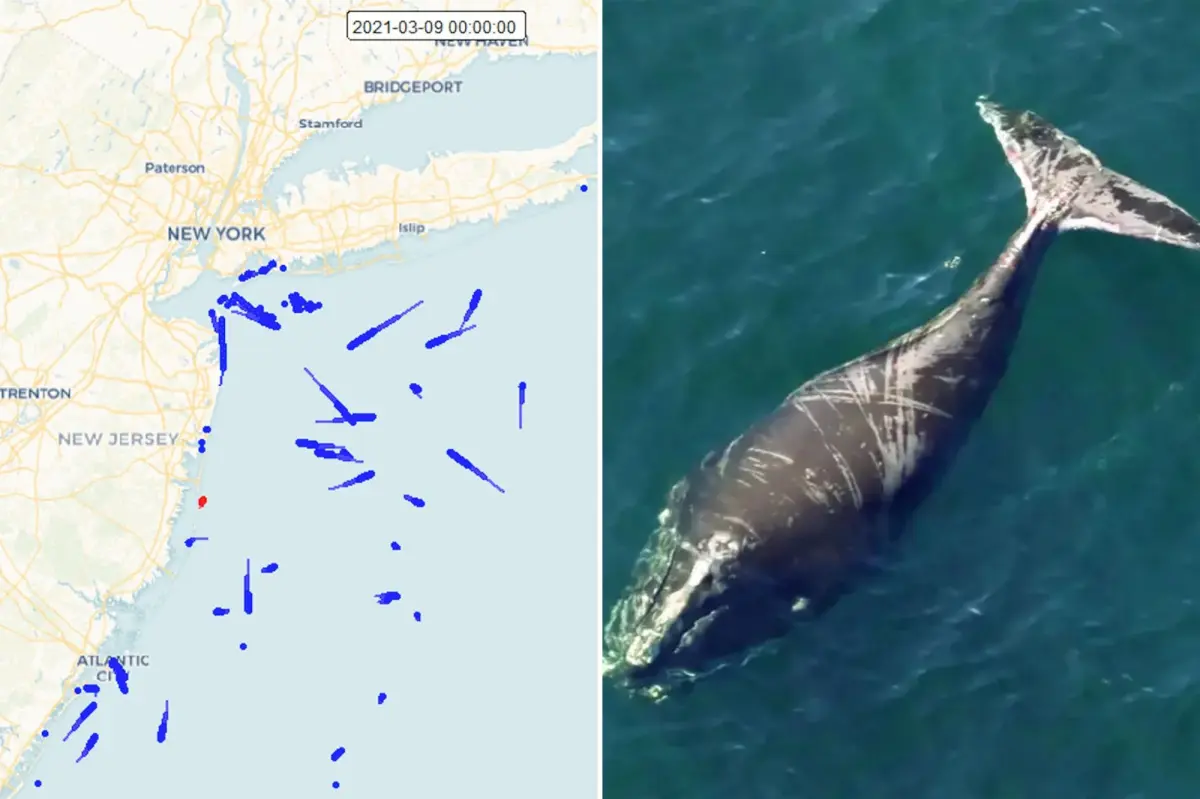

A young endangered North Atlantic right whale traveling north along the New Jersey-New York coast faced a dangerous obstacle course: waters crowded with enormous ships capable of killing it in seconds.
The 1-year-old female, identified as North Atlantic right whale #5042, was fitted with a satellite tag. Represented by the red dot on the video map, her journey highlights the grave risks facing one of the world’s most endangered marine mammals.
“Unless humans take measures to preserve the species, they are destined for extinction,” the National Oceanic and Atmospheric Administration (NOAA) warns.
As the whale moved north through the heavily trafficked waters in 2021, her route crossed a maritime highway used by commercial vessels.
And the map does not show every ship in the area.
It displays only vessels equipped with Automatic Identification Systems, or AIS. Other boats traveling through the whale’s habitat are not included in the visualization.
As of 2026, just 380 North Atlantic right whales remain in the wild. Commercial whaling had already driven the species to the brink of extinction by the early 1890s.
EXPLORE MORE: Thai Restaurant Dishes You Should Never Order—and Why
Although the United States banned whaling in 1972 and commercial whaling was prohibited worldwide in 1986, the population has never returned to its pre-whaling numbers. The whales continue to face a range of human-caused threats.
Fishing-gear entanglements and collisions with vessels are now the leading causes of death.
Ships pose a particular danger to right whales because the animals often swim near the ocean’s surface, directly in the path of passing vessels.
The risk is compounded by their dark coloring and the absence of a dorsal fin, which can make them exceptionally hard for mariners to see — especially in rough seas, poor weather or at twilight.
To help protect the whales, federal regulations require most vessels measuring 65 feet or longer to travel at no more than 10 knots, or about 11.5 mph, in designated areas along the East Coast.
Near the entrances to the ports of New York and New Jersey, the mandatory speed restrictions are in effect from Nov. 1 through April 30.
“Together with other technologies, such as satellite detection, tagging, and aerial and vessel surveys, we are advancing North Atlantic right whale recovery,” a NOAA spokesperson said.