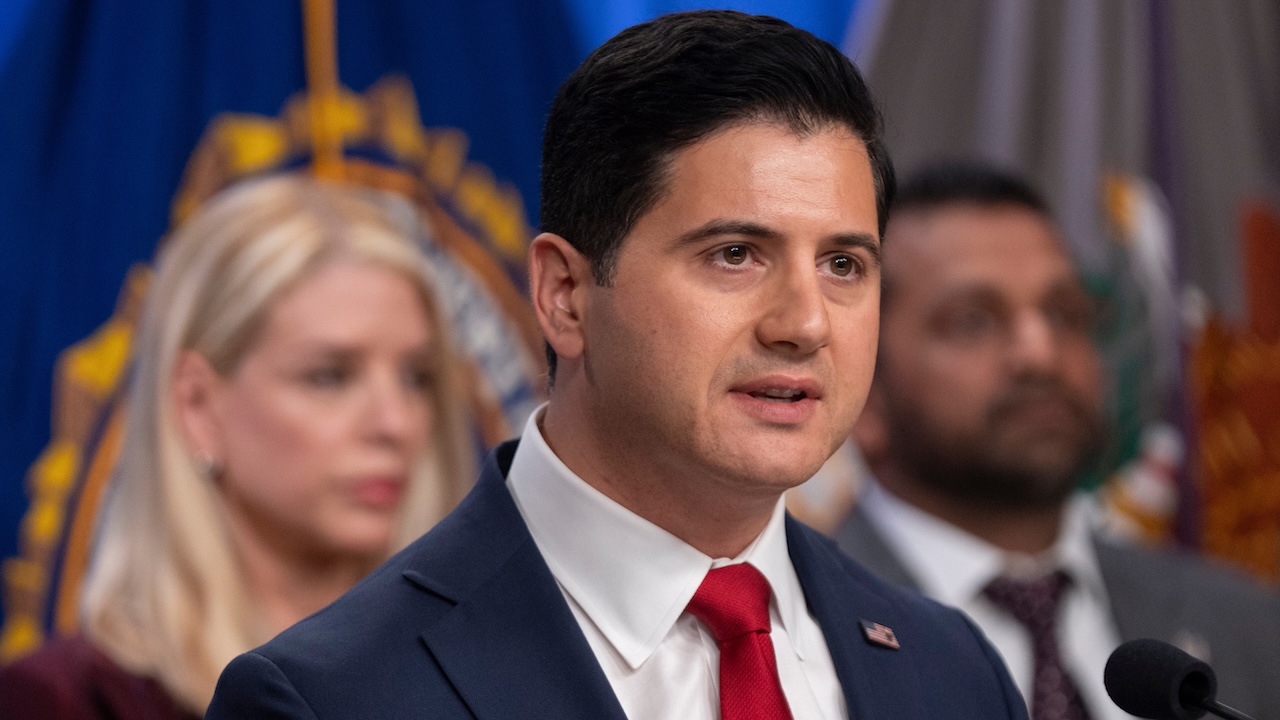

FILE – Bill Essayli, acting U.S. attorney for the Central District of California, speaks to reporters during a news conference at the Department of Justice on Nov. 19, 2025, in Washington. (AP Photo/Mark Schiefelbein, file).
A federal judge on Monday declined to suspend his order removing the Trump administration’s top federal prosecutor in Los Angeles, finding that Bill Essayli had been unlawfully serving as a “de facto” U.S. attorney.
In a 12-page order, Senior U.S. District Judge J. Michael Seabright denied the government’s request to stay his Oct. 27 ruling while the case proceeds on appeal. Seabright said the administration had not shown that it would face irreparable harm and had demonstrated a “low likelihood of success on the merits.”
Seabright, a George W. Bush appointee to the District of Hawaii, was assigned the case after judges in the Central District of California recused themselves because of the institutional relationship between the U.S. attorney’s office and the court.
His Oct. 27 ruling prevents Essayli from participating in or supervising the prosecutions of Jaime Hector Ramirez and Tu Anh Tran, who face firearm and stolen-property charges, respectively. The order disqualifying Essayli is scheduled to take effect Nov. 23, “subject to any further orders of this court or an appellate court.”
In October 2025, Seabright determined that Essayli could not legally serve as acting U.S. attorney without Senate confirmation. The judge nevertheless allowed him to remain in the office under a newly created title, First Assistant U.S. Attorney, or FAUSA.
After the 9th Circuit on Aug. 17 rejected a comparable arrangement involving Nevada’s Sigal Chattah, the defendants contesting Essayli’s FAUSA position asked Seabright to revisit that decision.
Seabright wrote that the government acknowledged it would “suffer no injury from the immediate, practical effect” of excluding Essayli from the two prosecutions. The Justice Department instead argued that the ruling improperly interfered with the executive branch’s authority to conduct criminal prosecutions.
Seabright rejected that argument. The order states:
To the extent the government argues that [the October ruling] encroaches upon Executive branch functions by “dictating” who can prosecute Defendants’ cases, it misconstrues the court’s ruling. [That ruling] dictates no such thing. Instead, it merely applies the law.
READ MORE: Tyler Robinson Defense Seeks Halt to Bullet Tests in Charlie Kirk Killing
The judge described the government’s separation-of-powers arguments as “vague and conclusory,” observing that the DOJ had failed to identify “any specific harm it is likely to suffer” once the order takes effect.
Seabright also dismissed the DOJ’s contention that his decision would “disrupt federal law enforcement.” Instead, he wrote, “Indeed, it is the government’s requested stay that may further delay the prosecution at issue.”
He likewise rejected the government’s assertion that the order could “potentially affect 5,000 cases in the largest district in the country.” Seabright called that claim a “bald assertion, absent any support or explanation,” and noted that it appeared for the first time in the government’s most recent reply brief.
Seabright also criticized the government’s characterization of a 2023 9th Circuit decision, which the DOJ cited as holding that courts “do not dictate to the Executive branch who will serve as its prosecutors.”
As Seabright noted, the complete passage begins with the qualification “Absent a violation of . . . the Constitution, a federal statute, or a procedural rule,” and concludes that courts may not dictate who serves as prosecutors “unless compelled by the law to do so.”
“Thus, despite the expansive and misleading nature of the government’s excerpted language, [the 9th Circuit’s ruling] neither holds nor suggests that a court offends separation of powers by disqualifying an Executive official who is unlawfully serving,” the order states.
The government has also petitioned the Supreme Court to review the 9th Circuit’s decision. Seabright declined to put his own order on hold while the justices consider whether to hear that case, warning that a stay connected to the petition could remain in place indefinitely. He cited an earlier 9th Circuit ruling cautioning that such a delay could last “perhaps for years.”
The Supreme Court has not yet decided whether it will take up the case.
The post Judge highlights ‘misleading nature’ of Trump admin’s argument in disqualifying LA’s top federal prosecutor first appeared on Law & Crime.


