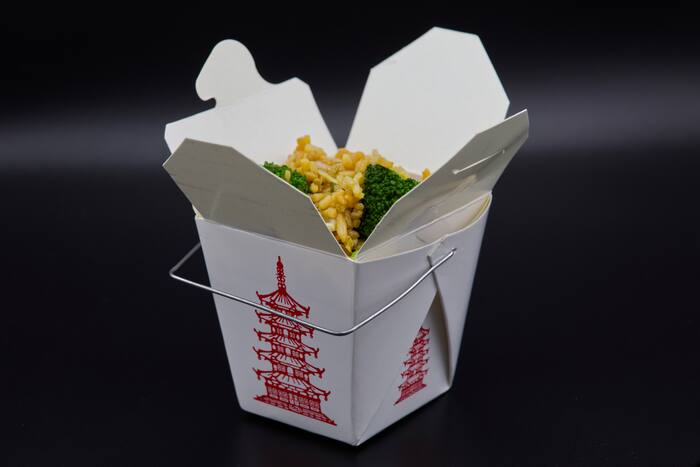

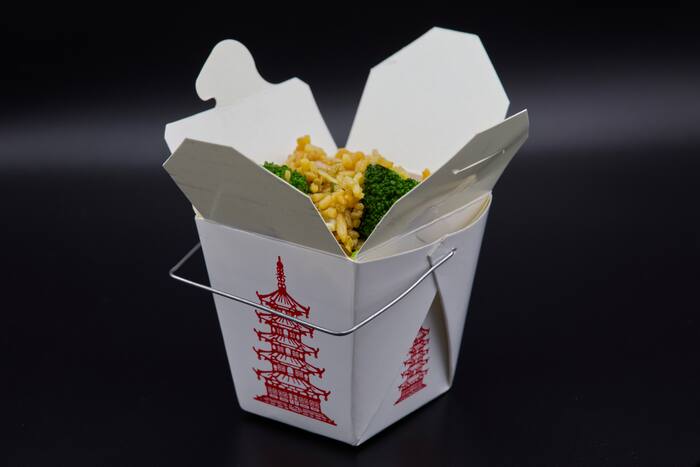
NEW YORK – Few food containers are as instantly recognizable as the familiar white takeout carton: a single sheet of cardboard folded into a compact trapezoid, sometimes topped with a wire handle and often decorated with a vivid red pagoda. Inside, of course, is the promise of a delicious meal.
Although it is strongly associated with Chinese cuisine in the United States, the modern Chinese takeout box is a distinctly American creation. Its story combines clever packaging, immigrant traditions reshaped into everyday American life and an enduring love of convenience — including the luxury of eating dinner at home in pajamas.
The basic concept dates back to 1894, when inventor Frederick Weeks Wilcox received a patent for what he described as “a new and useful improvement” to pails used for transporting oysters. His design called for one piece of material folded to provide stability, reduce leaks and create a built-in lid.
That explains the box. But how did it become linked so closely with Chinese food?
Chinese immigrants began arriving in the United States in large numbers during the mid-19th century, drawn by the Gold Rush and railroad construction. The Chinatowns that developed first in cities such as San Francisco and eventually across the country became centers of community life, including restaurants where an Americanized form of Chinese cuisine began to take shape.
Following World War II, Chinese restaurants expanded dramatically beyond familiar dishes such as chop suey and chow mein. “We see this explosion of interest and growth in Chinese food,” said Michelle King, a professor of Chinese history at the University of North Carolina at Chapel Hill.
That period also helped establish Chinese food as affordable, widely available and easy to order, King said. Restaurant owners wanted their businesses to feel accessible, and takeout became an important part of that appeal. Whether customers needed dinner at home or food for a gathering, the message was simple: the restaurant could provide it.
Sometime in the 1970s, Fold-Pak, the packaging company then producing the cartons, added the now-famous pagoda illustration. Some versions also featured lettering designed to invoke stereotypical images of Chinese culture.
The carton eventually became identified with Chinese American dining in much the same way a pizza box is connected with Italian food, King said.
Today, takeout containers come in many different designs, and the foods placed inside them represent far more than one cuisine. The former oyster pail can now carry an ever-widening variety of meals.
Still, the classic carton remains an enduring cultural symbol — quite literally. Just look for the “takeout” emoji on your phone.
___
This story is part of the recurring “American Objects” series, which explores items connected to the 250th anniversary of the United States. For more stories about American objects, click here. For additional coverage of the anniversary, click here.


