
Few people in wedding history can have looked less attractive than I did on the day of my first marriage in 1994.
My sister did not even disagree when I made that observation to her recently. There was no reassuring “Don’t be silly, you looked lovely,” nor the perhaps more unsettling, “It was so you.”
Instead, there was only a knowing silence.
I did have one explanation. My long-term boyfriend proposed on a Monday, then told me he had booked the register office for the following Thursday. Would I marry him?
Today, that sounds impossible, since marriage banns are apparently required to be displayed 28 days in advance. Yet both of us remember events unfolding exactly that way.
It was an unconventional proposal, fitting for a relationship that had followed an equally unconventional course. We were living separately at the time, and this felt like one of those decisive, make-or-break moments. After spending the night thinking it over, I decided to accept. The next day, frightened but exhilarated, I called to give him my answer.
There was no opportunity to plan anything, least of all find something beautiful to wear.
I have found that the more significant the occasion, the harder it is to find the right outfit. That is why, when you see something you truly love, it is worth buying it and waiting for the occasion to arrive. Sooner or later, it usually does.

When we met, Catherine wanted to hear my views, so we sat crouched on the floor of a Clarence House reception room, studying pages torn from Vogue
In any event, my wardrobe held nothing suitable for a wedding. With time running out, I hurried to Browns, the leading London boutique on South Molton Street near my office, accompanied by my friend and colleague Frances. Nothing truly captivated me, but I eventually chose a long-sleeved white dress by the then-popular label Ghost, along with a richly embroidered Dries van Noten shawl made from layers of silk and tulle.
I had been unhappy after ending the relationship more than once before we married, and I was anxious about what lay ahead. Perhaps that uncertainty showed in my appearance.
The photographs reveal a terrible haircut, meant to be an effortlessly chic shag but looking merely untidy, as well as a sallow complexion. The shapeless outfit did little to help. Thankfully, my sister and brother-in-law were the only witnesses—both to the ceremony and to the full extent of my appearance.
Looking like that remains one of my minor life regrets. It was hardly a catastrophe, but the memory has taught me that when something feels wrong, it is better to wear something that makes you feel confident—even if that means abandoning the plan. That dress never felt like me. It was too loose, too casual, while the shawl made me resemble a Hindu bride’s elderly great-aunt.
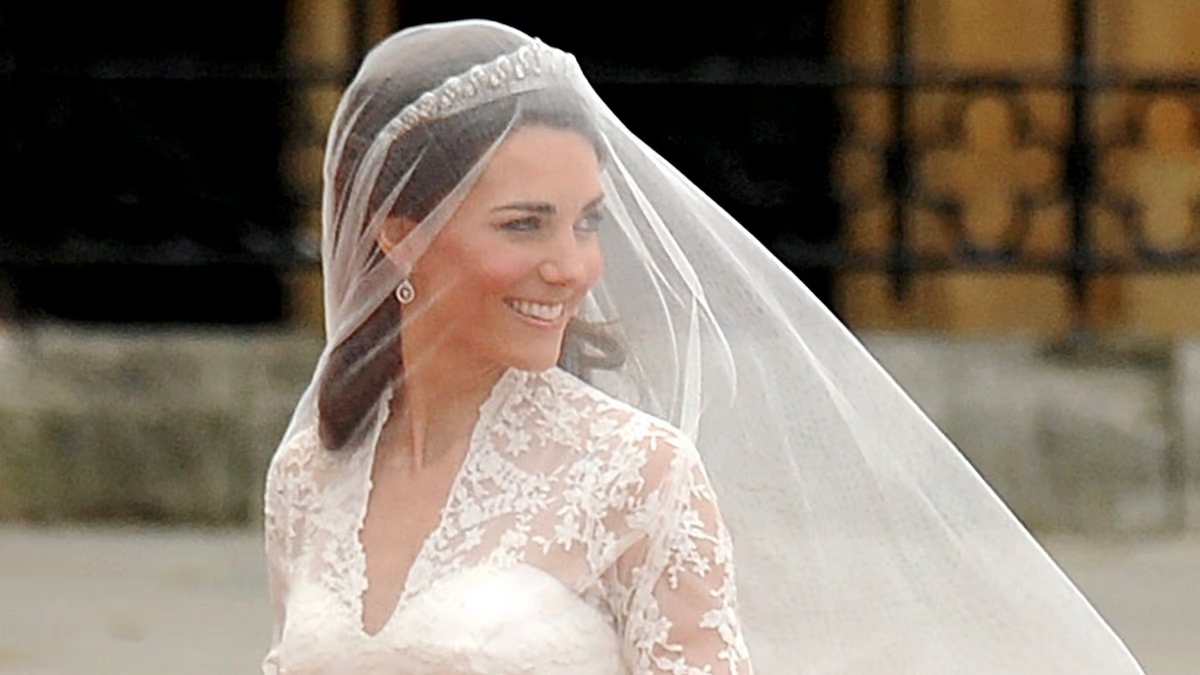
Royal wedding dresses, however, carry a significance far beyond personal taste. Several weeks after Prince William and Catherine Middleton announced their engagement in 2010, someone from Catherine’s team contacted me to ask whether I would come in to discuss designers she might consider for her wedding gown.
I was naturally flattered, but also deeply nervous. As I had already demonstrated, wedding dresses are not exactly my speciality. This gown, meanwhile, would need to embody the hopes and expectations of an entire nation. From the moment the wedding was announced, speculation began building over which designer would secure the coveted commission.
This was no simple assignment. Catherine would need to work with a designer able to honour the tradition of royal wedding dresses, which come loaded with all the symbolism and heritage attached to such a historical event. Every detail would be scrutinised and analysed for decades to come.
The gown also needed to be the work of a British designer with the exceptional skill and imagination required for a job of this status, but also able to carry out the whole business in complete secrecy. Security was a big concern. It was essential that their identity didn’t leak before the day.
They would also need the confidence to deal with the undoubted formality and regulations of the Royal Household while forging an empathy with the bride-to-be. After all, she had to feel comfortable with the designer seeing her in all states of undress and possibly at different junctures in the process where she might be feeling unsure. My gut reaction told me a woman would be the best solution.
When we met, Catherine was keen to know my thoughts and we crouched on the floor of one of the reception rooms in Clarence House looking at pages torn out of Vogue, showing British designers whom she might consider – Erdem, Vivienne Westwood, Catherine Walker, Bruce Oldfield, Alexander McQueen, along with established wedding-dress designers like Phillipa Lepley. From Catherine’s reaction to these, it was impossible to read what she thought.

Sarah Burton had a quietness about her that I thought would suit the bride-to-be, but also a strength of opinion and great expertise
At this stage her usual wardrobe wasn’t full of designer clothes and was similar to that of many young, middle-class, Middle England women, featuring brands like Reiss and Jigsaw. She wasn’t familiar with the process of custom-made clothes nor of working with a high-profile designer.
It was a different situation from that of the late Queen Elizabeth’s wedding dress in 1947. That was designed by British couturier Norman Hartnell, a man the then princess already had a close relationship with, as he had worked on much of her wardrobe. In those days, there were no brands like Reiss or Jigsaw. The Royal Family’s clothes were all made individually for them. Hartnell’s gown was embroidered with crystals and seed pearls depicting white York roses, and wheat sheaves to symbolise regeneration after the destruction of the recent war. Around the hem were garlands of orange blossom, often used in royal gowns to demonstrate fertility, chastity and virtue.
In her book Fashioning The Crown, Justine Picardie quotes Hartnell’s memoirs, which tell how the precise origins of the material used in the gown were scrutinised. ‘What was the nationality of the worms that had provided the silk from which the satin was made and from which I intended to make the dress?’ he wrote. When it emerged that he was planning to use a satin from the Scottish firm of Winterthur, he was told that certain circles were trying to stop this on patriotic grounds – the silkworms involved might be Italian, who were not our friends in the war, or, possibly worse, Japanese.
It’s a sign of the way times change that when it was announced that the worms were fine – they were Chinese – Hartnell was given the all-clear to go ahead. Nowadays we might be far more wary of Chinese worms than of the Japanese versions.
Before I left that afternoon, Catherine asked me who I thought would be best. Until that moment I hadn’t had a firm favourite, but I considered the options in front of us and suggested that Alexander McQueen – now designed by Sarah Burton, who had taken over the role of creative director after his death – would be a good choice.
Sarah had a quietness about her that I thought would suit the bride-to-be, but also a strength of opinion and great expertise. Lee McQueen, as he was known, had long used symbolism in his work and rich craftsmanship was a keynote of the house. Catherine just nodded and thanked me for all the help.
It was only when I was seated in Westminster Abbey on the day of the wedding and got a text through from my assistant Sacha announcing that the dress was indeed McQueen that I had any idea Sarah had landed the prestigious job.
In the Abbey, none of us could see what was happening outside and so missed the great reveal moment in real time. I am sure I was not the only person who made the recommendation, but I was very happy that final dress was not only perfect for this historical ceremony but also that the new princess forged a relationship with Sarah that would last for years to come.
Which brings me to my own second, relatively recent wedding.
This time I had slightly longer to find something to wear. David and I had been together for more than 20 years and had been talking for ages about getting married or, more frequently, about not getting married. There was always another reason not to make the decision.

I delighted in going into my new married life as a scarlet woman, not a blushing bride. When you know, you know. And I knew
But after my mother died, something shifted. It was impossible to push the powerful recognition of the passing of time to the back of my mind. We didn’t have for ever to keep batting this ball around. Tomorrow might not arrive. We needed to decide either to go for it or not. This time we booked a slot in Kensington and Chelsea register office (the same site as my first marriage) six weeks in advance.
We had kept the news relatively private and planned a minuscule ceremony, but with the photographs of my past wedding running on a carousel through my memory I knew I had to do better on the clothes front this time around.
But what is a suitable wedding outfit for a second wedding in your 50s or 60s or later? In general the situation does not obviously lend itself to the big white wedding dress treatment. It’s not age that is the issue but how much you want to present as the traditional, virginal bride.
Weddings are a meaningful acknowledgement of a relationship between two people and while obviously there is no rule about how to dress for such a thing, I wanted my clothes to reflect how I felt about the marriage. In truth, at the time I was a little unsure what that was. Was it tempting fate to marry at such a late age? Would our previously harmonious relationship survive the new ties? Would marriage make us feel safer and happier? Or would we both feel a new restriction in our lives together? Would I feel a sense of resolution? I had no idea.
Nor did I have any idea what I wanted to wear, only what I didn’t want to wear. I was clear that I would avoid the type of floppy, swampy dress that David particularly hates and I rather love – the ones he calls my Demis Roussos look were on my no-go list.
I wanted to buy something that I could wear again and ideally not only for very formal occasions. The wedding would be in late April when the weather could go any which way, adding the usual British uncertainty to what was going to work. I didn’t want to freeze on the steps of the register office, but neither did I want to be wearing a heavy coat. That for some reason didn’t seem joyful enough.
All white, I knew, was not flattering for me, and would also make me feel a bit silly. Navy – often my go-to – would be a little uncelebratory. Pink, perhaps, or green might be possible.
Surprisingly for someone who has had a long career running a magazine filled with suggestions of what to wear for what, I was paralysed with indecision. I didn’t even know where to start. The thought of ordering endless items online and then having to organise boxes of clothes to be returned, each piece of clothing another failure, was too grim to contemplate. I knew I had to go to a real bricks-and-mortar shop to try the outfit on there and then.
Eventually, only a week before the wedding, I took myself off to Liberty’s, a department store with the great advantage of being a manageable size to navigate.
I wandered around the floors picking up bits and pieces to try, knowing they were unlikely to be what I needed. Soon pooling on the floor in the changing room were the many midi and maxi dresses I tried on. Sleeveless floral numbers more suitable to a summer garden party, slithery bias-cut styles that didn’t suit me, exotically printed columns that reached the floor, ditto.
Looking at myself in the unforgiving light, I started to reconsider the whole business. Even, fleetingly, the marriage itself. Perhaps it would be best to stick to my edict of ‘Wear something you are sure you feel comfortable in.’ After all, it wasn’t as if I didn’t have countless dresses in my wardrobe from my years at Vogue.
Even so, that struck me as defeatist. Surely this marriage deserved better. The hunt would have to continue. Strolling mournfully towards the exit, I told the helpful sales assistant that unfortunately nothing worked and then… I spotted something perfect, coming to the rescue like the sight of land when lost at sea.
On the Jil Sander rail lined with otherwise monochrome tops and trousers, there hung a single pale pink satin pencil skirt decorated with small crimson poppies. I knew at a glance that it would fit me and was just what I wanted. And it was.
The assistant, excited at making a sale but also caught up in the emotion of helping to find a wedding outfit, scurried around to find a suitable top. She returned carrying a fine-knit bright tomato-red cardigan by Dries van Noten and – the icing on the proverbial cake – a crazy red feathered bag by the same designer.
The pencil skirt gave me a neat waist and hit exactly the right length below the knee. The cardigan was a flattering shape and the bag just the thing to make the outfit shout happily. Nothing swampy about it at all.
I knew that I would wear that skirt again and again, and each time it would remind me of the day, but it would go on to have new memories attached to it. And I delighted in going into my new married life as a scarlet woman, not a blushing bride.
When you know, you know.
And I knew.
Adapted from Black Coffee And Red Lipstick by Alexandra Shulman (£20, Mitchell Beazley) out October 1. © Alexandra Shulman 2026. To order a copy for £18 (offer valid to 30/09/26; UK P&P free on orders over £25) go to mailshop.co.uk/books or call 020 3176 2937.


