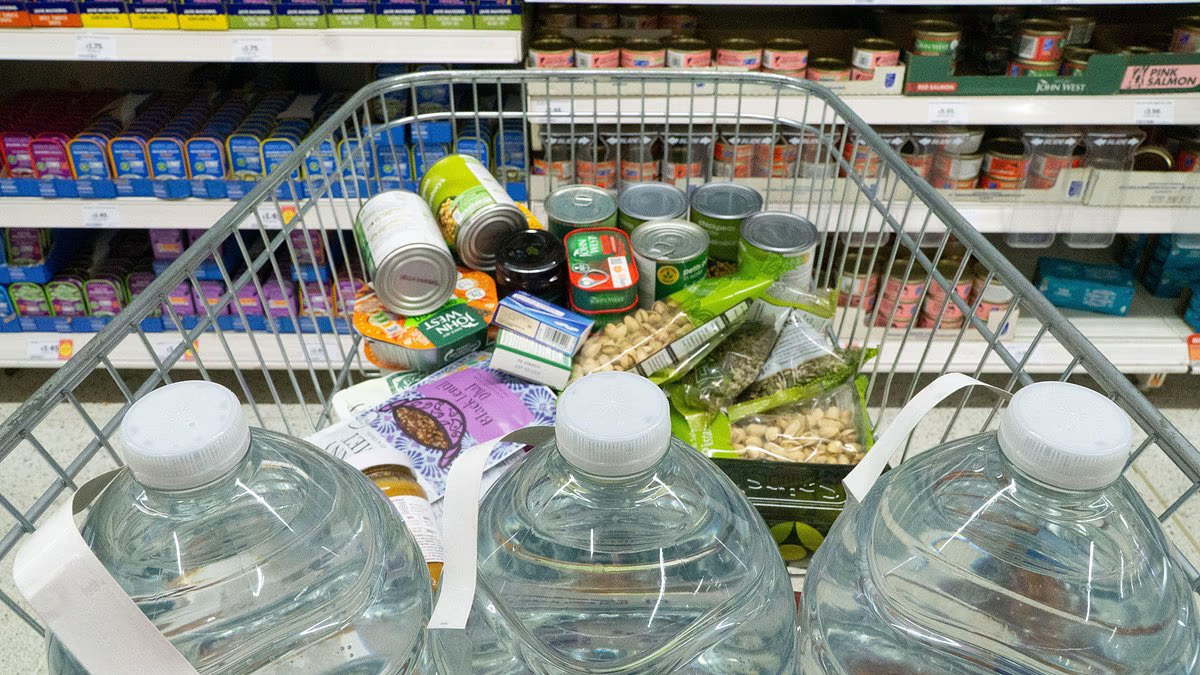

With emergency preparedness dominating the conversation, many people may feel tempted to rush out and buy everything they might need in a crisis.
But experts caution that panic-buying supplies in one go could intensify shortages and leave supermarket shelves even barer.
Their advice is to build an emergency stockpile steadily over several weeks instead.
A gradual approach spreads the expense for households while reducing the sudden surge in demand that can trigger shortages.
‘Build up supplies over a month, adding two or three items to each shop,’ Dr Sayed Elhoushy, senior lecturer in Marketing at Queen Mary University of London, and Shaheen Hosany, an associate professor of Marketing at Hult International Business School, wrote in The Conversation.
‘Start with water and tinned food, then add medicines and batteries. This spreads demand for retailers, spreads the cost for households, and gives people a clear plan to follow.’

Experts say filling a disaster cupboard in one shopping trip could worsen supermarket shortages, and are urging households to build supplies gradually

The Government last month urged households to store three days of food and water for emergencies, prompting what shoppers dubbed ‘Prepper Panic’

A shopper captured the ‘chaotic’ scene as preppers descended on a Costco store and filled their trolleys with essentials after the Government urged Britons to prepare a ‘survival kit’
The researchers pointed to recent crises, including the Covid pandemic, as evidence of how rapidly fears about shortages can spread.
Supermarket aisles were cleared of toilet paper, pasta and other household essentials as shoppers responded to growing uncertainty.
‘Shoppers can still strip a shelf, even if they all buy little amounts, at once,’ they warned.
‘The expectation that shelves will be empty can increase urgency and fear. Those feelings alter shopping behaviour. When people feel unsafe, they buy more, and shortages can follow, whether they are real or imagined.
‘Scarcity makes products seem more desirable and encourages people to seek them out at short notice. During the pandemic, the possibility of store closures sparked panic as people rushed to buy staples, driven by fear of missing out, social conformity and herd behaviour.’
Last month, the Government launched a campaign advising households to keep three days of food and water in reserve in case of an emergency.
The checklist, which people were encouraged to print and keep accessible, also advised having a power pack available to charge devices during a power cut.
Defence Secretary Wes Streeting said the guidance was intended to help households prepare for incidents including wildfires, flooding and cyberattacks.
At the same time, senior officials and military figures had warned about the possibility of sabotage or even a Russian strike.
The warnings fuelled so-called ‘Prepper Panic’, with some supermarkets reporting that baked beans and bottled water had been cleared from shelves.
IN CASE YOU MISSED IT: UC Irvine Surpasses Disneyland as Orange County’s Largest Employer

Experts say Government warnings about emergency preparedness helped push sales volumes up by 0.7 per cent in October
The experts said a measured, organised strategy is likely to be the most effective way to prepare for unexpected events.
The central issue is not always an actual lack of products, they said, but the way people respond to the perception of scarcity.
‘Uncertainty can also fuel people’s anxiety, making panic buying more likely,’ they said.
‘When many households follow the same advice during the same week, they can create the empty shelves that alarm other shoppers. A clear plan helps restore a sense of control.’
Instead of making one large emergency purchase, households are advised to assemble their supplies gradually over roughly a month.
That could mean adding a few extra items to ordinary shopping trips rather than making a dedicated bulk purchase.
The researchers said the strategy helps both shoppers and retailers by preventing sudden demand spikes. It also allows families to prepare without absorbing a large bill all at once.
Social media can further shape how consumers perceive the availability of essential goods, the experts said.
‘A study of UK shoppers during COVID found that photographs of empty shelves on social media increased uncertainty about stock levels, prompting many people to buy more,’ they said.
‘Those images can communicate fear and contribute to panic.’
Retailers can also help limit sudden buying frenzies by introducing temporary purchase restrictions when demand starts to rise sharply, they added.

During the Covid pandemic, supermarket aisles were stripped of toilet paper, pasta and other essentials. Pictured: trolleys piled high for delivery as shoppers queue at a London supermarket checkout on March 14, 2020
Although the UK Government recommends keeping three days of supplies at home, some specialists believe that period would provide insufficient protection in a major crisis.
They instead advise households to aim for up to two weeks’ worth of food, water and other necessities where possible.
Such preparations could help families cope with extreme storms, prolonged power cuts, terrorist attacks and even a nuclear emergency.
‘Stockpiling at least two weeks of supplies, for those who can afford it, is much better than three days in order to get through many more types of crises, including helping those around us,’ Professor Ilan Kelman, a disaster and climate expert at University College London, told Our News Outlet.
‘Many scenarios exist with electricity, water and transport routes unavailable for longer than 72 hours.
‘A resilient society includes households being able to afford and having at least two weeks of emergency supplies.’


