
A wave of destructive natural disasters has swept across multiple regions in recent weeks, with earthquakes, flooding, drought and powerful typhoons leaving communities around the world facing severe damage and disruption.
Some events, including major earthquakes, are driven by geological forces and would occur regardless of climate patterns. But forecasters warn that the emergence of a super El Niño is increasing the likelihood of extreme weather, raising the risk of more intense and unpredictable disasters globally.
Below are some of the most significant natural disasters recorded over the past month:
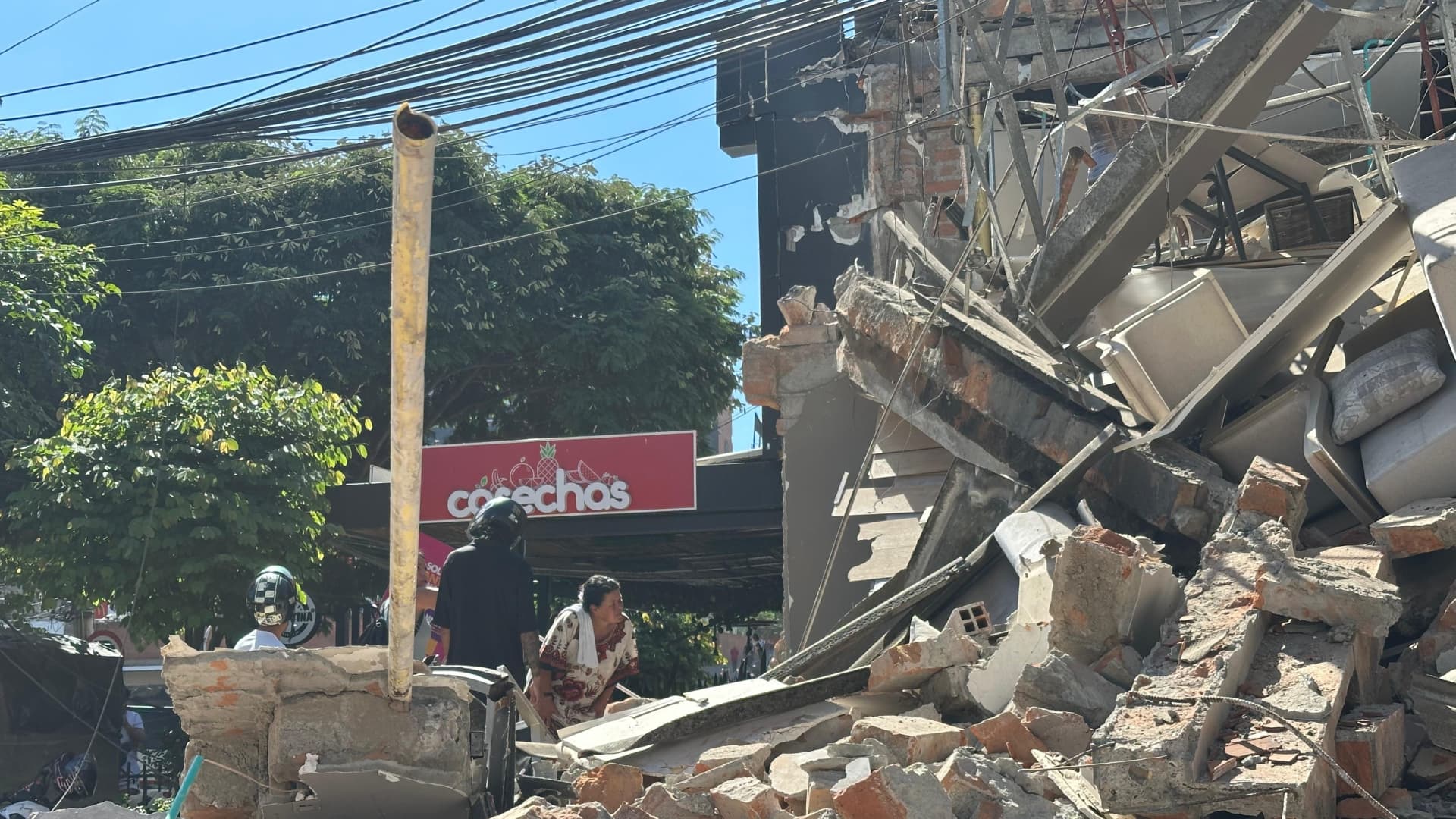
Earthquake strikes Colombia
An aerial image captures piles of rubble and debris from collapsed buildings in Pereira, Colombia, on August 24, 2026, two weeks after a 7.4-magnitude earthquake devastated the region. The quake, which struck western Colombia on August 10, killed hundreds and caused an estimated $9.57 billion in economic losses, President Abelardo de la Espriella said on August 18 in a preliminary assessment. Officials reported 289 deaths, 4,187 injuries and 143 people still missing. (Photo by ESTEBAN VEGA LA-ROTTA / AFP via Getty Images)
Esteban Vega La-rotta | Afp | Getty Images
The 7.4-magnitude earthquake, Colombia’s strongest in decades, struck the country’s coffee-growing region in the early hours of August 10. The violent shaking reduced homes and businesses to ruins, left hundreds dead and injured thousands more as rescue teams searched through heavily damaged neighborhoods.
PEREIRA, COLOMBIA – AUGUST 10: Residents stand in the streets after a powerful earthquake hit Colombia on August 10, 2026, killing at least 18 people in early reports and damaging buildings in Pereira. The tremor was felt across much of the country as authorities worked to determine the full scale of destruction and whether additional casualties had occurred. (Photo by Alexis Munera/Anadolu via Getty Images)
Anadolu | Anadolu | Getty Images
Workers watch the demolition of the damaged Maria Mercedes Lloreda building 37 days after a 7.4 earthquake in the Cuarto de Legua neighborhood in Cali, Colombia on September 7, 2026. (Photo by Joaquin SARMIENTO / AFP via Getty Images)
Joaquin Sarmiento | Afp | Getty Images
PEREIRA, COLOMBIA – AUGUST 10: Residents and rescue workers carry out search, rescue and evacuation operations after a powerful earthquake struck Colombia, killing at least 18 people and causing widespread damage in Pereira, on August 10, 2026 in Pereira, Colombia. Preliminary reports indicate that several structures collapsed, buildings and roads were damaged, and some public services were temporarily disrupted. Hospitals activated emergency plans to treat the injured, while technical teams began assessing damaged buildings as authorities warned residents to avoid unsafe structures and remain alert for aftershocks. (Photo by Alexis Munera/Anadolu via Getty Images)
Anadolu | Anadolu | Getty Images
Nepal flash floods
RASUWA, NEPAL – SEPTEMBER 03: An aerial view of houses surrounded by mud, rocks and debris following flash floods on September 03, 2026 in Betravati village, Rasuwa, Nepal. he floods, triggered by a glacier collapse on Langtang Lirung on August 26, have killed at least 900 people and left nearly 4,000 missing in Nepal as of September 1, with additional deaths and hundreds missing in neighbouring Tibet, authorities have said. (Photo by Ritesh Shukla/Getty Images)
Ritesh Shukla | Getty Images News | Getty Images
A massive glacial collapse in northern Nepal on Aug. 26 triggered a landslide of ice and rock and meltwater into the valleys below, with powerful floods sweeping away or cutting off entire communities and damaging roads, bridges and hydropower facilities.
The death toll exceeded 1,000, according to the Associated Press.
TOPSHOT – A man looks at the remains in the aftermath of flash floods at Trishuli in Nepal’s Nuwakot district on September 7, 2026. The August 26 glacial and mountain collapse on the China-Nepal border killed at least 1,398 people, with more than 5,500 missing, including around 800 foreigners. (Photo by Pedro PARDO / AFP via Getty Images)
Pedro Pardo | Afp | Getty Images
An aftermath view of flash floods and mudslides along the Trishuli River in Nuwakot, Nepal, on August 26, 2026. A flash flood swept through Nepal’s northern border region after an ice-and-rock avalanche, reportedly triggered by an earthquake, caused a sudden surge in the Lhende River on the Nepal-China border and sent large volumes of water, mud and debris downstream into the Bhote Koshi and Trishuli river systems. The event damaged settlements in Rasuwa and Nuwakot districts, sweeping away homes, roads, bridges, vehicles and other infrastructure and damaging hydropower and power facilities. In Nuwakot, riverside settlements including Trishuli Bazaar, Devighat, Betrawati and surrounding areas suffered damage, with homes swept away and large quantities of mud and debris deposited across communities. The flood also disrupted communications and transportation routes and prompted authorities to evacuate vulnerable riverside communities and issue warnings along the Bhote Koshi, Trishuli and Narayani rivers. The death toll from the disaster had climbed to 97, while at least 384 tourists and travelers, including foreign nationals, as well as soldiers and police personnel, were reported missing as search-and-rescue operations continued. Nepal Army, Armed Police Force and Nepal Police personnel were deployed to affected areas, while rescue operations were also underway on the Chinese side of the border. Authorities continued to assess the scale of casualties and destruction as access to several affected areas remained difficult because of damaged roads, bridges, heavy sediment and continuing flood risks. The disaster has been described as one of the most severe sudden flood events to strike the Nepal-China border region in recent years. (Photo by Safal Prakash Shrestha/NurPhoto via Getty Images)
Nurphoto | Nurphoto | Getty Images
TOPSHOT – A woman walks among the ruins of flash floods in Nepal’s Nuwakot district on September 1, 2026. The huge wave of freezing water and debris, sparked by a glacial collapse on the China-Nepal border, killed at least 939 people and left nearly 4,500 missing, with Kathmandu warning reconstruction costs could run into the “billions of dollars”. (Photo by Arun SANKAR / AFP via Getty Images)
Arun Sankar | Afp | Getty Images
Flight disruptions after Krakatau eruption
Passengers stand near a Flight Information Display System (FIDS) board displaying multiple flights as ”Cancel Due to Volcano” at I Gusti Ngurah Rai International Airport in Bali, Indonesia, on September 7, 2026. Authorities suspended flight operations at several airports and disrupted major aviation corridors across Java and Sumatra following the eruption of Mount Anak Krakatau. (Photo by Lana Priatna/NurPhoto via Getty Images)
Nurphoto | Nurphoto | Getty Images
Mount Anak Krakatau started a continuous eruption on Sept. 4 that lasted about 25 hours. It wreaked havoc with flight schedules in the region, including at Southeast Asia’s second-busiest airport, in Jakarta.
Hurricane Lowell in Hawaii
Hawaii is bracing for Hurricane Lowell, with schools and government offices on the islands of Kauai and Niihau being forced to close. The hurricane is expected to bring damaging winds, possible tornadoes and even dangerous rip currents to some areas.
Wildfires in North America
Wildfires have caused destruction across large swaths of the U.S. and Canada in recent months, with firefighters racing to control them in both countries. The Canadian government said that wildland fire danger is expected to be higher than normal in September across most of Canada, except in Alberta and Saskatchewan.
Typhoon Saudel in China
Typhoon Saudel is hitting southeast China with days of torrential rain. Authorities estimate that nearly 600,000 people were evacuated from high-risk, flood-prone areas in Fujian, while a further 128,000 people in 53 counties were also affected across Jiangxi, Guardian reported.
Southwest monsoon in the Philippines
The Philippines have also been battered by monsoon flooding, which is expected to persist until Thursday, according to local media reports. The 24-hour weather updates issued by the country’s civil defense also warned of possible flash floods or landslides. The monsoon, also called habagat, had a death toll of 39 as of Sept. 2, Manila Bulletin reported, citing the Office of Civil Defense.


