A Michigan father has been sentenced to spend the rest of his life in prison after killing the son he had described as his “favorite” and leaving two of his other children critically wounded.
Jeffery Smerer, 45, of Port Huron, received a life sentence without the possibility of parole on Monday for the 2025 shooting that killed his 17-year-old son, Kayleb, and critically injured his 13-year-old son, Bentley, and 12-year-old daughter, Kinzley, Law & Crime reports.
Smerer had entered guilty pleas in May to multiple charges, including one count of open murder, two counts of assault with intent to commit murder, two counts of first-degree child abuse and five counts tied to felony firearm use.
Investigators said the father of four had been due in court for sentencing on a misdemeanor indecent exposure case on the same day the shooting occurred.
That prior case stemmed from allegations that Smerer exposed himself in 2020 to a child who was being cared for at a daycare operated by his family, according to the Port Huron Times Herald.
After the shooting, Smerer told police he believed he “might be going to jail” and had planned to carry out a murder-suicide.
Authorities said the violence began on September 11, 2025, when Smerer first injured himself but survived.
He then turned a .380 handgun on Kayleb, Bentley and Kinzley, shooting all three children.

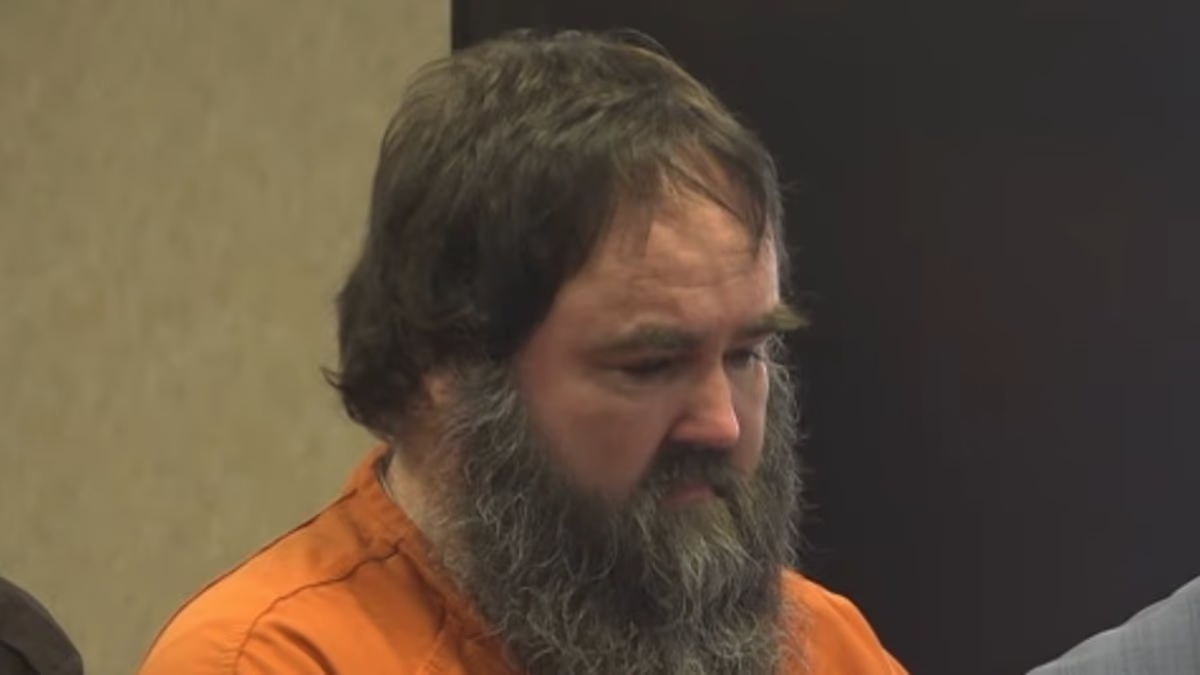
Jeffery Smerer, 45, of Port Huron, Michigan was sentenced on Monday to life in prison without the possibility of parole

Smerer fatally shot his 17-year-old son, Kayleb (pictured), on September 11, 2025

The father-of-four also critically injured two of his other children, Bentley, 13, and Kinzley, 12
But when it came time to take his own life, Smerer claimed his pistol ‘jammed.’
He was then disarmed by his wife, Brandi, and his 19-year-old son, who were awake and home at the time.
The children were then rushed from their apartment to the local hospital, where Kayleb succumbed to his injuries.
Bentley also suffered severe injuries to his face, including shattered cheekbones, upper jaw and nasal area, according to an online fundraiser that was set up to help the family with the funeral and medical expenses.
Kinzley, who loved volleyball and dance, also had to undergo facial reconstruction surgery and was left paralyzed from the shoulders down, it said.
In an update in January, the children’s mother, Brandi, said Bentley had been released from the hospital and was back in school as Kinzley was continuing to undergo physical and occupational therapy.
She described how her daughter ‘has so much strength and courage.’
‘She’s able to move her right arm fully, fingers don’t work yet, her left arm is currently casted from the shoulder to the wrist to try to get straightened out weekly,’ Brandi wrote.

An online fundraiser describes how Kinzley loved volleyball and dance

She was left paralyzed from the shoulders down following the shooting
READ MORE: Robert Irwin’s Hilariously Aussie Exchange With Prince William Sends Fans Wild
The mother, who had to work two jobs to support the family after Smerer suffered a stroke, added that Kinzley was starting to work with a new physical therapist.
Brandi also added that the family buried Kayleb on what would have been his 18th birthday.
The fundraiser also describes how the children’s father ‘seemed fine the night before’ but ‘had a mental breakdown.’
In court on Monday, the surviving siblings also told how the morning of September 11, 2025 started off just like any other.
Kayleb ‘just woke up like every other morning, got ready for school, watched his TikTok, doing whatever,’ the eldest son told the court.
‘He was on the couch with his backpack on waiting for [the dad] to take them to school and [the dad] was able to go up to him, point a gun at him and pull the trigger,’ the 19-year-old said, describing Kayleb as his father’s ‘favorite’ child.
Smerer was seen weeping in court as the teenager spoke, PEOPLE reports.

Bentley suffered severe injuries to his face, including shattered cheekbones, upper jaw and nasal area
Bentley also told the court how his father wished him ‘good morning’ before he opened fire.
‘I didn’t know a “good morning” was shooting me in the face,’ the 13-year-old said.
He then turned his attention directly to his father, saying: ‘You deserve everything coming to you. You can cry all you want, won’t change a thing.
‘You crippled my sister, you killed my brother – your own children that you loved your entire life, just to kill.
‘You deserve everything coming to you,’ Bentley reiterated.
Smerer had told police he shot Bentley while he was ‘underneath a blanket’ and on his cellphone.
‘He was aiming towards the glow,’ a detective testified at a preliminary hearing last year, citing statements Smerer made to police.
‘Kinzley was getting up and he aimed at her throat and fired.’

When Smerer was asked why he targeted the children, a detective said he claimed ‘his reason was that he was closest to Kinzley and Kayleb, He also said that Kinzley was close to Bentley’
When Smerer was then asked why he targeted the children, the detective said he claimed ‘his reason was that he was closest to Kinzley and Kayleb, He also said that Kinzley was close to Bentley.’
He said the plan was ‘to take Kinzley, Bentley and Kayleb with him and then shoot himself,’ the detective testified.
At the sentencing on Monday, Smerer’s lawyer told the judge it ‘is without question the most difficult sentencing hearing I have participated in.
‘Nothing that can be said today diminishes the horror of what occurred on September 11, 2025,’ the lawyer said. ‘One child lost his life. Two children suffered catastrophic injuries, one of whom may live the remainder of her life confined to a wheelchair. A family has been forever shattered.
‘There simply are no words that can adequately express the magnitude of that loss,’ the attorney continued. ‘Mr Smerer understands that. More importantly, he has accepted responsibility for it.’
The attorney then noted that Smerer ‘never attempted to blame anyone else for what occurred,’ saying he ‘plainly acknowledged’ that he shot his children in statements to the police.
His guilty plea ‘cannot undo the damage’ he caused or ‘erase the trauma suffered, but it is a meaningful act of accountability.’
The judge then seemed to agree, saying Smerer’s decision to plead guilty ‘had the effect of avoiding a very lengthy, very emotional, very difficult trial that probably would have resulted in the exact same outcome that your guilty plea did.
‘And to the extent that that was avoided, this is a good thing for those victims.’