
In 1974, Jeffrey Archer appeared to have lost everything. The 34-year-old MP for Louth in Lincolnshire had taken out a second mortgage on the family’s £100,000 home in The Boltons, Kensington, and borrowed more money from a friend to invest £350,000 in a Canadian industrial cleaning firm called Aquablast. He had been promised the deal would make him a millionaire.
Instead, Aquablast turned out to be a scam. When the company collapsed into liquidation, Archer was declared bankrupt. His wife, Mary, was seven months pregnant with their second child, and he was forced to surrender his seat in Parliament. His political career seemed over.
Yet recovering from disaster became a defining feature of Jeffrey Howard Archer’s life. Penniless, aged 34 and supporting a growing family, he took up a pen and began writing his first novel, ‘Not a Penny More, Not a Penny Less.’ The book became a bestseller and launched a writing career that lasted five decades, producing 31 novels, three stage plays and countless short stories.
By the time Baron Archer of Weston-super-Mare died yesterday aged 86, he had sold more than 320 million books in 115 countries. His own life, however, was arguably more colourful, improbable and controversial than many of the plots he created.
Archer was not merely a bestselling novelist. He was also an accomplished amateur athlete, a passionate art collector, a Conservative MP and, later, the party’s deputy chairman under Margaret Thatcher. In 2001, he served two years and two days in prison for perjury, then returned to the House of Lords and resumed his literary career. His death came only a day before the release of his final novel, Adam and Eve, published today, Tuesday, October 6.
Born in north London in 1940, Archer did not keep his talent for fiction confined to his books. He was a prolific storyteller and an accomplished embellisher, turning the lie into an art form. His ability to bend the truth was so notorious that journalist Kevin Maguire wrote in 2001 that even Archer ‘would not have dared to create a character so untruthful as himself’.

By the time of his death at 86, Jeffrey Archer had sold more than 320 million books. The novelist and former MP was photographed on Sunday, the day before he died

Alongside his bestselling writing career, Archer was an accomplished amateur athlete, a major art collector, a Conservative MP and later deputy chairman of the party under Margaret Thatcher
One of Archer’s earliest celebrated claims was that, after winning the Lincolnshire seat of Louth at just 29 in 1969, he had become the youngest MP ever elected. He had not. Bernadette Devlin entered Parliament for Mid-Ulster in April that year aged 22, while Christopher Ward won his seat at 25 only five weeks before Archer’s by-election victory. Archer was also accused of exaggerating his O-Level results to secure a place at Oxford, inventing a year at Sandhurst for his CV and presenting his father as a war hero, despite the man being a bigamist and fraudster who fled to the United States to escape arrest.
Even so, Archer repeatedly managed to survive the revelations. His loose relationship with the truth helped create the image of an ambitious, charming rogue and reinforced his reputation as one of his generation’s most compelling storytellers. The cover of his 1996 novel The Fourth Estate made the boast: ‘If there were a Nobel Prize for storytelling, Archer would win.’
Before publishing his first novel, Archer had a brief spell as an army recruit. One former fellow soldier described him as ‘hugely insensitive and amazingly pleased with himself’. He then spent five months serving with the Metropolitan Police in Brixton, south London. In his early twenties, he also claimed to have ‘sailed to California via Scotland and the Panama Canal on a tramp steamer’, raised $500,000 for a Canadian charity and earned a degree from Berkeley in California. Those who knew the young Archer — including his close friend Princess Diana — might have offered a different version of events.
His first political role was as a Conservative councillor for Havering on the Greater London Council. There, he acquired the nickname ‘Mr 10 per cent’ after allegedly helping councillors with their expenses in exchange for a share of their remuneration. He entered Parliament in December 1969 after winning the Louth by-election.
Bankruptcy brought his five years in Parliament to an abrupt end, but it also pushed the man Thatcher dubbed the ‘extrovert’s extrovert’ towards fiction. His third novel, Kane and Abel, published in 1979, made him internationally famous and wealthy. More than 30 million copies have been sold worldwide, placing it among the bestselling books ever published and ahead of titles including The Great Gatsby and Gone With the Wind. It was later adapted for television, starring Ed Begley Jr and François-Eric Gendron. Despite his enormous output, Archer claimed in later years that he did not know how to switch on a computer and wrote every novel by hand in felt-tip pen on lined paper.
The fortune generated by his books — estimated at more than £200 million by the time of his death — helped fund his other great passion: art. Archer became an avid collector, and his lavish lunch and Christmas parties were famous for their combination of Krug champagne and shepherd’s pie. When guests asked where to find the lavatory, he reportedly directed them to ‘turn left at the Picasso and right at the Monet’. Around 10 per cent of his collection was sold at Christie’s in London in 2011, raising more than £5 million. The holdings included works by L S Lowry, Andy Warhol and Camille Pissarro.

After bankruptcy ended his five-year parliamentary career, Archer — once described by Margaret Thatcher as the ‘extrovert’s extrovert’ — reinvented himself as a novelist

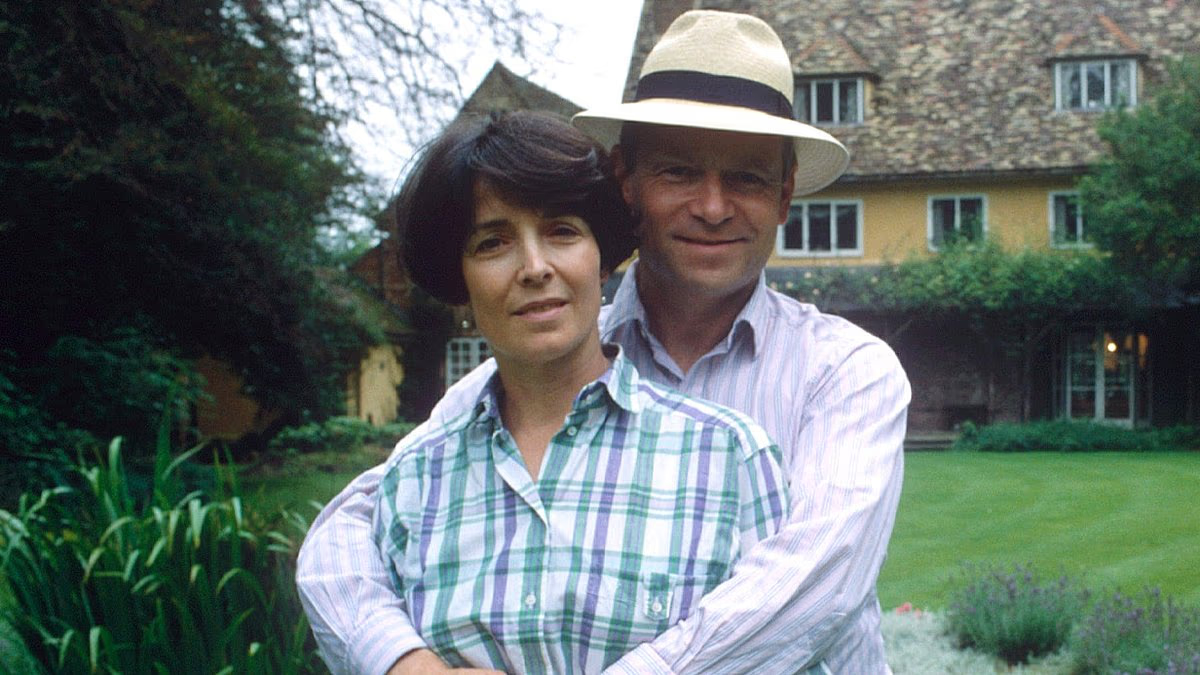
Archer met Mary, who was then a 19-year-old chemistry student at Oxford. They married in 1966, and she was made a Dame in 2012 for her services to the NHS
But Archer’s career also contained a devastating collapse. In 1987, he successfully sued the Daily Star after the newspaper reported that he had paid £2,000 to sleep with prostitute Monica Coghlan. The court awarded him £500,000 in damages — worth around £1.5 million today.
Fourteen years later, in July 2001, Archer was convicted of two counts of perjury and two of perverting the course of justice in connection with that 1987 trial. He was sentenced to four years in prison.
When the allegations first emerged in 1999, the Sunday Telegraph captured the scale of the crisis with its stark front-page headline: ‘Jeffrey Archer destroyed.’
SEE ALSO: Australian Teacher Accused of Grooming and Raping Student Still Paid
Archer endured a brutal public reckoning as the new millennium began. Despite winning the Conservative nomination decisively, he was forced to withdraw from the race to become London’s mayor.
And yet, who would have been so foolish as to bet against a man who seemed to rise from every fall like a coiled target at a fairground shooting gallery?
Archer went down in 2001 and spent two years at Her Majesty’s pleasure where he claimed to have survived courtesy of protection from a fellow inmate and murderer known as Big Al, and by paying other inmates to source a steady supply of Cussons soap and soft pillows.
Archer then emerged in 2003, seemingly unscathed, returned to the House of Lords, to which he had been appointed in 1992 by Sir John Major and continued to write novels, even publishing three volumes of prison diaries.
The infamous perjury conviction, however, wasn’t his only brush with the law. Years previously, Archer had been accused of stealing three suits from a store in Canada, walking out without paying. Although no charges were brought, the allegation did resurface in 1999 when Archer stood to be London Mayor. Undeterred, Archer gave in rebuttal the explanation that he had inadvertently walked over a footbridge connecting two separate stores without realising they were separate institutions. His ingenious explanation was only brought down when it emerged the footbridge in question hadn’t been built at the time.
Archer met his wife Mary – made a Dame in 2012 for services to the NHS – when she was a 19-year-old chemistry student at Oxford. Although it was love at first sight for him, he claimed she didn’t initially feel the same way. The pair married in 1966 and by the time Archer was on trial for perjury, Mary admitted in the witness box the two had ‘explored the further reaches of “for better or worse” far more than some other couples’.

Archer seen walking through the grounds of Hollesley Bay Prison in July 2003, ahead of his release later that month

Archer had various high-profile friendships throughout his career, including with Princess Diana, pictured at Harrods, London, in 1996. The pair are seen alongside actor Omar Sharif and doctor Magdi Yacoub
Lady Mary, who – along with their two sons and five grandchildren – survives her husband, was a distinguished scientist and even made it onto the board of the now-defunct Anglia TV. The appointment coincided with her husband purchasing shares in the company, leading to allegations of insider dealing which were strongly denied and, though they came to nothing, Mary resigned four months later.
And yet for all her professional success, Mary is perhaps best known for being described as a vision of ‘elegance, fragrance and radiance’ by the overly sympathetic Mr Justice Caulfield while summing up the 1987 libel action that preceded the perjury allegation.
In Jeffrey Archer’s final interview, conducted with this newspaper, he revealed his love and admiration for Mary was unmoved by 60 years of marriage: ‘I adore the woman,’ he said. ‘I’d be lost without her. I just hope I die first. I’d last a week without her, and it would be a bad one, at that.’
Archer remained active into his later life, at 70 still going to the gym three times a week: ‘It’s 20 minutes running, 20 minutes of weights and 20 minutes stretching,’ he told Our News Outlet in 2011. ‘And I’m writing a book a year. I’m not slowing down.’ Physical exercise had been a part of his life from his school days, when he started lifting weights after bullies cruelly nicknamed him ‘the Pune’.
He also continued to umpire cricket matches around London. Though not content with a merely watching brief, Archer allegedly used to give batters out ‘simply because he liked to be regularly involved,’ according to one friend.
Upon news of his death yesterday, Kate Elton, UK CEO of publishing house HarperCollins, said: ‘It has been one of the great privileges of my publishing life to have been Jeffrey Archer’s editor. He was the master storyteller and an editor’s dream – phenomenally hard-working, utterly committed to completing draft after draft to get every word as perfect as possible, and a true champion of the team nature of great publishing.’
Tory leader Kemi Badenoch added to the tributes, writing on X: ‘I am incredibly saddened to hear this news. He had sent me a lovely message just this morning and was always a great source of encouragement to me personally’.
Archer’s death came just a day after he had appeared with lifelong friend Gyles Brandreth at a show in London promoting his new book Adam and Eve.
Upon the opening of Archer’s play Exclusive at The Strand in 1989, Brandreth – who seemed to love and loathe Archer in equal measure – wrote in his diaries: ‘To his face we tease him. Behind his back we mock him. But I notice we don’t stay away.’
And there is the measure of the man: exasperating to his friends, infuriating to his foes, but entertaining to the end. He may have had a personalised number plate declaring: ANY 1, but Jeffrey Archer was never anything but himself.


