
A convicted killer will face sentencing again after an AI-generated video depicting his victim speaking from beyond the grave influenced the judge’s decision, an appeals court has ruled.
Gabriel Horcasitas, 55, was convicted of fatally shooting 37-year-old Christopher Pelkey during a road-rage confrontation in Chandler, Arizona, in 2021.
Horcasitas received a 10-and-a-half-year prison sentence in May 2025. His attorneys appealed, arguing that the trial judge should not have been allowed to view an AI-generated video of Pelkey before imposing sentence.
In the video, an AI recreation of Pelkey addressed Horcasitas directly, saying: “It is a shame we encountered each other that day in those circumstances. In another life, we probably could have been friends.”
The digital version of Pelkey continued: “I believe in forgiveness and God who forgives. I always have, and I still do.”
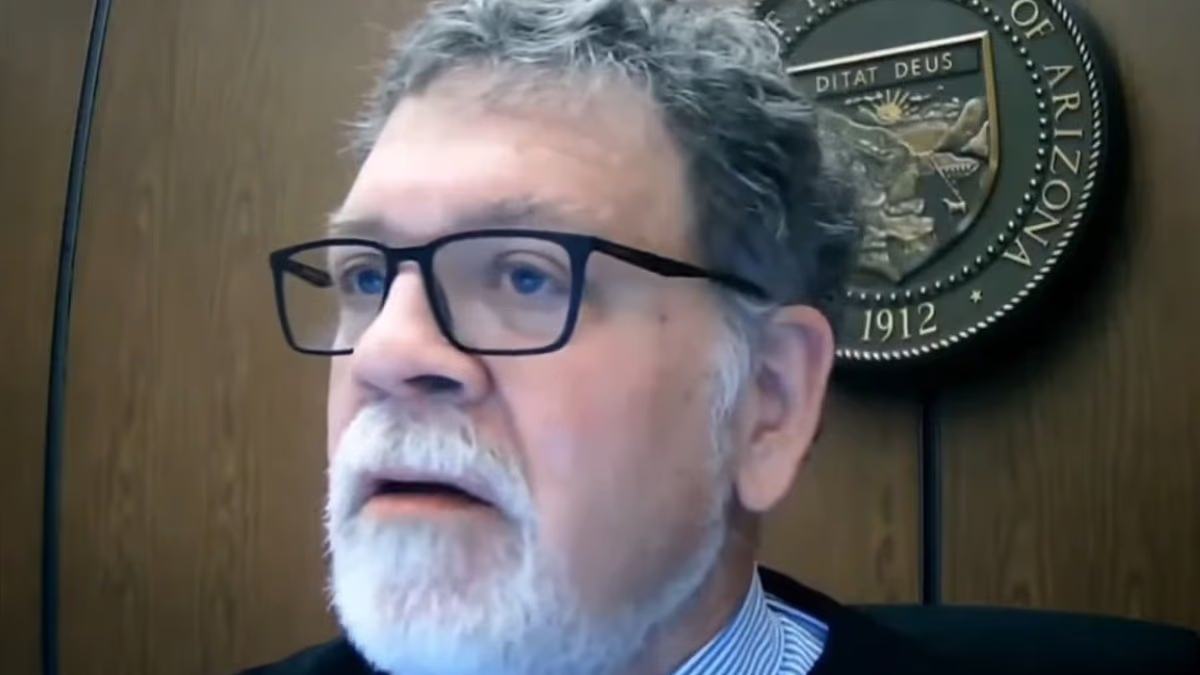
When the video ended, Maricopa County Superior Court Judge Todd Lang told those in the courtroom: “I loved that AI, thank you for that. As angry as you are, as justifiably angry as the family is, I heard the forgiveness. I feel that was genuine.”
After examining what is believed to be the first use of such a video in a US court, the Arizona Court of Appeals ruled Wednesday that Horcasitas must be sentenced again. Court documents reviewed by Our News Outlet said the clip “was not reliable.”
The original sentence has been vacated, although Horcasitas’s manslaughter conviction remains intact. A new sentencing hearing will now be scheduled.

Christopher Pelkey, 37, was shot dead during a road-rage incident in Chandler, Arizona. He appeared in an AI-generated video, pictured, during his killer’s sentencing in May 2025.

Gabriel Horcasitas, 55, was convicted of fatally shooting Pelkey and sentenced to 10 and a half years in prison. His lawyers appealed, arguing that the AI video was “not reliable.”

Maricopa County Superior Court Judge Todd Lang is shown reacting to the AI-generated video.
Horcasitas argued that the video deprived him of due process because the sentencing judge heard it and relied on it when determining his punishment, according to court records.
At one point, the AI clip included an earlier recording in which Pelkey said he was a US Army veteran and a deeply religious man with a strong belief in God.
The video then returned to the AI-generated version of Pelkey, which said it was “a true representation of who I was… not how the courtroom portrayed me.”
The court took a brief recess after the video ended. An attorney for Pelkey’s family then asked Judge Lang to “weigh the victim impact as rebuttal to any mitigation,” the appeals court said.
Before the video was shown, several of Pelkey’s relatives and friends had delivered emotional statements describing the impact of his death.
The family lawyer urged the judge to impose the maximum sentence. A prosecutor, however, recommended a slightly lower term of nine years in prison.
Three people also addressed the court on Horcasitas’s behalf and asked for leniency. Horcasitas apologized to Pelkey’s family, calling the shooting “the most frightening and regrettable five seconds of my life,” according to the ruling.
His defense attorney requested a seven-year prison term. Judge Lang then acknowledged the suffering experienced by both the victim’s family and the defendant’s relatives.
Turning to Pelkey’s family, Lang said: “Does that mean I think that Mr. Horcasitas, because of the loss to the family, should get the maximum sentence or I think that he should get the minimum sentence?
‘It doesn’t matter what I think. Whether I think he should get 40 years or 1 year. I have to follow the law.’

In the middle of the AI-generated clip, a past video showed Pelkey discussing his faith and being a US Army veteran
The sentencing judge then went on to share his apparent fondness for the video.
‘As I said, I’d like to think I would do that. I don’t know that I would, but I love the beauty in what Christopher – and I call him Christopher. I always call people by their last names. It’s a formality of the Court, but I feel like calling him Christopher as we’ve gotten to know him today.
‘I feel that that was genuine; that his obvious forgiveness of Mr. Horcasitas reflects the character I heard about today, but it also says something about the family because you told me how angry you were and you demanded the maximum sentence, and even though that’ s what you wanted you allowed Christopher to speak from his heart as you saw it.
‘I didn’t hear him asking for the maximum sentence,’ Lang said.
In the end, Lang decided that Horcasitas was a person that had ‘spent his entire life as a law-abiding citizen’ and that he ‘made a dreadful error of judgement’ that day.
‘However, the loss I’ve heard from the victim’s family, as I said, could not be more profound. It’s not an aggravator, but it reduces the effectiveness or power of the mitigating fact that Mr. Horcasitas has led a lawful life.
‘For that reason I find the presumptive term of 10.5 years in prison is appropriate. That’s more than the state asked for,’ Lang concluded.

Pelkey’s family created the clip using a previously recorded video of him, and the script for it was created by his sister, Stacey Wales (pictured holding a display of her late brother)
Horcasitas has gone on to argue that the AI video itself brought an ‘undue emotional weight’ and was therefore ‘inadmissible,’ the three-judge panel wrote.
They have agreed that the presentation was a ‘constituted fundamental error’ that ‘clearly impacted the sentencing judge.’
‘While the record does not reflect precisely how the AI video factored into sentencing calculus, there is no question it played a role,’ the ruling read.
The appellate ruling stated: ‘The judge’s consideration of the AI video so prejudiced Horcasitas as to render the sentencing procedure fundamentally unfair.’
Pelkey’s family created the clip using a previously recorded video of him, and the script for it was created by his sister, Stacey Wales, AZ Family reported.
It is unclear when Horcasitas will be resentenced.
Our News Outlet contacted lawyers for the Pelkey family and Horcasitas for comment.


