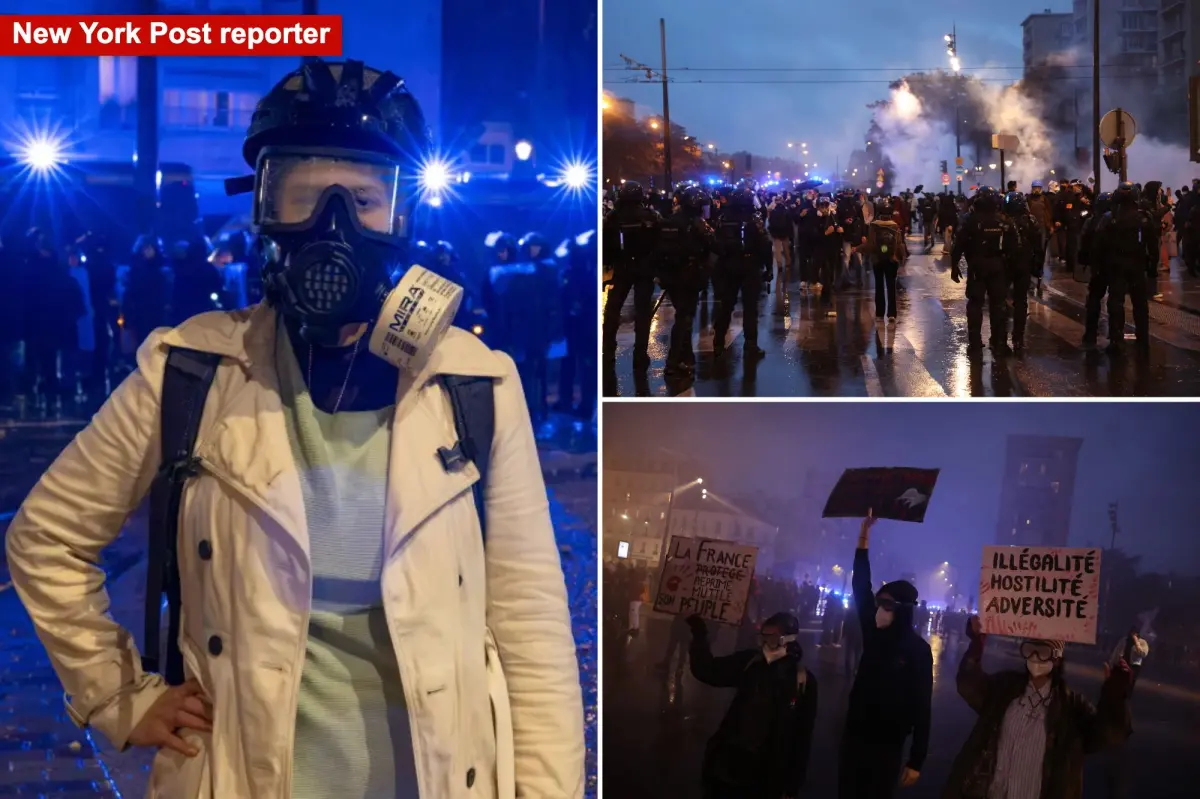

PARIS — I was in the middle of a street in eastern Paris, surrounded by protesters—most of them wearing masks—when my throat suddenly began to sting. Within seconds, I was coughing uncontrollably and struggling to breathe as the first tear gas of the evening spread through the crowd. I quickly pulled out the gas mask I had carried in my backpack all day, during what had been a massive but largely peaceful demonstration.
Saturday’s main Paris protest began at Porte d’Italie, a predominantly residential district on the Seine’s left bank. Police altered the authorized route late Friday night, arguing that the original path—from Place de la Bastille through Place de la Nation in central Paris—would be too challenging to protect.
The revised route also passed through an area with few stores, leaving protesters with far fewer commercial targets than during the previous weekend’s unrest. Instead, the march moved past working-class apartment towers, where residents unused to seeing large political demonstrations in their neighborhood stepped onto balconies to watch the tens of thousands passing below. Some observed with cigarettes in hand.
After nearly three hours, the march reached its destination at Porte de Vincennes. There, riot police and military units made it clear that they intended to control the situation—unlike the previous weekend, when police tactics drew widespread criticism. Whenever the crowd appeared close to breaking apart, officers moved forward to contain it.
For almost another hour, however, the atmosphere stayed calm. Demonstrators continued chanting, while others danced and leaped along with the crowd. We began wondering whether it was time to leave and check on events unfolding elsewhere in Paris.
IN CASE YOU MISSED IT: Explosion and Fire at Quaker Oats Plant in Cedar Rapids, Iowa, Leave No Injuries
More coverage of the riots plaguing France’s streets
Then the crowd began to change. Many of the peaceful protesters were boarding the Metro to go home, while a different group was arriving. These newcomers wore face coverings and gas masks, carried no signs identifying a cause and moved with an unmistakable sense of intent.
A sudden explosion shattered the air, loud enough to resemble gunfire. Within seconds, at least half a dozen more deafening blasts followed.
Police responded with tear gas and stun grenades after masked rioters threw rocks and fireworks toward officers.
A peaceful Paris march that had continued for hours was abruptly transformed into a violent confrontation. Smoke filled the streets as police struggled to push the masked crowd back.