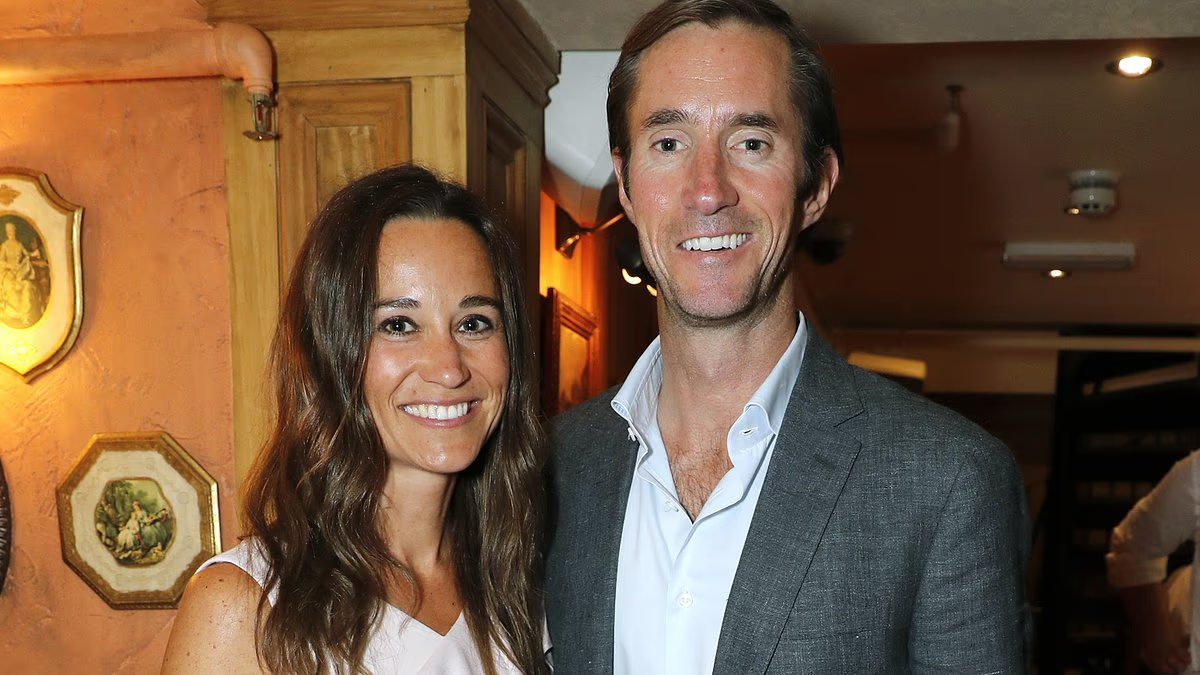
Pippa Middleton and her hedge fund manager husband, James Matthews, have won a planning dispute that will prevent the public from using a footpath running through their £15million country estate.
The Princess of Wales’s sister argued that the route, which crosses their Grade I-listed Barton Court estate in Berkshire, posed a potential security risk to her family.
Residents of nearby Kintbury use the path to reach the village without walking along Station Road, a narrow route with blind bends, heavy traffic and no pavement.
However, Middleton and Matthews faced accusations that they were invoking her sister’s royal connections to support the decision to restrict access to the footpath.
Local residents said the estate’s former owner, the late Habitat furniture founder Sir Terence Conran, had consistently left the gates open because the route was understood to be available as a public passageway.
After buying the estate for £15million in 2022, the couple installed electric gates at both ends of the path, along with signs stating ‘Private: No Public Access’ and ‘No Trespassing’.
Thirty-five residents, supported by The Ramblers’ Association, appealed to West Berkshire Council for the lane to be formally recognised as a public right of way.
Matthews, who is heir to a Scottish feudal title, maintained that the route had not been used openly and without permission for the 20-year period required under the law.

Pippa Middleton and her husband James Matthews have won their fight to stop the public using a footpath through their £15million country estate

Mill Lane crosses the couple’s Barton Court estate, connecting a public footpath with a busy main road
Ken Taylor, the government-appointed planning inspector, overturned the route’s designation as a public right of way. He said the couple could not rely on privacy and security concerns, but concluded there was insufficient evidence that walkers had used the path freely for 20 years.
A spokesman for the couple said: ‘We are grateful for the careful consideration given to the facts and appreciate the time invested by all parties.’
Tony Vickers, a local Liberal Democrat councillor, said: ‘I am surprised and very disappointed that the inspector came down on the landowner’s side. After attending almost all the inquiry, I could not see any relevant argument put by Mr Matthews’ supporters.’
Reports in May said residents believed Middleton was using her sister’s royal status to imply that she and her husband should receive special treatment because of their privacy and security concerns.
One angry resident told Our News Outlet in April: ‘They’re not even the proper Royal Family.’
Neil Pike, the local ‘footpath secretary’ for ramblers, told the inquiry Mill Lane was ‘intrinsic’ to life in Kintbury.
Join the discussion
Should wealthy homeowners have the power to block historic public paths for their own privacy?

Mr Matthews attended the opening of the Planning Inspectorate inquiry held at Kintbury’s village hall without his wife in May

The extensive gardens at the £15million Grade I-listed Barton Court in Berkshire
He said: ‘Until recently I have never known Mill Lane to be closed for any reason.
‘In all the time I have been footpath secretary no one has reported to me that they’ve been stopped or turned back while walking along Mill Lane.
‘If Mill lane is removed from public use then Station Road is the only alternative and does not bear thinking about.
‘I do not understand why the present owners are trying to close it when it has been used by the walking public for decades.’
But Paul Wilmshurst, the barrister representing Mr Matthews, said in a written submission that declaring the path a public right of way would ’cause very real practical [and] privacy difficulties and security issues’.
He said: ‘The route is over land, which, at all material times, has formed and has had the local reputation as being the private drive to the house at Barton Court.’
Mr Matthews told the public inquiry: ‘There are implications for my family, due to their high public profile, which means there is a need for a higher level of security than would otherwise be the case.
‘Therefore to improve security for my family, before we moved in, I arranged for an electric security gate to be erected on the drive.’
He was supported by Victoria Conran, the widow of Sir Terence, who sold the estate to him after her husband’s death.

Victoria Conran, who previously lived on the estate with her late husband Sir Terence Conran, was seen speaking to Mr Matthews in May
Lady Conran told the inquiry: ‘In the 30 years that I lived at Barton Court, I only ever saw one person using the driveway who should not have been there… Suffice to say, I never observed any organised groups of ramblers using the driveway.’
Mr Taylor, the planning inspector, said that there was evidence from at least 1983 of a ‘Barton Court Private Road’ sign on the path. Another image showed that by June 2020 the sign read ‘Barton Court Estate, No Through Road’.
He concluded that the ‘low levels of use’ of the drive was not sufficient to demonstrate that the public were asserting a continuous right to use it as a footpath.