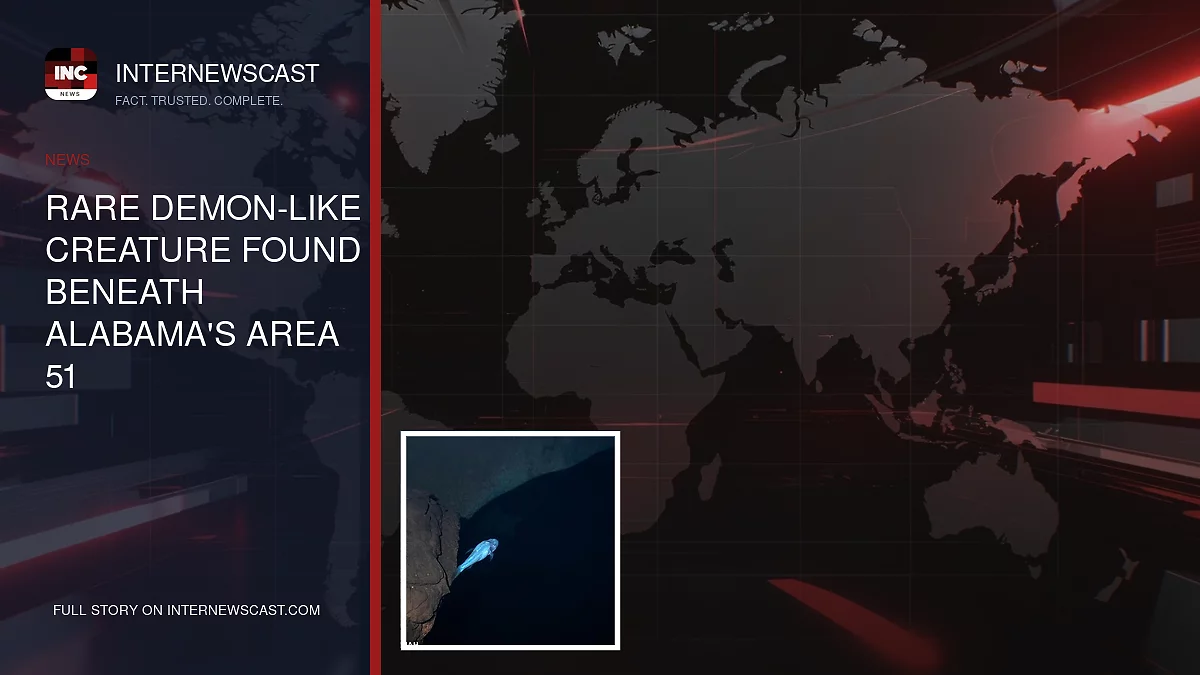

Scientists have identified a previously unknown species hidden beneath a high-security military site often nicknamed Alabama’s Area 51.
The tiny fish, named Demogorgonichthys arcanus — or the “demon cavefish” — was found by researchers in Huntsville living in a single small pool inside an underground cave beneath the US Army’s Redstone Arsenal. It has no eyes, no pigmentation and reaches only about two inches long.
Although it is not alien life, the pale, eerie-looking creature was uncovered in a setting with a distinctly otherworldly reputation: a military facility associated with UFO lore and classified work involving missiles, rockets and space-related technology.
Genetic analysis showed the fish is related to other North American cavefish, but its lineage appears to have split from comparable species roughly 11.6 million years ago.
Over that vast stretch of time, it became fully adapted to permanent darkness, losing its eyes while developing specialized sensory organs across its body to navigate the subterranean world.
The researchers said the fish is so genetically distinct from known cavefish that it warranted placement in an entirely new biological subgroup.
Among the clues was an eyesight-related gene that had become severely degraded in the demon cavefish — a change scientists anticipated because the animal lives in total darkness and no longer relies on vision.
What stunned the team was that the new species evolved in the same pools as the Southern Cavefish, Typhlichthys subterraneus, yet followed a separate evolutionary route despite sharing the same underground habitat.

Scientists have discovered a new species underneath a base tied to UFO conspiracies in Huntsville, Alabama

The ‘demon cavefish’ (Demogorgonichthys arcanus) is similar in appearance to other cavefish scientists have found but is said to be genetically unique
Scientists revealed that while finding independent evolutionary paths among different cavefish species has happened before, uncovering a unique creature adapting in its own way in the exact same pool alongside other cavefish is very rare.
Dr Matthew Niemiller, associate professor of biological sciences, said in a press release: ‘This is one of the last places we’d have bet on it.’
‘Finding an entirely unknown, new genus of freshwater fish in eastern North America today is a little like finding a new kind of big cat. The group is so well known, we thought the big surprises were behind us. To have one turn up in a cave we’ve watched for three decades is a real reminder to stay curious. It was genuinely surprising.’
Only a handful of the demon fish were seen in the team’s observations between 2019 and 2025, which were published in Scientific Reports.
The fish has only been found in this one small aquifer system, and it is believed to have a very small habitat underneath Redstone Arsenal.
Since the fish, which is less than two inches long, lives in such a tiny area of the cave and depends on groundwater to survive, Niemiller’s team considers it highly vulnerable to pollution, changes in water flow, droughts and floods – making it critically imperiled and possibly a critically endangered species.
The fact that the cave is under Redstone Arsenal is believed to have given the fish some protection from extinction, since base restrictions have kept the public from building on the site and destroying the cave.
Although the base’s cave is protected from the public, scientists found that the environment the fish were living in was still contaminated – apparently with residue from chemical weapons.

The fish was found in a cave under Redstone Arsenal, a US Army base that also houses US Space Command

Scientists found that the cave was contaminated with materials used in both conventional and chemical weapons
‘Trace metals, including cadmium, chromium, and lead, have been detected at elevated concentrations in water samples from Bobcat Cave over the past two decades,’ the team wrote in their study.
Niemiller’s team said the most likely reason for the pollution was that Bobcat Cave sits under an old industrial part of Redstone Arsenal where the Army used to dispose of both regular and chemical explosives.
Some of those materials seem to have slowly leaked into the underground water that flows into the cave.
Cadmium, chromium and lead are all metals that can be harmful to living things even in small amounts.
Lead has served as the main metal in most bullets and projectiles. Lead compounds have also been used in primers, the part that starts the explosion when the trigger is pulled.
Meanwhile, both chromium and cadmium have been used by the military as a protective plating that resists rust and corrosion.

Redstone Arsenal has been called the Area 51 of Alabama

Unproven claims have alleged that recovered UFOs were taken to Redstone Arsenal in 2026
The mysterious base opened in 1941 to support the US during World War II, and it now has a workforce of more than 45,000 military personnel, civilian employees and contractors.
According to a government fact sheet about Redstone: ‘The installation is the birthplace of NASA and has grown to include more than 65 diverse and distinct organizations.’
However, the base’s newest task – becoming the home for US Space Command – has revived decades-old UFO conspiracy theories tied to Redstone Arsenal.
In fact, just a month after US Space Command officially transferred its operations to Redstone, unproven allegations began spreading online claiming that non-human craft being held at Area 51 in Nevada were being moved to Alabama.
In 2020, Amy Eskridge, a researcher working on anti-gravity technology in Huntsville, claimed during an explosive interview that the source of UFO and alien disclosure would be Redstone Arsenal.
Eskridge, who died in 2022, said: ‘Redstone Arsenal in Huntsville, Alabama is the biggest f****** deal that you’ve never heard of.’


