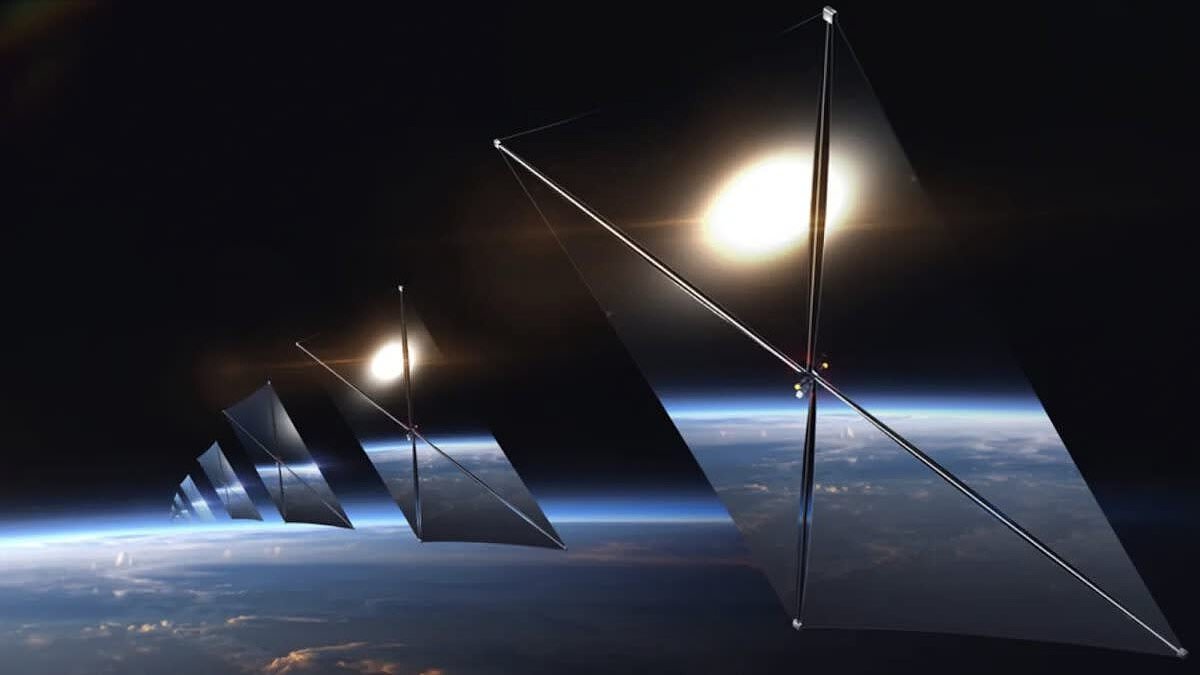

Researchers have unveiled a bold initiative to send 50,000 mirrors into orbit, aiming to provide ‘sunlight on demand’.
Reflect Orbital, a startup based in California, is on the verge of gaining approval to launch an 18.3-meter (60-foot) prototype mirror into space. This mirror is designed to redirect sunlight back to specific areas on Earth.
Upon reaching an altitude of 640 kilometers (400 miles), the mirror will expand and cast light over an area approximately 4.8 kilometers (three miles) wide.
Observers on the ground would notice a bright spot in the sky, comparable in brightness to the moon.
Reflect Orbital envisions these space mirrors enabling solar power facilities to function around the clock, providing illumination in disaster-stricken areas, and potentially replacing conventional street lighting.
The company has submitted an application to the US Federal Communications Commission (FCC), which regulates satellite licenses, and the massive mirror could be launched as early as this summer.
However, not everyone is on board with the plan.
Martha Hotz Vitaterna, a neurobiologist at Northwestern University and co–director of the Center for Sleep and Circadian Biology, warned: ‘The implications for wildlife, for all life, are enormous.’

Experts have warned this could disrupt circadian rhythms and ground–based astronomy, even as firms like SpaceX are trying to make their satellites (artist’s impression) less reflective
Reflect Orbital, which has already raised more than $28 million (£20.8 million) from investors, is not the first group to dream about harnessing the sun with mirrors.
In 1993, a Russian satellite dubbed Znamya, or Banner, unfurled a 65–foot mirror and reflected a beam of light as strong as two or three full moons.
The idea was to see whether a small fleet of satellites could be used to extend daylight hours in the remote region of Arctic Siberia.
However, Reflect Orbital’s plan is even more ambitious than those early experiments.
The company says it plans to harness the vast quantities of sunlight that normally pass Earth by, and sell it on demand to people, companies and governments.
The biggest appeal will be for the growing solar power industry, which is currently facing the unavoidable problem that solar panels can’t generate electricity at night.
Ben Nowack, Reflect Orbital’s chief executive, told the New York Times: ‘We’re trying to build something that could replace fossil fuels and really power everything.’
By the end of 2027, Reflect Orbital plans to launch two more prototype mirrors with hopes to launch 1,000 larger satellites by the end of the following year.

By the end of 2027, Reflect Orbital plans to launch two more prototype mirrors with hopes to launch 1,000 larger satellites by 2028, 5,000 by 2030 and 50,000 orbiting mirrors by 2035
According to the company’s current plan, that number will expand to 5,000 by 2030 and reach a full constellation of 50,000 orbiting mirrors by 2035.
Mr Nowack says the company will charge about $5,000 (£3,700) for an hour of sunlight from one mirror if a customer signs an annual contract for at least 1,000 hours.
He also says that solar power plants may be able to arrange for lighting by agreeing to split the revenues of the energy generated with Reflect Orbital’s light.
While that might come as a boon for renewable energy, scientists have raised major concerns about the plan’s safety and efficacy.
Critics warn that the mirrors could distract pilots, interfere with ground–based observatories, and wreak havoc on the natural sleep cycles of animals and humans.
Circadian rhythms, the natural biological cycles that help organisms know when to sleep, are hugely influenced by the presence or absence of sunlight.
If they’re disrupted, animals might breed at the wrong times when food is scarce, hibernating animals and insects might wake up in the middle of winter, and plants might bloom when there are no pollinators.
The additional light could also confuse migratory birds, sending them flying off into the deadly cold when they think summer is approaching.

Reflect Orbital is not the first to attempt this. In 1993, the Russian satellite Znamya (pictured) unfurled a 65–foot mirror and reflected a beam of light as strong as two or three full moons
That could also be a problem for humans in the affected areas, with additional light in the evenings sending our natural sleep cycles into disarray.
The campaign group DarkSky says that these activities ‘pose serious risks to the nighttime environment’.
DarkSky adds: ‘Such illumination would introduce an entirely new source of artificial light at night, with far–reaching consequences, including disruption to wildlife and ecosystems that depend on natural cycles of light and dark, as well as serious public safety concerns.’
Unfortunately, the FCC does not take any of these factors into consideration when considering Reflect Orbital’s application.
The agency’s official policy is that anything that happens in space is, by definition, not on Earth and therefore not subject to environmental review.
Besides the environmental impacts, scientists are also extremely concerned that Reflect Orbital could jeopardise astronomy.
Astronomers have been warning for years that the light bouncing off the thousands of satellites in orbit is making it more and more difficult for telescopes to look out into space.
Even as SpaceX are voluntarily trying to make its satellites darker, Reflect Orbital is trying to make its spacecraft as bright as physically possible.
Professor Gaspar Bakos, an astronomer from Princeton University, told the Daily Mail: ‘It will disrupt ground–based astronomy big time.’
The company claims that the beam of light would be restricted to a limited area, avoiding the most sensitive ground–based observatories.
However, Professor Bakos points out that light would inevitably scatter through the atmosphere on clouds and air molecules, adding a glow of light pollution to the sky.
Professor Bakos says that Reflect Orbital should ‘absolutely’ be prevented from placing mirrors in orbit, adding: ‘This is harming our environment in so many ways.’
The Daily Mail has contacted Reflect Orbital for comment.


