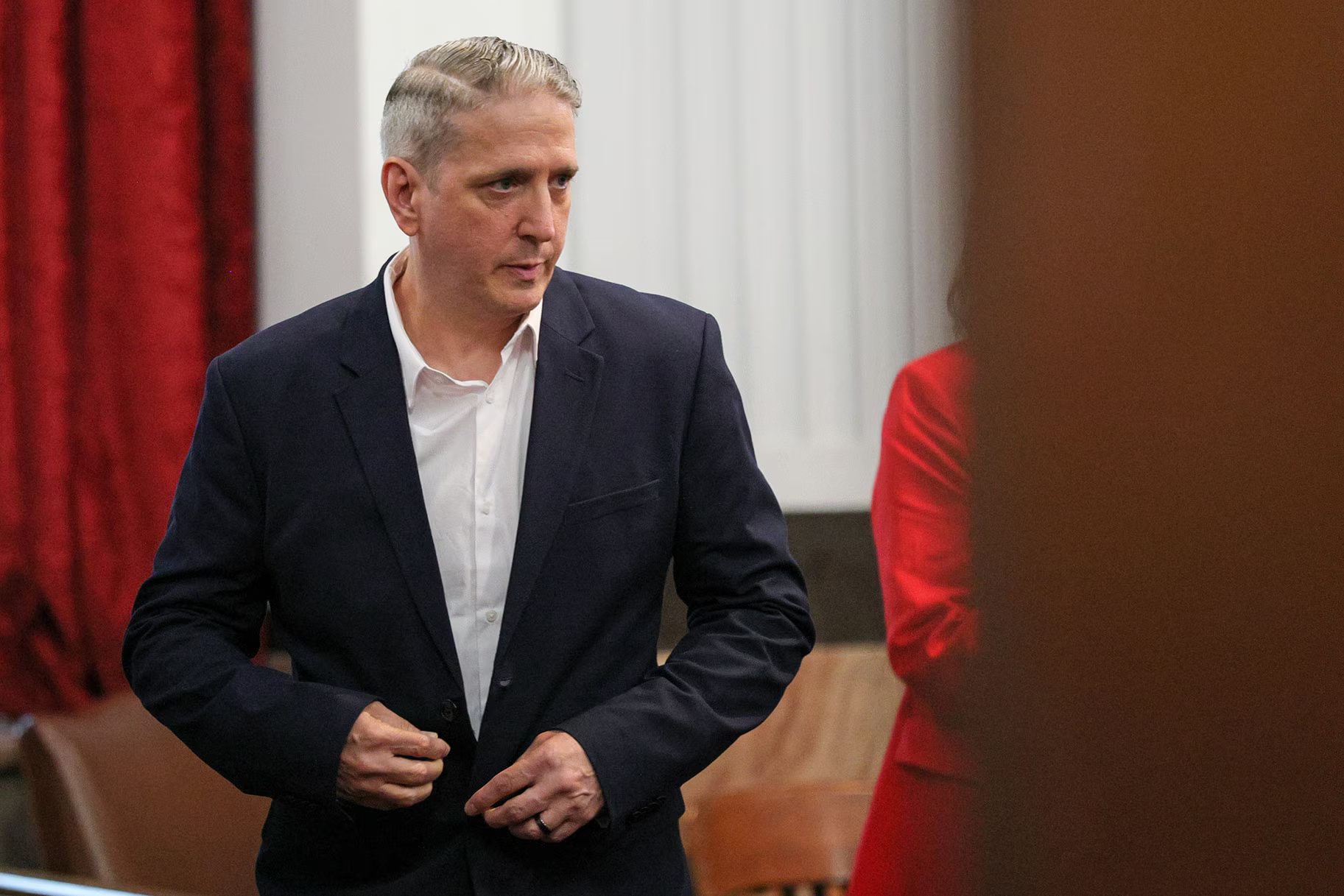

Richard Glossip, who spent almost three decades on death row, is no longer facing a murder charge in the 1997 killing of his former boss, motel owner Barry Van Treese.
As part of an agreement reached in Oklahoma, Glossip pleaded guilty on Nov. 12 to the reduced charge of being an accessory to first-degree murder.
“Richard Glossip finally took some measure of responsibility for the murder of Barry Van Treese,” Attorney General Gentner Drummond announced. “While allowing Glossip to plead guilty to the lesser-related charge of Accessory to First Degree Murder was a difficult decision for me and, more importantly, the Van Treese family, we both recognize that this path ensures a conviction related to Mr. Van Treese’s murder and gives us the best chance to secure additional prison time for Glossip.”
The plea follows a February 2025 decision by the U.S. Supreme Court that overturned Glossip’s murder conviction. The justices ordered a new trial after finding that prosecutorial misconduct had undermined the case against him.
Glossip has not yet been sentenced on the accessory conviction. Prosecutors are seeking the maximum 45-year prison term, with Drummond citing what he described as Glossip’s “deceit and deception along with his complicity” in Van Treese’s death.
Glossip’s lawyer, Don Knight, has taken the opposite position, arguing that his client has already spent more than enough time incarcerated.
“For 30 years, Richard Glossip has maintained his innocence,” Knight said in a statement. “After nearly executing him nine times, the State of Oklahoma has now dismissed the murder charge against him. This morning, to finally put this matter to rest, Rich pleaded guilty to being an accessory after the fact.”
“We believe Rich has more than paid his debt to society by spending nearly 30 years on death row,” Knight added, “during which time he was served three last meals, and came within minutes of being executed for a crime he did not commit.”
Glossip, who was released on $500,000 bail in May, said after the hearing that he was “grateful for his attorneys and all their hard work,” as well as for his wife’s continued support, according to KOKH.
Barry Van Treese Was Beaten to Death by Justin Sneed
Van Treese owned Best Budget Inn motels in Tulsa and Oklahoma City, while Glossip managed the Oklahoma City location.
During the summer of 1996, Glossip allowed Justin Sneed and Sneed’s stepbrother to stay at the motel in return for help with maintenance and housekeeping.
“Sneed, however, had a history of violence, angry outbursts, and substance abuse that included marijuana, methamphetamine, cocaine, and acid,” the Supreme Court wrote in its decision. “When, on January 6, 1997, Van Treese visited the inn to collect cash deposits there, Sneed beat him to death with a baseball bat.”
Glossip later told investigators that Sneed had admitted killing Van Treese. He also acknowledged helping Sneed fix a broken window in a room where Van Treese’s body was subsequently discovered.
After several rounds of questioning, however, Sneed claimed Glossip was far more deeply involved. According to court records, Sneed told authorities that Glossip had hired him to kill Van Treese so they could steal the motel owner’s money.
Prosecutors offered Glossip a deal if he testified against Sneed, but he rejected the offer and continued to deny involvement in the murder.
RELATED: From $12,000 in Debt to $140,000: How a Dumpster Business Turned Profitable
Sneed, meanwhile, agreed to cooperate with prosecutors and testify against Glossip in exchange for avoiding the death penalty.
“Sneed’s testimony was the only direct evidence connecting Glossip to the murder,” the U.S. Supreme Court stated.
Sneed ultimately received a life sentence, while Glossip was sentenced to death.
Glossip’s first conviction was overturned in 2001 after a court found that he had received ineffective legal representation. He was convicted again in 2004 and sentenced to death for a second time.
U.S. Supreme Court Overturns Richard Glossip’s Murder Conviction
In 2023, Drummond ordered an independent examination of the case after discovering that state officials had withheld a box of documents, known as “Box 8,” from Glossip’s defense team, according to a statement from the Oklahoma Attorney General’s Office.
The review also revealed that prosecutors knew Sneed was taking lithium for a psychiatric condition. Sneed had testified that he was not receiving mental health treatment, but prosecutors did not correct that statement.
“Following the independent review, which documented multiple instances of error that cast doubt on the conviction, Drummond filed a motion in April 2023 with the Oklahoma Court of Criminal Appeals (OCCA) to set aside Glossip’s conviction and remand the case to district court,” the attorney general’s office said. “Despite the State’s confession of error, the OCCA upheld Glossip’s conviction and death sentence.”
The case eventually reached the U.S. Supreme Court, which ruled in 2025 that Glossip’s murder conviction had to be vacated and that he deserved a new trial.
The justices found that the original prosecutors committed a Napue violation by knowingly allowing Sneed to provide false testimony, depriving Glossip of a fair trial.
“Correcting Sneed’s lie would have undermined his credibility and revealed his willingness to lie under oath,” the justices wrote. “The false testimony also bore on Glossip’s guilt because evidence of Sneed’s bipolar disorder, which could trigger impulsive violence when combined with his drug use, would have contradicted the prosecution’s portrayal of Sneed as harmless without Glossip’s influence. Hence there is a reasonable likelihood that correcting Sneed’s testimony would have affected the judgment of the jury.”
Where Is Richard Glossip Now?
Following the Supreme Court’s ruling, Glossip was released from prison on $500,000 bail while awaiting a new trial, according to The New York Times.
Knight told Oxygen that Glossip has been “living a peaceful and law-abiding life” since his release.
He is scheduled to be sentenced on the accessory charge in December.
“We look forward to an opportunity to show why returning him to custody would not serve the interests of justice, and to ending this nightmare for Rich and all concerned,” Knight said.


