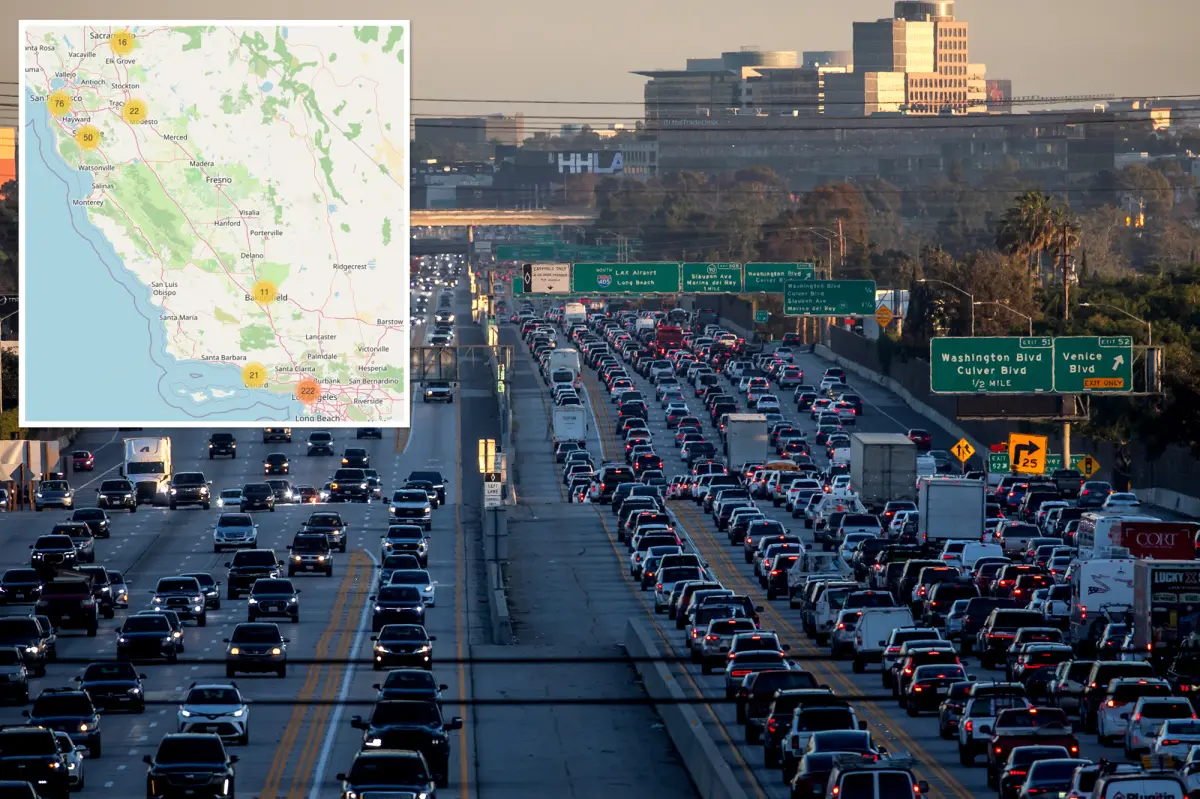
A newly released California traffic camera map is offering drivers a closer look at where red-light and speed enforcement cameras are being used across the state, with the heaviest clusters appearing in Los Angeles and the Bay Area.
The statewide breakdown, assembled by Ticket Snipers, identifies automated traffic enforcement locations throughout California, covering both traditional red-light cameras and the newer generation of speed safety cameras.
According to the map, the greater Los Angeles region is expected to see 139 cameras, while the Bay Area already accounts for 83. In Northern California, the listed cities include San Francisco, Oakland and San Jose.
Across Los Angeles County, camera locations are expected in several high-traffic communities, including Koreatown, West Hollywood, Pico-Robertson and Long Beach.
Malibu has also recently added cameras along Pacific Coast Highway, part of a broader push to reduce speeding on the scenic but notoriously hazardous coastal route.
The map also highlights red-light camera locations spread across multiple California cities.
Ticket Snipers reports 25 red-light cameras in San Francisco, 18 in San Jose and 16 in Sacramento. Modesto and Merced together account for 22 cameras, while Redding has 12 and Chico has five.
In Southern California and the Central Valley, the map lists 11 red-light cameras in Bakersfield, 21 in Ventura, 71 in Los Angeles and 12 in Orange County. Solana Beach and Del Mar have five combined.
Automated traffic enforcement is expanding in California as cities turn to cameras to monitor dangerous roads and intersections and, officials say, reduce crashes and speeding.
The technology allows authorities to issue citations based on evidence captured by cameras rather than requiring a police officer to pull over a driver.
Speed cameras use radar or lidar technology to detect vehicles traveling above the posted speed limit and photograph their license plates.
The expansion comes as Los Angeles prepares for one of the largest speed-camera programs in the state.
The city plans to install 125 cameras, with citations expected to begin this fall, according to the Los Angeles Department of Transportation.
Under the city’s program, civil penalties start at $50 for drivers traveling 11 to 15 mph over the speed limit. Fines increase to $100 for speeds 16 to 25 mph over the limit and $200 for going at least 26 mph over. Drivers traveling more than 100 mph can face a $500 penalty.
The cameras were authorized under Assembly Bill 645, which Gov. Gavin Newsom signed in 2023. The law created a five-year pilot program allowing Los Angeles, San Francisco, Oakland, San Jose, Glendale and Long Beach to use automated speed enforcement in certain areas, including school zones and streets with high rates of crashes.
The violations are civil penalties and do not add points to a driver’s license or affect insurance rates. The law also provides income-based reductions, payment plans and other alternatives for qualifying drivers.
LADOT has said the program is intended to improve safety rather than generate money for the city, and state law restricts how revenue from the cameras can be used.
San Francisco, which launched its speed-camera program in March 2025, reported an average 72% reduction in speeding at 15 monitored locations during its early rollout. Average speeds fell by four mph, according to city officials.
Oakland began installing an 18-camera network in late 2025, while other cities have been moving ahead with their own programs.
The rollout has nevertheless fueled debate among California drivers and critics of automated enforcement, who question whether the systems will primarily improve safety or become prolific ticket generators.
National Motorists Association policy director Jay Beeber, who helped campaign against Los Angeles’ former red-light camera program, has argued that automated enforcement programs can shift their focus from safety to revenue.
“The biggest problem with these programs is that they always devolve into a revenue generation program as opposed to a safety program,” Beeber previously told The California Post.