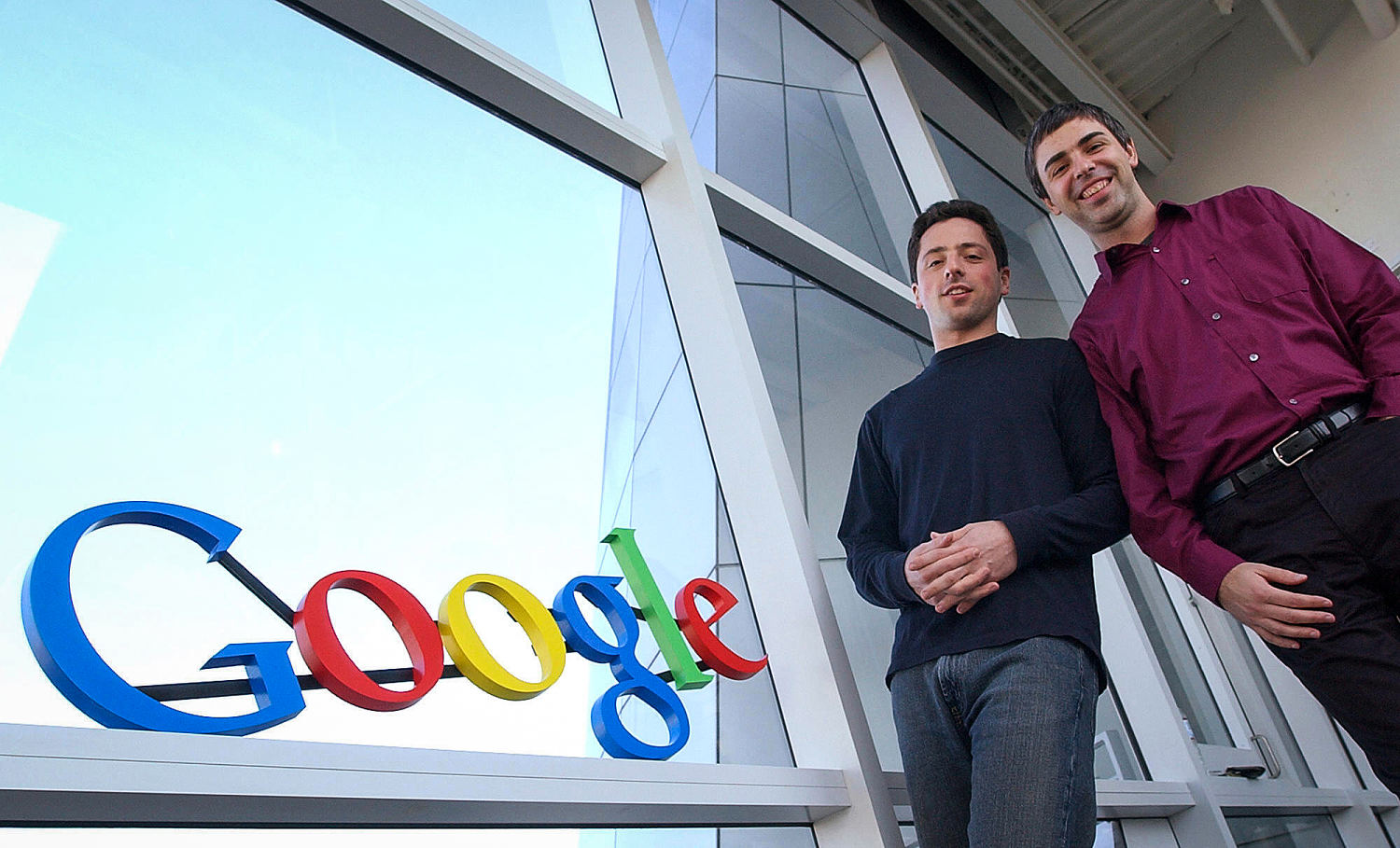
SAN FRANCISCO — Google co-founders Larry Page and Sergey Brin loved pulling pranks, so much so they began rolling out outlandish ideas every April Fool’s Day not long after starting their company more than a quarter century ago. One year, Google posted a job opening for a Copernicus research center on the moon. Another year, the company said it planned to roll out a “scratch and sniff” feature on its search engine.
The jokes were so consistently over-the-top that people learned to laugh them off as another example of Google mischief. And that’s why Page and Brin decided to unveil something no one would believe was possible 20 years ago on April Fool’s Day.
It was Gmail, a free service boasting 1 gigabyte of storage per account, an amount that sounds almost pedestrian in an age of one-terabyte iPhones. But it sounded like a preposterous amount of email capacity back then, enough to store about 13,500 emails before running out of space, compared to just 30 to 60 emails in the then-leading webmail services run by Yahoo and Microsoft. That translated into 250 to 500 times more email storage space.
Besides the quantum leap in storage, Gmail also came equipped with Google’s search technology so users could quickly retrieve a tidbit from an old email, photo or other personal information stored on the service. It also automatically threaded together a string of communications about the same topic so everything flowed together as if it was a single conversation.
“The original pitch we put together was all about the three ‘S’s” — storage, search and speed,” said former Google executive Marissa Mayer, who helped design Gmail and other company products before later becoming Yahoo’s CEO.
It was such a mind-bending concept that shortly after The Associated Press published a story about Gmail late on the afternoon of April Fool’s 2004, readers began calling and emailing to inform the news agency it had been duped by Google’s pranksters.
“That was part of the charm, making a product that people won’t believe is real. It kind of changed people’s perceptions about the kinds of applications that were possible within a web browser,” former Google engineer Paul Buchheit recalled during a recent AP interview about his efforts to build Gmail.
It took three years to do as part of a project called “Caribou” — a reference to a running gag in the Dilbert comic strip. “There was something sort of absurd about the name Caribou, it just made make me laugh,” said Buchheit, the 23rd employee hired at a company that now employs more than 180,000 people.
The AP knew Google wasn’t joking about Gmail because an AP reporter had been abruptly asked to come down from San Francisco to the company’s Mountain View, California, headquarters to see something that would make the trip worthwhile.
After arriving at a still-developing corporate campus that would soon blossom into what became known as the “Googleplex,” the AP reporter was ushered into a small office where Page was wearing an impish grin while sitting in front of his laptop computer.
Page, then just 31 years old, proceeded to show off Gmail’s sleekly designed inbox and demonstrated how quickly it operated within Microsoft’s now-retired Explorer web browser. And he pointed out there was no delete button featured in the main control window because it wouldn’t be necessary, given Gmail had so much storage and could be so easily searched. “I think people are really going to like this,” Page predicted.
As with so many other things, Page was right. Gmail now has an estimated 1.8 billion active accounts — each one now offering 15 gigabytes of free storage bundled with Google Photos and Google Drive. Even though that’s 15 times more storage than Gmail initially offered, it’s still not enough for many users who rarely see the need to purge their accounts, just as Google hoped.
The digital hoarding of email, photos and other content is why Google, Apple and other companies now make money from selling additional storage capacity in their data centers. (In Google’s case, it charges anywhere from $30 annually for 200 gigabytes of storage to $250 annually for 5 terabytes of storage). Gmail’s existence is also why other free email services and the internal email accounts that employees use on their jobs offer far more storage than was fathomed 20 years ago.
“We were trying to shift the way people had been thinking because people were working in this model of storage scarcity for so long that deleting became a default action,” Buchheit said.
Gmail was a game changer in several other ways while becoming the first building block in the expansion of Google’s internet empire beyond its still-dominant search engine.
After Gmail came Google Maps and Google Docs with word processing and spreadsheet applications. Then came the acquisition of video site YouTube, followed by the introduction of the the Chrome browser and the Android operating system that powers most of the world’s smartphones. With Gmail’s explicitly stated intention to scan the content of emails to get a better understanding of users’ interests, Google also left little doubt that digital surveillance in pursuit of selling more ads would be part of its expanding ambitions.
Although it immediately generated a buzz, Gmail started out with a limited scope because Google initially only had enough computing capacity to support a small audience of users.
“When we launched, we only had 300 machines and they were really old machines that no one else wanted,” Buchheit said, with a chuckle. “We only had enough capacity for 10,000 users, which is a little absurd.”
But that scarcity created an air of exclusivity around Gmail that drove feverish demand for an elusive invitations to sign up. At one point, invitations to open a Gmail account were selling for $250 apiece on eBay. “It became a bit like a social currency, where people would go, ‘Hey, I got a Gmail invite, you want one?’” Buchheit said.
Although signing up for Gmail became increasingly easier as more of Google’s network of massive data centers came online, the company didn’t begin accepting all comers to the email service until it opened the floodgates as a Valentine’s Day present to the world in 2007.
A few weeks later on April Fool’s Day in 2007, Google would announce a new feature called “Gmail Paper” offering users the chance to have Google print out their email archive on “94% post-consumer organic soybean sputum “ and then have it sent to them through the Postal Service. Google really was joking around that time.