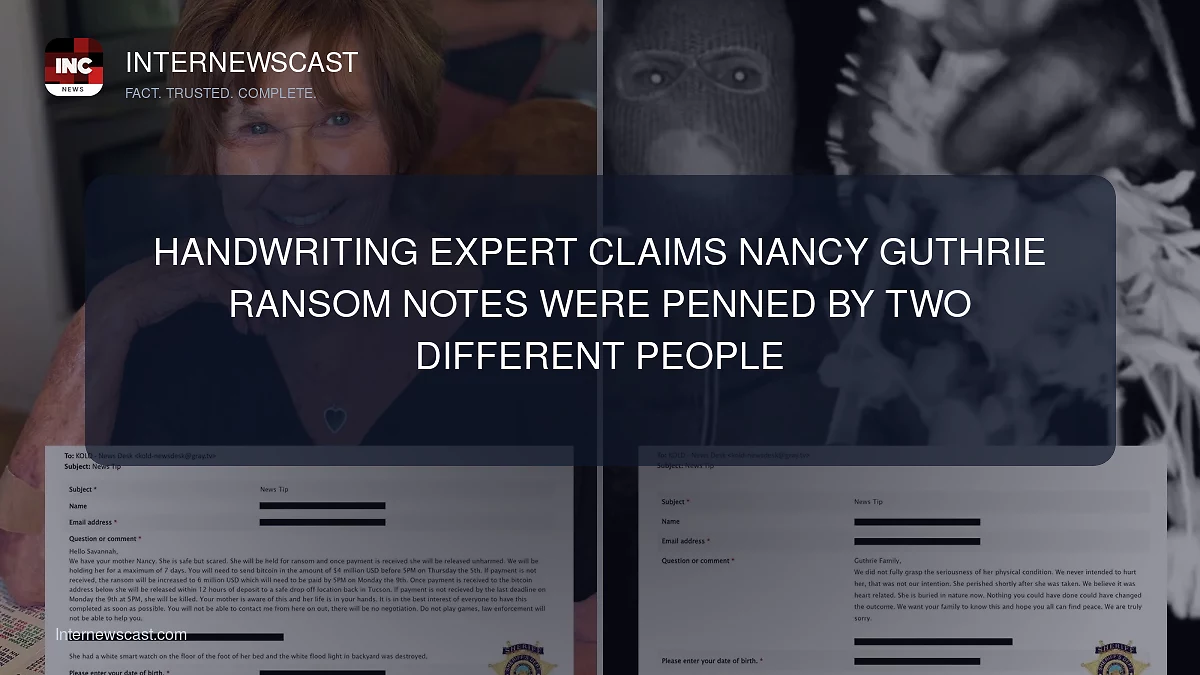

A forensic psychologist says the two ransom notes tied to missing 84-year-old Arizona matriarch Nancy Guthrie were likely not written by the masked prowler spotted lingering on her porch, raising the possibility that multiple people with conflicting motives were involved.
Gary Brucato said the first message, which sought millions of dollars in cryptocurrency, appeared to have been composed by someone intelligent and calculating. The second note, which claimed Guthrie had died and was “buried in nature,” struck him as the work of a more emotional writer.
“These two ransom notes… do suggest to me two different people who are perhaps experiencing some kind of rupture in terms of their attitude about what happened,” Brucato told NewsNation journalist Brian Entin on Friday.
Brucato said he believes the second note may have been written by a woman who possibly knew Guthrie’s daughter, TV star Savannah Guthrie, and was attempting to create distance from the case both emotionally and legally.
“When I look at the note with the modicum of sympathy and the distancing, it seems to me a risk was taken in writing that because it would’ve been written from the same place that the first one was written,” he said, calling the wording of the second message “florid.”
Brucato noted that the second message directly undermined the purpose of the first. “The first one is demanding money and the second one is undoing the ability of the first person to get money, which suggests to me that the first person would’ve been kinda mad that the second person wrote the note,” he explained.
“There’s something going on in the dynamic that’s causing a rupture and yet for some reason no one has come forward,” Brucato added.
Based on his read of the notes and the porch sighting, Brucato suspects as many as three people may be connected to the case — but he does not believe either note writer was the masked person seen outside Guthrie’s home.
“I think [it] is clear was some sort of goon that was put there to give the impression of a totally outside agent who never met this woman who came in to do the dirty work,” he said, describing the figure as “quite a cool-headed character under pressure.”
“We’ll see there was a person who did the deed, who I’ve called the waiter who served it, and I think that’s ‘porch guy,’ and behind the scenes I think there are at least two people with different psychologies and motives.”
RELATED: Australian Hiker Found Dead After Losing Contact Near Yellowstone
Brucato suspects the motive of the so-called porch guy was “probably money” but believes the author of the second note could’ve been inspired by something else, without being specific.
“It was money and something else, emotion, something that was preyed upon and the person regretted it because it all went up in smoke,” he said.
“Ultimately nobody got anything out of this. The way this is going to feel to a basically normal individual, not a psychopath, is like the way you would feel if you put all of your money into a slot machine and it went up in smoke,” Brucato added.
“I got nothing and now on top of it I’m even in more trouble than I was to begin with.”
The two notes were sent on Feb. 2 and Feb. 6. One demanded $4 million in bitcoin but also shared two details that implied some sort of familiarity with the scene of her Catalina Hills home.
The second note addressed to the Guthrie family, as opposed to Savannah, claims the kidnappers “did not fully grasp the seriousness of her physical condition.”
“We never intended to hurt her, that was not our intention. She perished shortly after she was taken,” it said, suggesting Nancy Guthrie died from a heart-related condition.
“She is buried in nature now. Nothing you could have done could have changed the outcome,” the note claimed. “We want your family to know this and hope you all can find peace. We are truly sorry.”
Guthrie’s pacemaker app disconnected at 2:28 a.m., Pima County Sheriff Chris Nanos revealed at a Feb. 5 press conference.
Nanos has vowed the case isn’t cold even though six months have passed since Guthrie’s disappearance.
He admitted that analyzing the digital and DNA evidence collected during the case has been “complex and time-intensive.”