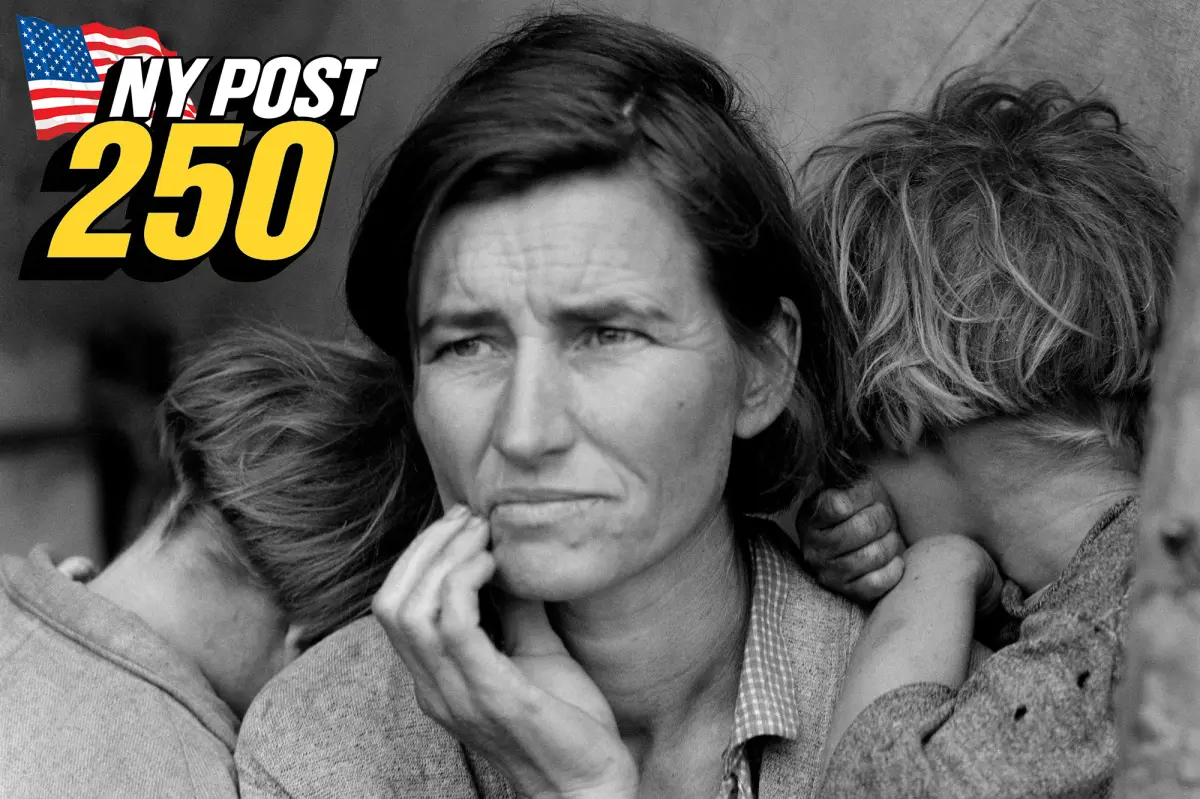

More than five years into the Great Depression, an Indiana commentator offered a mournful portrait of the American struggling to get by.
“Who is the ‘forgotten man’ in Muncie?” the writer asked. “I know him as intimately as I know my own undershirt … He is the little guy that takes odd jobs when he can get them … And there are hundreds of him in Muncie. They are the original spirit that is America.”
That “original spirit” remains central to how many Americans understand the country’s character. It is also part of why the men and women who endured the 1930s and 1940s are still remembered with reverence as “the Greatest Generation.”
They preserved that spirit through years of economic hardship that tested nearly every household. Our great-grandparents saved tin cans, worn rubber bands, balls of string and scraps of gold, tucking what little they had into mattresses. There were no 401(k)s to cushion old age. Yet those same Americans held on to hope and, in time, rallied together to defend democracy in World War II. How did they manage it?
The answer begins with the staggering conditions of 1932. One in four Americans was unemployed, and the stock market had collapsed to roughly a tenth of its former value. Into that crisis stepped Franklin Roosevelt, then the governor of New York and a figure many voters remembered from his service as assistant secretary of the Navy during World War I.
Roosevelt campaigned on a promise to lift up the “forgotten man,” whom he described as “the man at the bottom of the economic pyramid.” He called for a New Deal: an ambitious federal response meant to thaw a frozen economy and put Americans back to work.
A desperate public was ready to take that gamble. As humorist Will Rogers famously put it, “If he burned down the Capitol, we would cheer and say, ‘Well we at least got a fire started, anyhow.’”
Roosevelt did ignite plenty of change, launching programs that either helped directly or gave many Americans reason to believe help was finally on the way. Federal deposit insurance made banks feel safer for families with savings to protect. Social Security created pensions for older Americans at a time when younger households often could not support their parents. Public works and relief programs put many of the unemployed back on payrolls, even if much of that work was temporary.
But some fires the new president set did more to destroy than to thaw. It turned out Roosevelt didn’t want to aid the country’s most important economic sector, manufacturing. He wanted to take it over — personally. And did so by seeing into law a giant new bureaucracy called the National Industrial Recovery Administration.
Congress, besotted with Roosevelt’s boldness, gave him the same power over agriculture. Prices, wages, supply — all were now managed top down. The President made it clear he also had to control money, requiring all citizens hand in their private gold to the Treasury.
The chain of logic behind the takeovers of manufacturing and farming was that reducing supply of goods, or grain, would raise prices and thereby restore the economy. That argument defied common sense. The gold collection sounded like “monetary management” — i.e., respectable — but was simple expropriation. When businesses or individuals complained, the New Dealers prosecuted or scapegoated them. The icon of ’20s prosperity, former Treasury Secretary Andrew Mellon, spent the 1930s in court.
The result was economic disaster. Mandated to pay a New Deal minimum wage they could not afford, struggling companies paid that wage to the workers on their shrunken payrolls — but refused to hire or rehire. Roosevelt’s farming experts insisted that farmers destroy their own crops. In the South, farmers had a hard time getting their mules, so carefully trained to walk between cotton rows, to trample the plants. The mules balked.
ALSO READ: Unmasking the Church: Hugh Jackman's Faith and Emily Watson's Chilling Accusations
The mules could not talk back. But citizens did.
After millions of piglets were slaughtered, a disconcerted housewife wrote the Agriculture Secretary, Henry Wallace: “It just makes me sick all over to think how the government has killed millions and millions of little pigs.” The policy backfired, driving prices so high that pork became unaffordable. As the writer noted, “we poor people cannot even look at a piece of bacon.”
The Supreme Court also talked back, throwing out both the NIRA and its agricultural corollary, the Agricultural Adjustment Administration. Roosevelt reacted by finding new ways to impinge, including the 1935 passage of a strong pro-union law, the Wagner Act. Still-strapped companies paid the higher wages Washington-backed unions demanded. And, once again, refused to hire up.
Uncertainty over currency and property stalled market recovery. Some voters were beginning to assume they would be “forgotten men” forever, as in the Muncie writer’s comment.
Yet come election year 1936, Republicans did not offer an alternate to the Democrat Roosevelt; the GOP candidate, Alf Landon, put forward a program that looked like New Deal Lite. Voters were now the frozen ones — frozen in panic. With joblessness still over 10%, they stuck with what they knew and reelected Roosevelt in a landslide.
Emboldened, Roosevelt told the country that he would show businesses he was “their master.” The Depression actually deepened so dramatically in the later 1930s that people spoke of “the Depression within the Depression.” Unemployment surged to 15%. The pessimism stemmed in part from the fact that the president was waging an especially aggressive campaign against one of the few industries promising enough to fuel recovery: utilities.
It was a utilities executive, Wendell Wilkie, who managed to revive the country from its stupor. The New Deal had lulled the nation with a fallacy, “a bedtime story” of government power to cure, he said. Willkie’s common sense grew so popular that, when he ran for president in 1940, many predicted he would beat Roosevelt. And Willkie probably would have won — had not Hitler invaded Poland and sent his Heinkels and Junkers to bomb London.
Voters reckoned the old Navy hand, FDR, would be a better commander-in-chief than chief executive. He proved them correct, calling off his war on business and mounting successful campaigns in the Pacific and Europe. In 1944, following D-Day, citizens voted Roosevelt a historic fourth term.
But following Roosevelt’s 1945 passing, and victory, Americans showed they had drawn some conclusions from 15 years of experience. They now recognized the merits of collective support for a strong leader in wartime; but they also saw that, when it came to restoring prosperity in peacetime, the individual mattered more.
Voters and Congress showed their understanding first by passing a new law that undid the worst of Roosevelt’s destructive labor statute.
When Roosevelt’s successor, Harry Truman, tried to take over an industry — this time, it was steel — the Supreme Court quickly blocked him. And states across the land ensured there would not be another perma-president by passing an amendment to limit any commander-in-chief to two elected terms.
Stand up for the collective in war. Stand up for the individual — the true “forgotten man” — in peacetime. That’s strong wisdom, and handed down to us by an impeccable source, the Greatest Generation.
Amity Shlaes is the author of “The Forgotten Man: A New History of the Great Depression.”