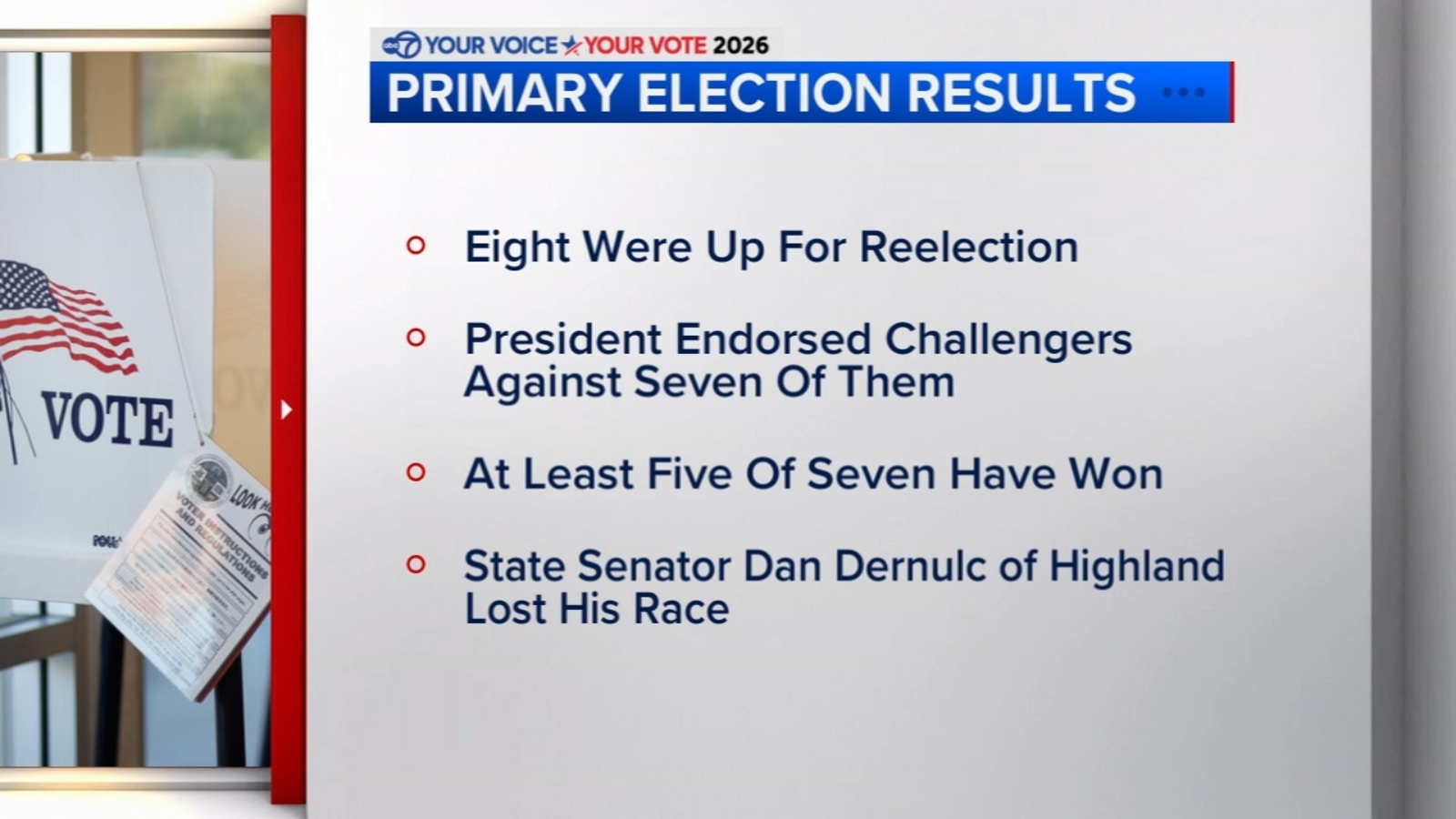
In Highland, Indiana, the political landscape shifted Tuesday as a Republican state senator was unseated by a challenger endorsed by former President Donald Trump. Meanwhile, another incumbent managed to retain his seat amidst a series of primary battles that gauge Trump’s sway in this staunchly Republican state.
Blake Fiechter, bolstered by Trump’s endorsement, emerged victorious over State Senator Travis Holdman. In contrast, Senator Greg Goode successfully fended off a challenge from Brenda Wilson, who also had Trump’s backing.
ABC7 Chicago is now streaming 24/7. Click here to watch
The former president had set his sights on seven Indiana state senators who opposed the White House’s push for mid-decade redistricting. This move was aimed at enhancing Republican prospects in the upcoming midterm elections.
This internal party conflict has been both costly and unprecedented, intensifying the rift among Republicans as they head toward the critical November midterms, which will decide congressional control. Trump’s supporters have invested at least $8.3 million in these races, which typically garner little attention from the nation’s capital.
Travis Holdman, an attorney from the Fort Wayne region, has served in the Indiana Senate since 2008. Known for his composed demeanor, he chaired the Senate Republican caucus.
As voters cast their ballots on Tuesday, Holdman expressed his acceptance of the outcome, stating, “I’m at peace with however it goes.”
Indiana Lt. Gov. Micah Beckwith said the primary is about how far the party will go to get an edge over Democrats – a contest between “the Republicans who tend to want to avoid the fight and the Republicans who feel like we need to fight.”
“So the only question is, ‘Will you fight or will you get trampled by the other side?’” said Beckwith, who is supporting the Trump-backed challengers.
Indiana rejected Trump on redistricting
Trump began leaning on Republican-led states last year to redraw their congressional maps to make it easier for his party to hold its thin majority in the U.S. House. Although redistricting is normally done once a decade, after a new census, Trump wanted to abandon tradition to gain a political edge.
Texas was the first to follow through, and the White House pressured Indiana to go along too. Vice President JD Vance met with state politicians in Washington and Indianapolis, and Trump weighed in by conference call.
However, Indiana senators rebuffed the effort, one of the president’s first significant political defeats of his second term.
The redistricting fight divided Republicans in Indiana, a state Trump won three times by no less than 16 points. Republican Gov. Mike Braun, U.S. Sen. Jim Banks and organizations such as Turning Point Action have worked alongside Trump to unseat the incumbents.
Jim Bopp, a prominent Indiana attorney who leads a political action committee aligned with Braun, predicted that Trump’s support will carry the day for the challengers.
“Republican voters overwhelmingly support Trump, and when they find out Trump has endorsed a particular Senate candidate, they swing their support behind them,” he said.
Voters had mixed views on Trump’s involvement
In Columbus, Ronda Millig voted for Trump-backed challenger Michelle Davis over redistricting opponent state Sen. Greg Walker.
“I really believed some of the things I had heard about him,” said Millig, a retiree. “It didn’t seem like he was someone I wanted in office.”
But Milling did not say that Trump’s endorsement was the deciding factor.
“That doesn’t always mean anything,” she said.
Emily Bohall Board, also voting in Columbus, said she had never voted in a Republican primary before Tuesday. But the redistricting influenced her to vote for Walker.
“Greg Walker is the only option not supported by Donald Trump, and I have been very upset about everything Trump has done,” said Board, who is 37 and an occupational therapist.
Madison Long, who is 28 and a lawyer, who also voted for Walker, criticizing Davis for her ties to Trump.
“She doesn’t have any promises of her own or any agenda of her own. Her goal is to just follow Trump,” Long said. “I find that extremely concerning given the nature of the nationwide politics.”
Indiana opposition came from constituents, former governor
Former Republican Gov. Mitch Daniels, who had stepped away from politics after leaving the governorship in 2015, reemerged to help raise money for targeted incumbents.
The senators who broke with Trump said they were listening to constituents who were overwhelmingly against his redistricting plan. Some said they didn’t like Trump’s aggressive tone in pushing the plan.
“We hate to be told what to do,” said Mike Murphy, a former Republican state representative. “We’re very independent-thinking people. So when Donald Trump and his goons come in and try to tell us that we need to redistrict to help his political future, that’s the worst thing you can do.”
He said Trump and those spending big money to take out the incumbents don’t understand Indiana politics.
“There’s just so many misjudgments on people’s part because they tend to fly at the 50,000-foot level, and they don’t go to the barbecues and the church fish fries and the things that make Indiana politics,” Murphy said.
Bopp, who supports the Trump-backed challengers, said the primary is a chance for Indiana Republicans to express how important it is to redraw the congressional lines there.
“It’s not a matter of Trump’s power,” Bopp said. “It’s about Republican primary voters who support his agenda and don’t want a Democratic House that will be hugely destructive to the Trump presidency and the country.”
Voters going to the polls in Highland, Indiana had a long list of candidates to vote for up and down the ballot. Like most places, cost-of-living issues are top of mind.
“I’m 85 years old, and I always vote. Because I think it’s important to get the people in that I know are going to do a good job,” Indiana voter Mary Ann Kenders said.
Incumbent Dan Dernulc is facing a primary challenge from businessman Trevor De Vries, who is endorsed by Trump.
“Midterms are coming up, and people want to read the tea leaves and want to use this in a bellwether,” Notre Dame professor Joshua Kaplan said.
And while few national resources have been put into these opponent’s campaigns, political science professor emeritus Kaplan says, Trump-aligned political action committees have gone all in.
“Normally you’d see $100,000. We’re seeing millions being poured into these races,” Kaplan said.
On Truth Social, Trump weighed in, saying “Good luck to those Great Indiana Senate Candidates who are running against people who couldn’t care less about our Country, or about keeping the Majority in Congress.”
Republican voter Eric Parker didn’t say who he voted for.
“I guess it’s everybody’s aspiration to have Trump endorse you. Maybe it is, maybe it isn’t. That’s not why I would vote for someone,” Parker said.
ABC7 Chicago’s Michelle Gallardo contributed to this report.
Copyright © 2026 by The Associated Press. All Rights Reserved.


