
Early Saturday morning, Long Island Rail Road (LIRR) employees, part of the largest commuter rail network in the United States, launched a strike, causing over 330,000 daily commuters to seek alternate travel options.
At precisely 12:01 a.m., around 3,700 LIRR workers, represented by five unions that include ticket clerks, locomotive engineers, signalmen, electricians, and machinists, stopped working. This marks the fourth strike in the rail line’s history.
The LIRR announced that services are currently halted and will remain so until further notice.
“Please avoid nonessential travel and work remotely if you can,” the railroad advised. “We will provide limited shuttle bus services on weekdays for essential workers and those unable to work from home.”
A sign at New York’s Penn Station warned travelers of the impending Long Island Rail Road strike on Thursday, May 14, 2026. (AP Photo/Seth Wenig)
Kevin Sexton, the national vice president of the Brotherhood of Locomotive Engineers and Trainmen, reported that no new negotiation sessions have been arranged.
“We’re far apart at this point,” Sexton said. “We are truly sorry that we are in this situation.”
MTA Chairman Janno Lieber said the agency “gave the union everything they said they wanted in terms of pay” and claimed it appeared union leaders had intended to strike all along.
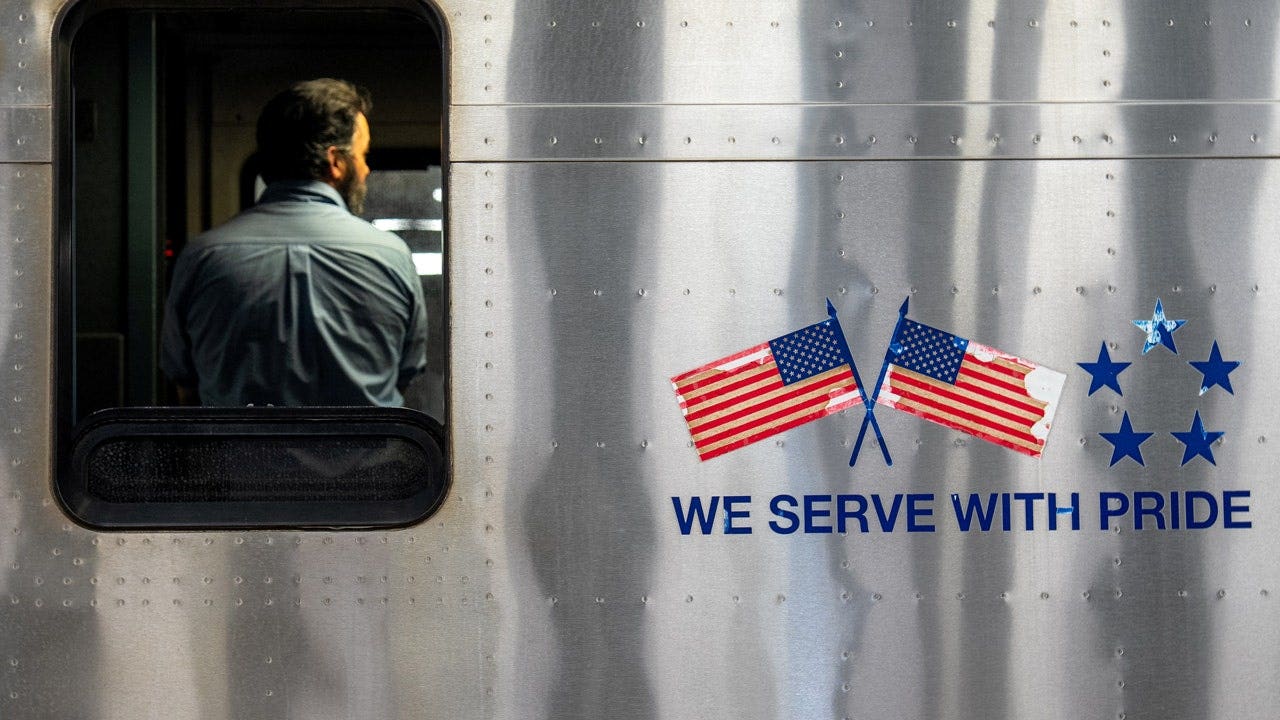
A conductor stands in a train of the Long Island Railroad (LIRR), the nations largest commuter train system, ahead of a possible strike by railroad workers in Penn Station, New York City, U.S., May 15, 2026. (REUTERS/David Dee Delgado)
Leading up to the strike, unions and the Metropolitan Transportation Authority (MTA) negotiated a new contract that included work-rule changes and annual wage increases of 3% over three years.
The dispute centered on a proposed fourth-year wage increase, with unions seeking a 5% raise for the final year.
MTA officials said they could not meet that demand and warned it could force fare increases.
New York Gov. Kathy Hochul called the Long Island Rail Road strike “reckless” and “unacceptable.” (David Dee Delgado/Getty Images)
The agency also warned the shutdown would cause severe congestion and delays across the region.
As part of its contingency plan, the MTA said it would operate limited weekday shuttle bus service during peak commuting hours between select Long Island locations and subway stations in Queens.
New York Gov. Kathy Hochul described the strike as “reckless” and “unacceptable.”
“Commuters are dealing with unnecessary dysfunction and thousands of union LIRR workers are being forced to go without a paycheck because of decisions made by a small group of union leaders,” she said in a statement. “I stand with LIRR riders and will fight to preserve the long term stability of the MTA.”
“I believe a deal can be done and I urge both the MTA and these unions to return to the table and bargain non-stop until a deal is reached,” she added.
Hochul also blamed the disruption in part on the Trump administration, saying federal officials cut mediation efforts short and pushed negotiations closer to a strike.

New York Gov. Kathy Hochul spoke during a news conference at the WIN NYC family shelter on March 5, 2026, in New York City. (Adam Gray/Bloomberg via Getty Images)
New York City Mayor Zohran Mamdani said his office was helping coordinate contingency efforts.
“New Yorkers should prepare for heavier-than-usual traffic, crowded transit options and additional travel time,” he wrote in a post on X. ”The MTA has announced that limited weekday bus service will be available for essential workers and others who cannot telecommute.”
The first LIRR strike occurred in 1980 and lasted two days. Another strike in 1987 lasted 11 days, while a third strike in 1994 lasted two days.
<!–>
–>