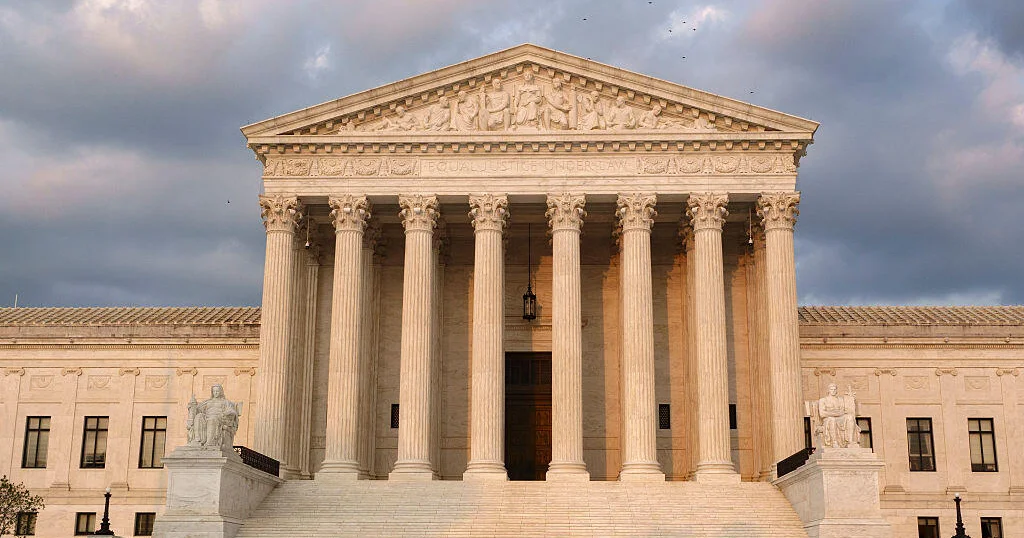
A federal judge ruled Tuesday that Missouri may, at least for now, proceed with a newly drawn congressional map that benefits Republicans. The order came just hours after the U.S. Supreme Court declined to disturb a Missouri Supreme Court ruling that had directed the state to use its previous congressional districts.
The nation’s highest court rejected an appeal from Missouri officials seeking to implement new congressional boundaries backed by President Trump for the November election. The move was a setback for Republicans, who had viewed the revised Missouri congressional map as a potential boost in their effort to protect a narrow U.S. House majority. By leaving the state court’s decision intact, the justices allowed to stand a ruling that said the new districts could not be used in November because they had been overtaken by a citizen petition calling for a statewide vote.
Soon afterward, however, U.S. District Judge Stephen Clark issued a temporary restraining order in a separate lawsuit challenging the Missouri Supreme Court’s decision. Clark wrote that the plaintiffs would otherwise suffer “irreparable harm,” noting that “many Missouri voters would have to cast their general-election votes for candidates whom they had no role in nominating.”
The dueling court actions have deepened uncertainty over which Missouri congressional districts will govern the November elections.
The new U.S. House map, approved by the Republican-led state legislature last year, would significantly reshape Democratic Rep. Emanuel Cleaver’s long-held Kansas City-area district and make it more favorable to GOP candidates.
Missouri used the new congressional districts during the August primaries. But the Missouri Supreme Court ruled last week that the state must return to the map adopted after the most recent census.
Republican state Attorney General Catherine Hanaway, who took the fight to the U.S. Supreme Court, argued that changing district lines between the primary and general elections would violate voters’ federal rights. She also warned that such a shift would create widespread confusion for election officials and voters alike.
“A federal-election-administration disaster is unfolding in Missouri,” Hanaway wrote in her emergency request asking the Supreme Court to pause the state court ruling. She cautioned that the dispute could trigger “unprecedented chaos” and make the primary “utterly pointless.”
She continued: “Looking forwards, the State is genuinely unsure whether it can switch its governing congressional map in time to run a timely federal election.”
Richard Von Glahn, who sued over the new maps, urged the U.S. Supreme Court not to intervene, writing that the state “waited as long as possible to manufacture the present dispute over Missouri’s congressional districting map” by not moving to reject the petition for a referendum until last month.
Hanaway’s request for the U.S. Supreme Court to step in was rejected by Justice Brett Kavanaugh on Tuesday.
Missouri currently is represented in the House by six Republicans and two Democrats who were elected under districts that Republican state officials approved in 2022.
But at Mr. Trump’s urging, Missouri Gov. Mike Kehoe called the Legislature into a special session last year to redraw congressional boundaries to their advantage ahead of the midterms.
The revised map targeted the 5th Congressional District, held by Cleaver. It reassigned portions of Kansas City to two neighboring districts represented by Republicans and stretched the remainder of Cleaver’s district far eastward into rural Republican areas.
Cleaver was unopposed in the Democratic primary. State Sen. Rick Brattin won the Republican primary in the reshaped district.
On the same day as the primary, Republican Secretary of State Denny Hoskins rejected a petition with thousands of signatures seeking to force a November referendum on the map. Hoskins asserted that Missouri’s Constitution doesn’t allow a referendum on congressional redistricting. A lower court agreed, but the state Supreme Court reversed Hoskins’ decision.
The state’s top court said the new districts were retroactively frozen in December, when the petition signatures were submitted, and thus never became law. Hoskins on Tuesday assigned the redistricting referendum as Proposition A on the November ballot, in compliance with the state court order.
The Missouri Constitution does not specifically say that a referendum can be used for congressional redistricting. But the state Supreme Court said a constitutional provision allowing a referendum on “any act” of the Legislature encompasses congressional redistricting legislation.
Missouri was the second Republican-led state, after Texas, to respond to Mr. Trump’s call last year to redraw congressional districts. Several other states followed. All told, Republicans had hoped to win as many as 16 additional seats from new House maps enacted in eight states — Texas, Missouri, North Carolina, Ohio, Florida, Tennessee, Louisiana and Alabama.
Democrats, whose counterattack faced several setbacks, think they could win up to six additional seats from new districts in California and Utah.
It remains to be seen whether the redistricting works as intended for Republicans. The president’s party historically has lost congressional seats in the midterms, and Mr. Trump’s poor approval ratings could provide an extra hurdle for Republican candidates.