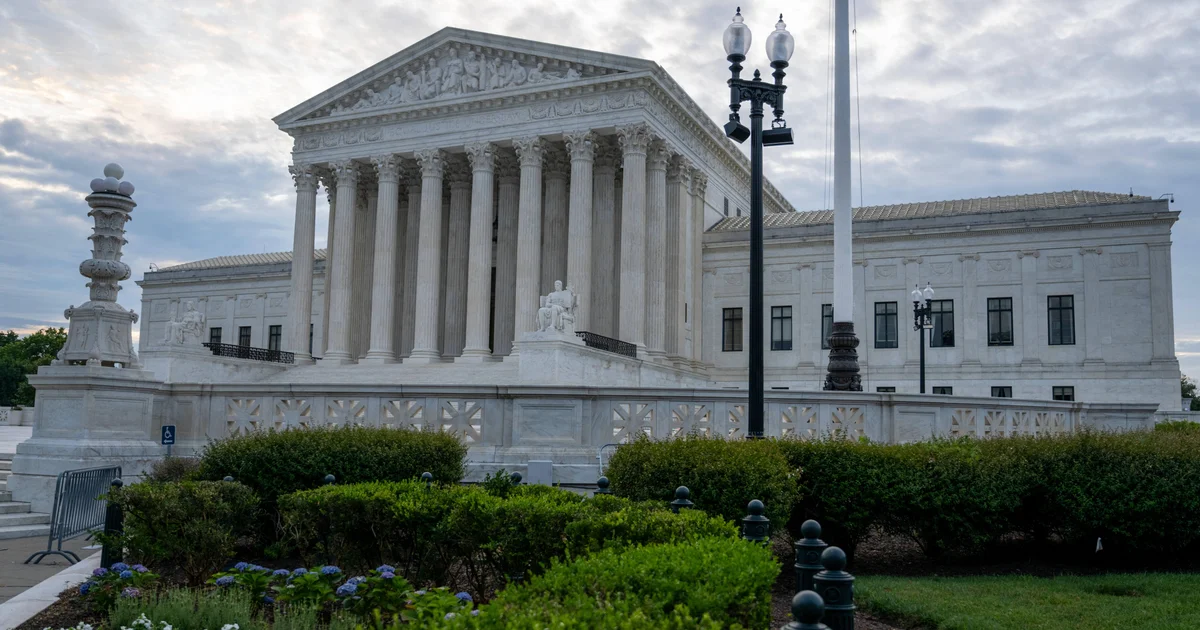
Washington — The Supreme Court on Thursday invalidated a Hawaii law that barred concealed-carry permit holders from taking firearms onto privately owned property that is open to the public.
In a 6 to 3 decision in Wolford v. Lopez, the justices ruled in favor of gun owners and a gun-rights organization that challenged Hawaii’s limits on where licensed individuals may carry firearms, arguing the rule violated the Second Amendment.
Hawaii’s law required people with concealed-carry permits to obtain consent before bringing guns onto private property accessible to the public, including businesses such as gas stations, restaurants and retail stores. Writing for the court’s conservative majority, Justice Samuel Alito said the restriction “hobbles what the Second Amendment protects: the right of Americans to carry arms for self-defense as they go about their daily lives.”
“The Hawaii law at issue here violates the constitutional right to keep and bear arms,” Alito wrote.
The decision marks another victory for gun-rights advocates following the Supreme Court’s 2022 decision that, for the first time, recognized a constitutional right to carry a firearm outside the home.
That 2022 ruling established a new test for courts reviewing gun regulations, requiring the government to demonstrate that a restriction is consistent with the nation’s historical tradition of firearm regulation. The Supreme Court first applied that framework in 2024, when it upheld a federal law prohibiting people subject to domestic violence restraining orders from possessing firearms.
Last week, in a separate case involving a federal gun restriction, the court said the government cannot automatically disarm people who regularly use marijuana if they are not shown to be dangerous.
Thursday’s ruling does not affect Hawaii’s other firearm restrictions, including bans in locations such as bars, beaches and parks, which were not before the court. It also leaves untouched limits on guns in sensitive places such as schools and government buildings.
In a dissenting opinion by Justice Ketanji Brown Jackson, joined by Justice Sonia Sotomayor, Jackson argued the case is not about gun rights, but rather property rights, since there is no constitutional right to enter private property without permission. Jackson accused the Supreme Court’s majority of manipulating its 2022 Second Amendment decision “into a free-for-all that lets the judiciary thwart the will of legislatures by privileging access to firearms above all else.”
“Today’s decision makes one thing clear: the court’s objective is protecting guns, not consistently preserving any principle of law,” Jackson wrote.
Justice Elena Kagan authored her own dissent, saying that Hawaii’s law is similar to colonial and founding era laws that barred carrying of firearms onto private property without the owner’s consent.
Hawaii’s law, which has been dubbed the “vampire rule,” requires armed concealed-carry permit holders to seek permission before entering private property that is open to the public. Carrying a gun without that permission is a misdemeanor that is punishable by up to one year in prison.
Hawaii is one of five states with laws presumptively restricting carry by license-holders on private property, though similar measures in New York, California and Maryland have been blocked by courts. In the remaining 45 states, licensed handgun owners can generally carry arms onto publicly-accessible private property.
The limits on the places people in Hawaii could bring their firearms were signed into law following the Supreme Court’s 2022 landmark gun rights decision.
The dispute dates back to 2023, when three Maui County residents and the Hawaii Firearms Coalition challenged the state’s default rule as a violation of the Second Amendment. A federal district court sided with the challengers, finding Hawaii’s restriction likely violates the Second Amendment as applied to property that is accessible to the public.
But after the state appealed, the U.S. Court of Appeals for the 9th Circuit upheld Hawaii’s law.
The Trump administration backed the gun owners in the case and argued that the measure was “blatantly unconstitutional” and effectively prevented public carry, as any armed permit holder risked committing a crime simply by stopping to put gas in their car or running errands at a grocery store.
The Supreme Court heard arguments in the case in January and appeared likely to side with the gun owners.