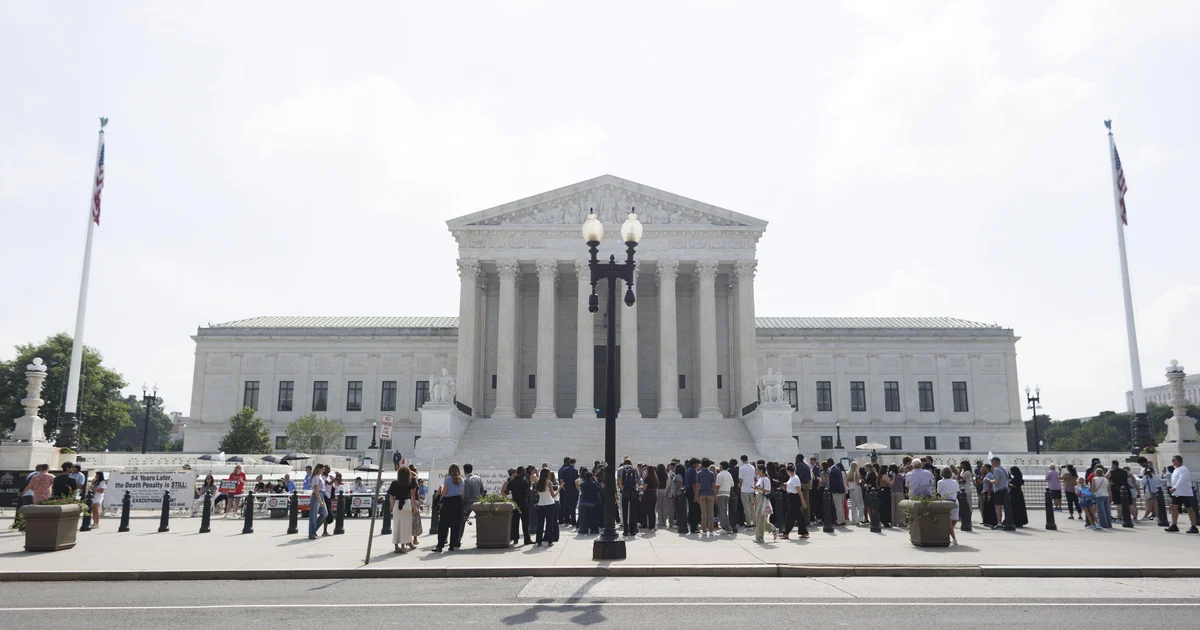

Washington — Last summer, amid a wave of lawsuits challenging major elements of President Trump’s agenda, the Supreme Court handed down a pivotal ruling limiting federal judges’ power to issue broad orders that halted enforcement of his policies nationwide.
Those nationwide injunctions, which applied beyond the specific plaintiffs in a case, had become a source of frustration not only for Mr. Trump, but also for President Joe Biden before him. Biden’s Justice Department had urged the Supreme Court to examine whether such expansive orders were lawful.
The justices ultimately took up the issue in Trump v. CASA, concluding that nationwide — often called universal — injunctions likely went beyond the authority Congress gave the federal judiciary.
The decision by the court’s conservative majority drew sharp backlash, including from its liberal justices. Justice Sonia Sotomayor, writing the main dissent, cautioned that the ruling “renders constitutional guarantees meaningful in name only for any individuals who are not parties to a lawsuit.” Justice Ketanji Brown Jackson described the outcome as an “existential threat to the rule of law.”
Yet in the year since the Supreme Court narrowed the availability of nationwide injunctions, the effects have not appeared as dire as opponents predicted. Instead, challengers confronting a more complicated legal environment have increasingly relied on other tools to seek broad relief from district courts reviewing the legality of Mr. Trump’s policies.
“The landscape is complicated. There are a lot of moving parts,” said David Marcus, a law professor at UCLA. “There has been real success after Trump v. CASA of plaintiffs turning to the class-action option in ways the justices anticipated. But there have also been some interrelated legal developments … If you look at where things are June 2026 relative to June 2025, it is absolutely true that federal district court power is more bounded than it was a year ago.”
Class-action suits
One alternative path — class-action litigation — was deployed within hours of the Supreme Court’s June 2025 ruling. Shortly after the decision was released, attorneys for the American Civil Liberties Union filed a class-action challenge to Mr. Trump’s executive order on birthright citizenship.
Within two weeks, U.S. District Judge Joseph Laplante in New Hampshire provisionally certified a class covering all babies born after Feb. 20, 2025, who would fall under the president’s directive limiting birthright citizenship. He then barred the Trump administration from enforcing the order against that group.
As a result of Laplante’s order and at least one other decision from the U.S. Court of Appeals for the 9th Circuit, which maintained the nationwide injunction in a case brought by four states, Mr. Trump’s birthright citizenship plan never took effect.
The case from New Hampshire then landed before the Supreme Court, which struck down the president’s directive late last month as unlawful.
“For many of the cases challenging Trump administration policy, the class-action has proven a viable, effective and entirely appropriate way to get broad relief in the manner that plaintiffs were getting using the nationwide injunction before Trump v. CASA,” said Marcus, who has argued that cases that led to nationwide injunctions could proceed as class actions.
Those types of lawsuits have been brought to challenge several of the president’s immigration policies, including the revocation of temporary deportation protections for immigrants from Honduras, Nepal and Nicaragua, and his invocation of the wartime Alien Enemies Act to summarily deport Venezuelan migrants who the administration says were alleged gang members.
A federal judge in late December found that the administration’s termination of the TPS programs for Nepal, Honduras and Nicaragua was unlawful under a federal law known as the Administrative Procedure Act, and nullified the Homeland Security secretary’s termination decisions.
That law, which governs the agency rulemaking process, has also emerged as a key mechanism for groups suing the Trump administration and seeking broad relief. The Administrative Procedure Act authorizes courts to “hold unlawful and set aside agency action” that is found to be arbitrary or capricious or exceeds its authority, among other factors.
In a concurring opinion in the case involving nationwide injunctions, Justice Brett Kavanaugh highlighted the Administrative Procedure Act as an alternative for plaintiffs, writing that they could ask a court to “preliminarily ‘set aside’ a new agency rule.”
Plaintiffs have followed Kavanaugh’s advice.
In a decision earlier this month, a federal judge in Massachusetts ruled the Trump administration’s policy imposing a $100,000 fee on new H-1B visas for high-skilled workers is unlawful and ordered it to be set aside. The judge, Leo Sorokin, said he would not “depart from the longstanding view that vacatur of an unlawful agency action is a proper remedy under the APA.”
A complicated legal landscape
While groups that frequently face off against the Justice Department in court have found success in broadly halting administration policies while their cases move forward, they said it hasn’t been easy navigating the post-CASA terrain.
“The legal landscape is complicated. It takes more resources from plaintiffs’ side, advocates challenging these government abuses, these really harmful policies, and it definitely does risk inconsistent treatment nationwide,” said Lupe Aguirre, deputy director of U.S. litigation for the International Refugee Assistance Project. “Even though the APA and the class-action relief are separate avenues, not every court sees it that way.”
The Justice Department often pushes back against requests for sweeping relief and asks courts to narrow their orders to only the parties in a lawsuit. If some courts agree to do so, it can lead to limited relief when a judge finds a policy illegal, Aguirre said.
“It can be a gift to the executive,” she said. “It can wreak havoc on the rule of law when we have inconsistent orders across the country where a policy is very clearly or very likely illegal or unconstitutional.”
And backers of the Trump administration have accused judges of overstepping their authority when voiding a policy under the Administrative Procedure Act, arguing that the law doesn’t grant them that breadth of power.
After a federal judge in California blocked the Trump administration from making arrests at immigration courts nationwide, Chad Mizelle, who served as chief of staff at the Justice Department, criticized the decision.
“The APA has, for far too long, been used by judges to shutter any policy they dislike — even policy that is well within the discretion of the agency,” he wrote on X, going on to ask, “Who authorized judges to exercise this type of power? Certainly not the founders. Or the Constitution. Nor does the APA, properly understood.”
Still, in his decision halting the administration’s policy, U.S. District Judge P. Casey Pitts wrote of his remedy that “prohibiting the enforcement of the challenged policies only against particular individuals would not comply with that Congress’s instruction to ‘set aside’ the policies themselves,” citing the language of the Administrative Procedure Act.
“The administration or others can be frustrated with what courts are doing, but if it were me, I’d take a step back and say, ‘Why am I routinely violating basic administrative procedures? Why am I routinely acting arbitrarily and capriciously? Why am I routinely violating constitutional and statutory law?'” said Matt Platkin, the former attorney general of New Jersey who now represents plaintiffs in challenges to the Trump administration’s policies.
But even while the legal landscape has shifted in the last year toward class-action lawsuits and alleged violations of the Administrative Procedure Act, the Supreme Court has limited the availability of class-wide relief in at least one subset of cases: those challenging the Trump administration’s terminations of federal funding and grants.
In a decision last year that cleared the way for the Trump administration to cancel millions of dollars in federal education grants, the Supreme Court said any challenges to grant terminations must be brought in the Court of Federal Claims. But that court, Marcus said, does not have the power to certify classes.
While unrelated legally, the decisions involving nationwide injunctions and grant terminations demonstrate an effort by the Supreme Court to rein in the lower courts, he said.
“It seems anxious about federal district judges issuing these broad, group-wide remedies,” Marcus said of the high court. “And whether the justices are doing this intentionally or not, these various developments are motivated in part by concern about the breadth of district court power.”
While class-actions have been effective, he stressed these other legal shifts mean they’re not a “one-to-one exchange” with nationwide injunctions.
The Supreme Court’s decision last year restricted lower courts’ ability to issue those sweeping orders, but it did not prohibit them entirely. Instead, the high court’s majority said injunctions must be tailored to provide complete relief to the parties to a case.
In some cases, that has led judges to block implementation of certain policies against not just the plaintiffs in a case.
In legal fights over Mr. Trump’s executive order that seeks to overhaul federal elections, including by requiring documentary proof of citizenship to register to vote, at least two judges have agreed to bar the Trump administration from implementing some of its provisions anywhere in the nation.
“Given the additional harms that a dual federal election law regime would impose on the Plaintiff States, the Court concludes that a total injunction preventing Defendants from implementing [the sections] is necessary to ‘administer complete relief between the parties’ here,” U.S. District Judge Denise Casper wrote in a decision last month in a case brought by attorneys general in 19 states.