
Washington — President Trump said Sunday that he has approved a plan to transform a proposed monumental triumphal arch into a “top grade Military Complex” featuring drone storage and sniper positions.
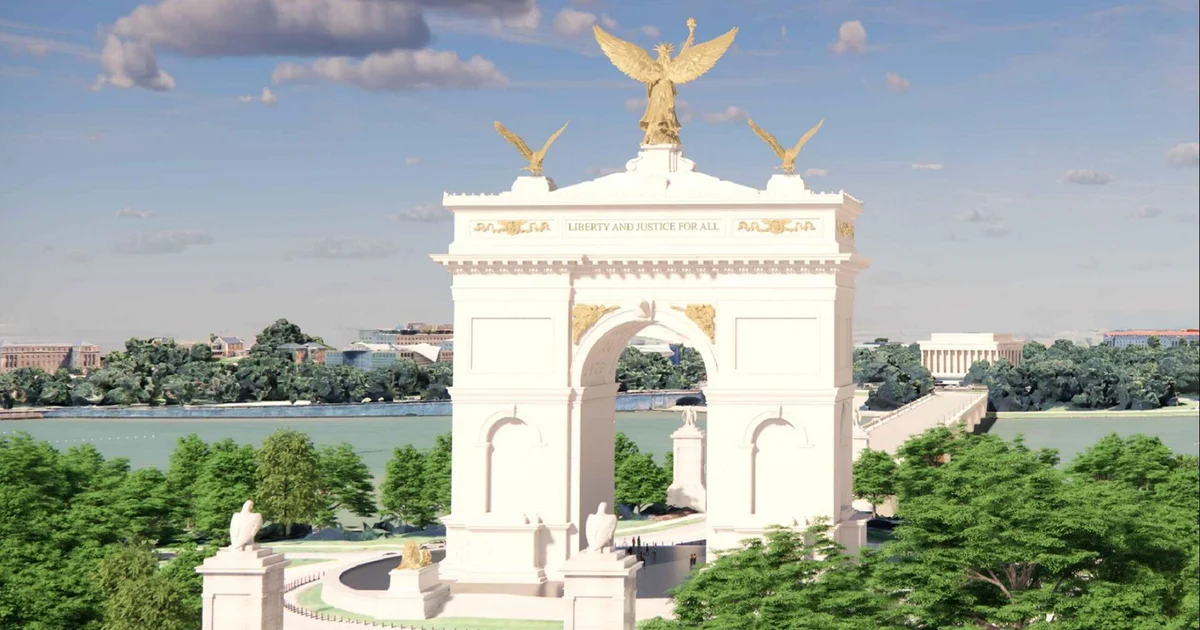
“At the strong request of the United States Military, and for National Security purposes, I have agreed to convert the magnificent Triumphal Arch, planned since the Civil War Era many years ago, at the Receptive Circle adjoining the Arlington Memorial Bridge, into a top grade Military Complex/Triumphal Arch,” Mr. Trump said in a post on Truth Social.
Construction of the 250-foot-tall arch was expected to start this month, including excavation at the site across the Potomac River from Washington, D.C., near Arlington National Cemetery. The proposed structure would be faced with granite, topped by three gold-colored statues and include an observation deck.
Mr. Trump said the project would “house, store, and have the rapid ability to use large numbers of drones, plus Snipers, on both the roof and plaza areas,” as well as maintain “large quantities of sniper ammunition in storage.”
He said the planned facility would be unlike anything else in the world.
“Out of the 59 top cities and Capitals, Washington, D.C., IS THE ONLY ONE IN THE WORLD THAT DOES NOT HAVE A TRIUMPHAL ARCH, but it will now and, by far, the greatest of them all!” he added.
The administration has described the arch as part of a wider effort by the president to leave his architectural mark on the nation’s capital. Officials have also said the project is intended to commemorate the 250th anniversary of the signing of the Declaration of Independence this year. The proposal has faced opposition, however, over concerns that the structure could disrupt views between major Washington monuments and Arlington National Cemetery. Its location near Ronald Reagan Washington National Airport has also raised questions.
The Federal Aviation Administration ruled Friday that the arch would not pose a danger to aircraft arriving at or departing from the nearby airport. The decision came despite concerns from Democratic lawmakers that the project could add to the complexity of an already congested Washington-area airspace.