Share this @internewscast.com

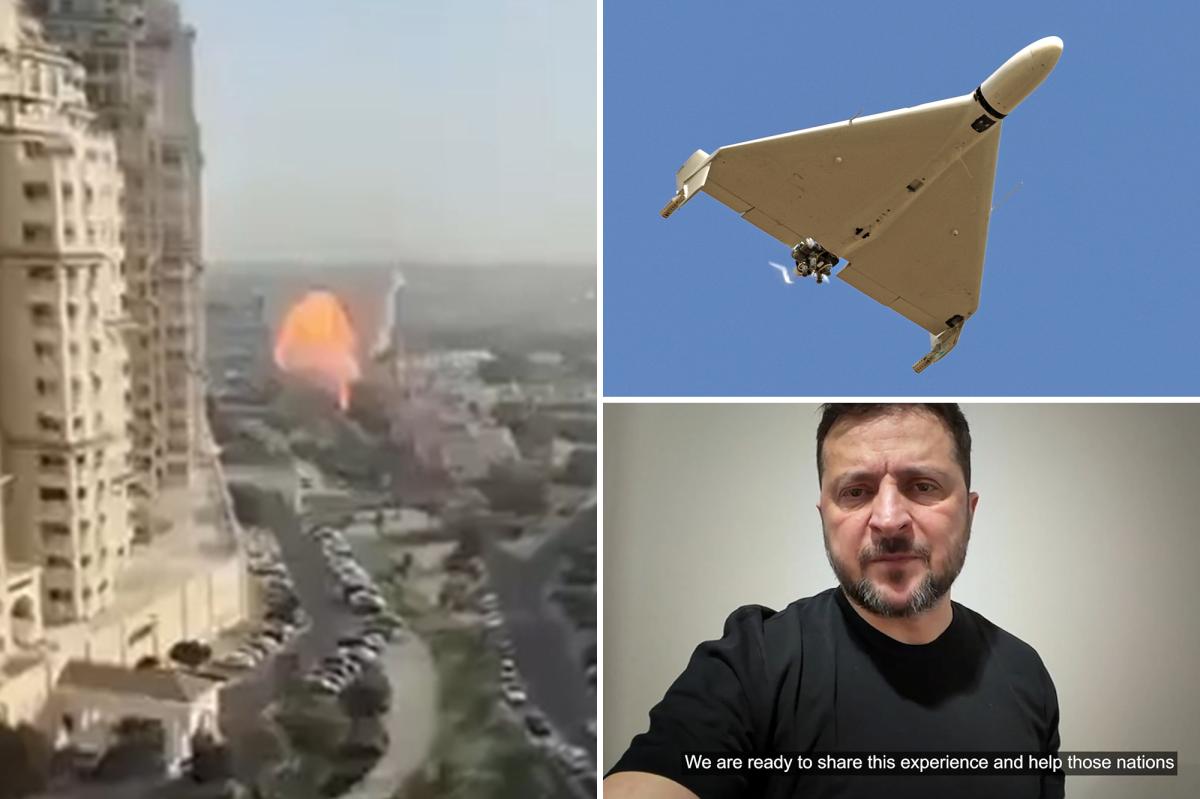
KYIV, Ukraine— As nations grapple with the increasing threat of Iranian drones, Ukraine is extending a hand to share its extensive battlefield knowledge gained through years of combat. Ukrainian President Volodymyr Zelensky has issued a stark reminder that no nation should consider itself invulnerable to the relentless drone attacks that Russia has been deploying night after night.
“The world is beginning to understand the unparalleled value of Ukraine’s defense strategies,” Zelensky stated in a message on X, emphasizing the importance of collaboration with international partners.
“We stand ready to impart our expertise and support those countries that have extended their help to Ukraine during this conflict. Our aim is to collaborate on enhancing Europe’s collective defense mechanisms,” he added.
The urgency of this offer has been underscored by recent developments. Since the conflict with Iran escalated on Saturday, following U.S. and Israeli military actions against Tehran, Iran has reportedly launched over 500 ballistic drones targeting its adversaries in the region, according to the United Arab Emirates’ Defense Ministry.
Ukraine has been confronting the Iranian drone menace since the fall of 2022, when Russia began acquiring these drones from its ally Iran, over a year into its aggressive campaign against Ukraine. Maj. Gen. Vadym Skibitskyi, deputy chief of Ukraine’s defense intelligence, shared with The Post that the use of attack drones by Moscow has surged dramatically throughout the conflict.
Initially, Russia was deploying about 30 Shahed drones per month. However, this number has increased substantially, with hundreds now being launched on a regular basis, marking a significant escalation in the drone warfare strategy.
“The largest number of UAVs that the Russian Federation used in July last year was 802,” Skibitskyi said. “It’s a huge number.”
During some nights, more than 90 drones are launched in a single wave.
Skibitskyi pointed to an overnight Sunday assault in which Russia launched 94 Shahed drones — Ukrainian forces intercepted 84 of them, with only 10 reaching their targets.
“That is the practical experience of our militaries of intercepting Shahed,” he said. “We have the expertise to know which direction, when, at what time they launch the Shaheds and which direction they fly.”
He said Ukraine’s air defenses rely on layered coordination — from mobile ground teams to anti-aircraft missiles to radio-electronic warfare — all working together.
“It should be working in complex incorporation, not by just one type,” Skibitskyi said. “All together.”
Zelensky called on Westerns nations to dramatically scale up production of air defense systems and interceptor drones, saying the continent must build “real strength” to defend its skies, land and sea.
“Europe must have enough air defense missiles, enough experience in shooting down drones, and sufficient production of modern interceptor drones,” he said. “Together, we can make this happen.”
His comments come as Russia continues to hammer Ukraine with waves of Iranian-designed Shahed drones and ballistic missiles — attacks that Ukrainian forces have learned to blunt with a patchwork of Western-supplied systems, mobile fire groups and electronic warfare.
It’s this experience that Ukraine is willing to share with partners, knocking down drone threats through three different angles: by interceptor-drones that explode in the air next to incoming Shaheds, jamming them with electronic warfare and shooting them out of the sky.
“The situation in the Middle East shows how difficult it is to provide one hundred percent protection against missiles and ‘Shahed’ drones,” Zelensky said, noting that Gulf countries with more advanced air defense systems still failed to intercept every ballistic missile and drone launched at them.
His message to the West was blunt: stockpiles and production lines must grow.
“In particular, this means building sufficient air defense production capacity — both against drones and against ballistic missiles,” Zelensky said.
Skibitskyi stressed that Ukraine is not offering to deploy troops abroad, as they must still counter the threats Russia poses to Kyiv daily, but to share the lessons it has learned under relentless fire.
“We are not saying that we are going to participate in practice,” he said. “But the shared experience — because the threat is still there.”
As Russia expands the scale and frequency of its drone attacks, Kyiv is positioning itself not only as a frontline state but as a testing ground whose hard-won expertise could shape the rest of the world’s future defenses.