
The U.S. Army said Sunday it has tested a new electronic warfare capability designed to quietly interfere with the navigation signals enemy precision weapons depend on, potentially making long-range strikes less accurate while helping U.S. forces avoid detection.
Known as “Hammer of the Gods,” the system was evaluated at sea off the U.S. West Coast for the first time in mid-July during the Project Convergence Capstone 6, or PC-C6, experiment.
The Army has demonstrated land-based versions of the technology over the past two years, but the July exercise marked the formal debut of its maritime variant, officials said.
The portable signal-disruption system is intended to impair the guidance of enemy precision weapons, including long-range artillery, guided missiles and cruise missiles.
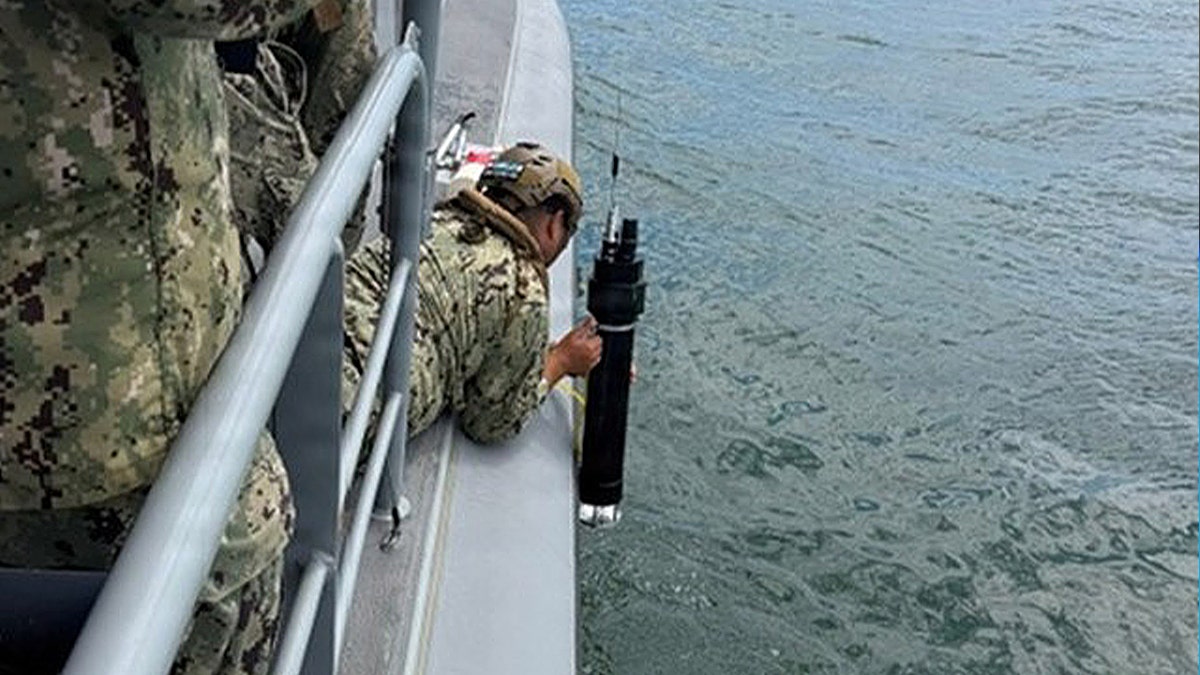
Hammer of the Gods underwent its first maritime test in mid-July. (U.S. Army)
The system targets positioning, navigation and timing signals — including GPS data — that precision-guided munitions use to stay on course and reach their targets.
When those PNT signals are degraded or denied, weapons can lose accuracy quickly, raising the chances of missed targets and delayed missions.
Army officials said the capability also helps build a more resilient communications network, allowing friendly forces to remain connected even in environments saturated with electronic jamming.
RELATED: Lindsay Clancy’s Ex-Husband to Resume Testimony on 3 Children

U.S. Army soldiers march during a military parade on Armed Forces Day in Vilnius, Lithuania, Nov. 25, 2023. (Yauhen Yerchak/SOPA Images/LightRocket via Getty Images)
It links military devices together, so troops can continue to “shoot, move and communicate” even while operating in degraded environments.
Army officials said the experiment demonstrated the counter-PNT system could be successfully launched, operated and recovered in real-world maritime environments.

Multiple U.S. Army soldiers walk behind a U.S. flag. (istock)
The testing brought together the U.S. Army, Navy and Space Force, alongside U.S. Space Forces Pacific, Naval Base San Diego and the U.S. Army Space and Missile Defense Command, to integrate space, cyber and conventional capabilities during the exercise.