
Readers of the Mail newspapers — and the reporters and editors behind them — have strong reason to welcome Mr Justice Nicklin’s ruling in the High Court yesterday.
All claims brought against the Daily Mail and The Mail on Sunday, including the highly damaging allegations aired so publicly by Prince Harry, were thrown out. There were no qualifications, no carve-outs and no exceptions. It was an emphatic victory for both titles and for the journalists who work on them.
The action against Associated Newspapers, which publishes the two papers, amounted to an attempt to portray them as villains in the court of public opinion — and, if possible, to bring them down altogether.
The 436-page judgment is therefore a significant win not only for Associated Newspapers but for the wider free Press, affirming the right of newspapers to scrutinise the conduct of the wealthy and influential, provided they operate within the law.
Those who seek to undermine that principle — along with anyone tempted to cut corners or act unlawfully — may find yesterday’s outcome gives them pause.
The print industry has endured falling circulation for the best part of 20 years, while some newspapers have struggled to adapt fully to the demands of the digital era. This ruling will provide a much-needed lift to papers across the country and to the journalists who serve them.
Yet however clear-cut the victory may be, it should not be mistaken for one won without difficulty. The legal bill on both sides has been vast — exceeding £50million — with Associated Newspapers having already paid more than half of that sum. The judge has still to decide the question of costs.
Equally significant has been the pressure the proceedings placed on many of those working at Associated. The burden fell especially heavily on the roughly 40 journalists who were required to explain their actions in court.

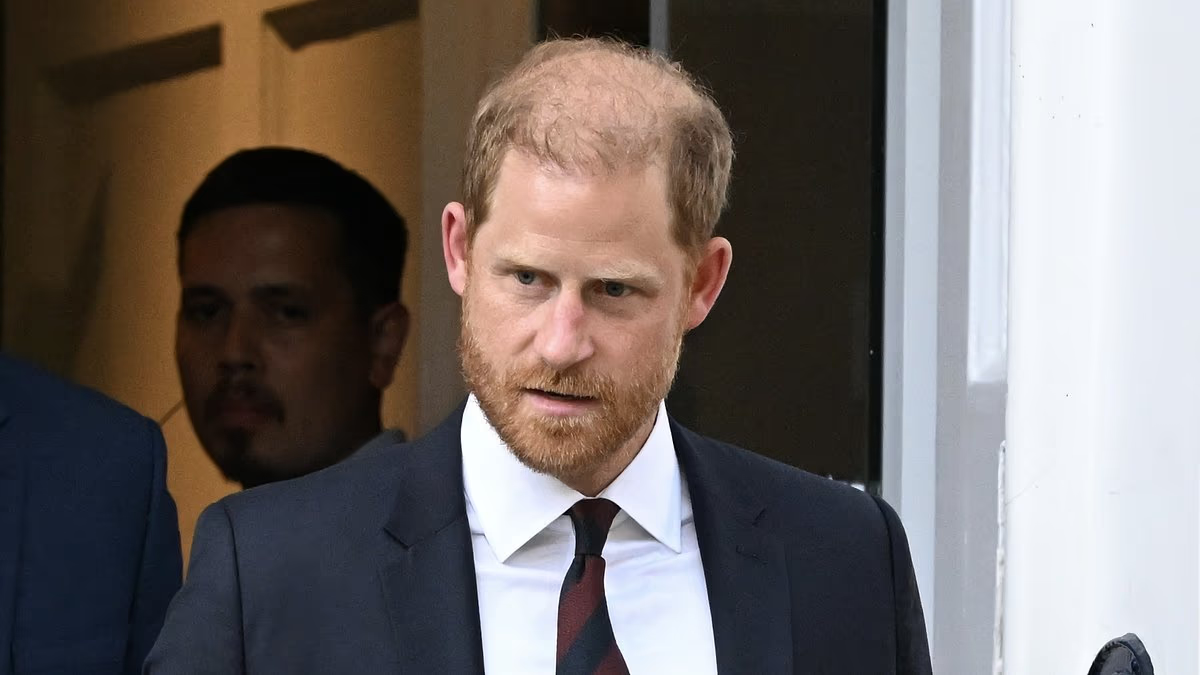
Prince Harry, who has waged a seven-year war against the Press, is likely now to desist, writes Stephen Glover

Mr Justice Nicklin singled out a number of Mail journalists for being ‘honest’ and ‘impressive’ witnesses
It is cheering, of course, that Mr Justice Nicklin should have been impressed by the integrity of these witnesses, a number of whom were singled out by him for being ‘honest’ and ‘impressive’ during the 11-week court hearing. This was a tribute to the quality of the journalists who have worked, and still work, for the Mail titles.
Among the seven claimants, by contrast, while the Judge accepted that the individual claimants were honest, they were found to have limited direct evidence in support of the claims. Only one witness – David Furnish, husband of Sir Elton John – was deemed impressive.
In fact, after the claimants’ key witness, former private investigator Gavin Burrows, withdrew an earlier statement, they had no credible evidence at all, and were reduced to making unsubstantiated allegations.
But the paucity of the evidence did not dispel the anxiety consuming many Mail journalists. They were falsely accused of career-destroying activities. Reputations were at stake.
The journalist who had most to lose, and whose considerable achievements were called into question, was Paul Dacre, the Mail’s editor from 1992 until 2018.
Along with others, Mr Dacre was accused by the claimants of having lied to the Leveson Inquiry in 2012 when he stated that the Mail titles had never taken part in phone hacking. The judge found no truth in these baseless allegations.
Probably more painful to Mr Dacre were the accusations of Doreen Lawrence, whose son, Stephen, was murdered by thugs in south London in 1993. Almost four years later, after police attempts to charge the culprits had foundered, the Mail ran its famous front page with the single headline: ‘Murderers’.
Most of the political establishment and several newspapers immediately criticised the Mail, though Lord Denning, the legendary former Master of the Rolls, described it as a ‘marvellous piece of journalism’.

Former F1 president Max Mosely also tried to damage the Mail after it revealed he was the publisher of a racist election pamphlet used by his father Oswald
RELATED: Lakeside Community’s Waterfront Homes Climb to $861,000

Baroness Doreen Lawrence outside at the High Court with friend and lawyer Imran Khan

Former Lib Dem MP Dr Evan Harris pictured outside court during the hearing
It was a measure of Denning’s greatness that he could grasp that the Mail was fighting for truth and justice by standing up for a murdered black teenager whose unprivileged parents had been failed by the police and the prosecuting authorities.
So it was a bitter pill when, for reasons that are still not clear, Baroness Lawrence joined the ranks of the claimants, accusing the Mail of targeting her with unlawful information-gathering techniques. These allegations were entirely dismissed by the judge.
All this shows the intolerable strain under which many Mail journalists, past and present, have been living as they were subjected to groundless – and also potentially ruinous – claims.
These claims did not appear out of a clear blue sky – which is why I can confidently speak of a conspiracy. A number of individuals consciously set out to damage – and preferably destroy – the Mail.
One of them was Press-hating Max Mosley, famous for winning a libel case in 2008 against the now defunct News of the World, which had accused him of orchestrating a ‘Nazi-themed orgy.’ They were right about the orgy, where blood was shed, but couldn’t prove the Nazi bit.
In 2018 the Mail was able to prove that Mosley was the publisher of a squalid racist election pamphlet used by his father, the fascist Oswald Mosley, in 1961. This revelation only increased Mosley’s determination to damage the Mail.
Suffering from terminal cancer, he shot himself in May 2021, but not before he had used some of his enormous fortune (much of it inherited from his obnoxious father) to benefit Hacked Off – the group that campaigns for state oversight of the Press.
One of the beneficiaries was Graham Johnson, to whom Mosley gave at least £565,000, some of which was used to pay witnesses against the Mail. Another was Professor Brian Cathcart, a founder member of Hacked Off, who received generous funding from Mosley to write a book.
The exact role of Hacked Off in the campaign to bring down the Mail is for another day. Suffice to say now that one of those giving evidence on behalf of the claimants, the ex-Lib Dem MP Dr Evan Harris, was once an executive director of the group. He was described by the judge as having been ‘particularly prone to reconstruction’.
The Daily Mail has triumphantly seen off its enemies in this case, but let no one suppose that they will creep away from the battlefield never to cause trouble again.
Prince Harry, who has waged a seven-year war against the Press, admittedly winning against the publishers of the Sun and Daily Mirror, is likely now to desist, although he showed remarkable ill grace yesterday in describing the judgment as an ‘obvious whitewash’.
But Hacked Off, and sympathetic voices on the Labour benches, won’t stop calling for so-called ‘Leveson Part Two’, whose objective, they hope, would be to curtail a free Press and institute some form of state control.
Indeed, Hacked Off responded to yesterday’s judgment by calling for a public inquiry. That takes some brass neck in the circumstances. However discredited the organisation and its cause may be, they won’t give up.
So vigilance should be our watchword. A decisive battle for a free Press has been won but the war will never be over. There will be other rich chancers such as Max Mosley who will want to muzzle the Press, and more celebrities who will make false accusations.
But for the moment let us be thankful to Mr Justice Nicklin for his good sense, and congratulate this newspaper’s journalists for holding the line in such trying circumstances. I am proud to be their colleague.
Read more:


