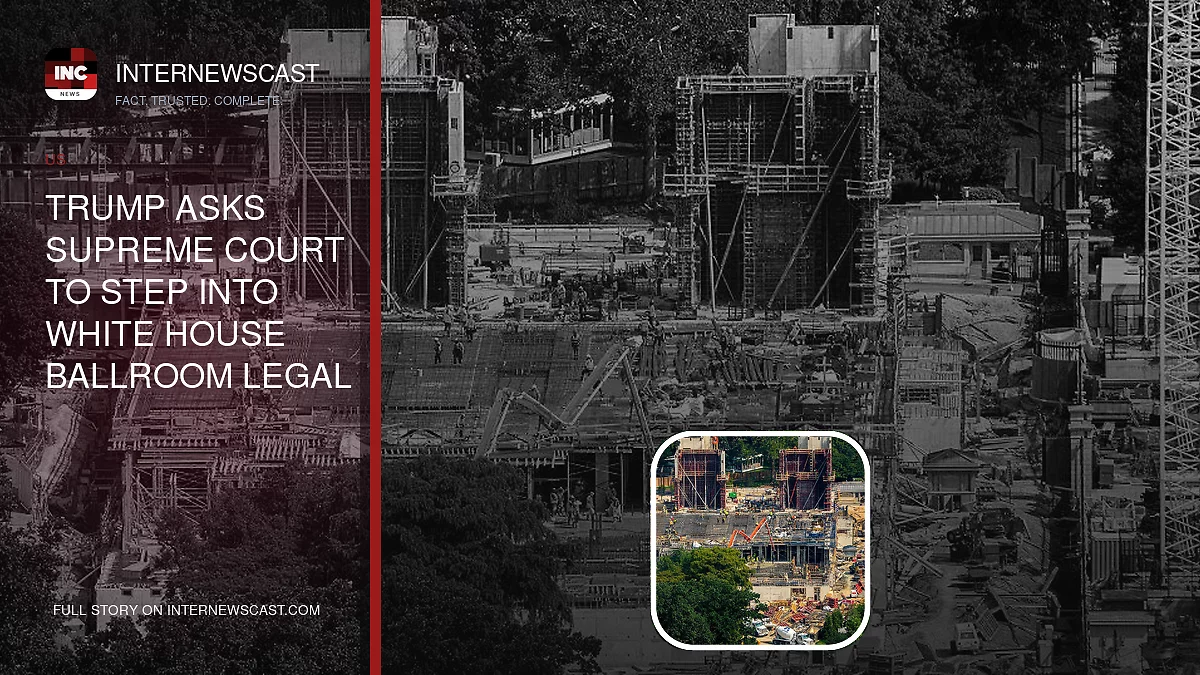

Washington — The Trump administration on Friday asked the Supreme Court to step in and clear the way for construction of a new 90,000-square-foot ballroom on the site where the White House East Wing was demolished.
The emergency appeal to the high court comes a week after a federal appeals court ruled the White House lacked authority to move ahead with the $400 million project without approval from Congress.
In a filing submitted to the Supreme Court, Solicitor General D. John Sauer urged the justices to put on hold a lower court order blocking above-ground construction while litigation over the White House renovation continues. Other parts of the plan — including an underground bunker, medical facilities and additional security-related features — have been allowed to proceed.
“This case involves an extraordinary and unlawful injunction that will halt the ongoing construction of the integrated military complex, including a totally secure ballroom space, at the East Wing of the White House, which is vitally required by national security,” Sauer wrote.
Sauer argued that the White House renovations are “absolutely required and should not be enjoined,” saying any delay could endanger President Trump in light of recent domestic and international assassination plots targeting him.
Earlier this month, a three-judge panel on the U.S. Court of Appeals for the District of Columbia agreed with the district court that the White House “very likely” did not have the legal authority to tear down and rebuild the East Wing. The judges said Congress has “full constitutional control over federal property and the funding of its maintenance and development.”
The appeals court paused its ruling for two weeks, giving the federal government time to seek Supreme Court review.
In his filing with the Supreme Court, Sauer argued that the district court’s ruling “rests on glaring errors as to Article III standing, the merits, and the equities, and creates a needless interbranch collision.”
“In upholding it, a D.C. Circuit majority wrongly viewed the President as a mere ‘tenant’ of the White House … with the district judge as his de facto landlord,” the solicitor general wrote. “The President of the United States of America is not a tenant, but rather the sole, elected head of the Executive Branch, and Congress has authorized him to renovate, secure, and protect the White House and its grounds, as other Presidents have been allowed to do, without exception.”
Sauer wrote that the project is “65% complete in its entirety, and moving quickly toward total completion.”
“A concrete-and-steel superstructure stretches five stories deep and 70 feet high, and occupies nearly 50,000 square feet, with construction on and above the second-story level above ground,” he wrote.
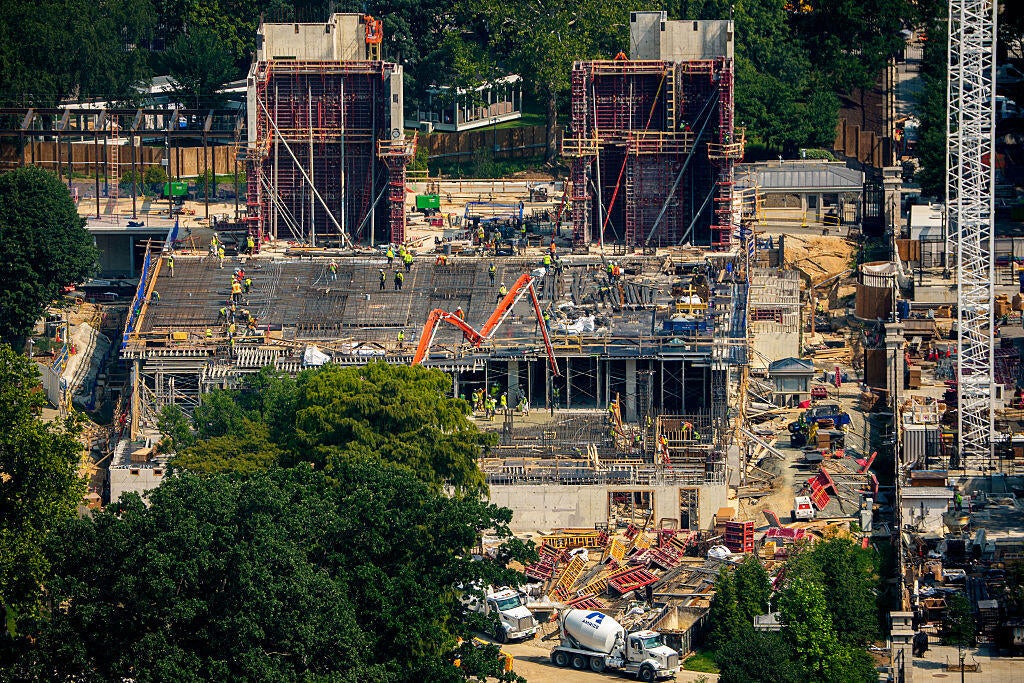
Andrew Harnik / Getty Images
Reacting to the appeals court’s decision, Mr. Trump wrote in a post on Truth Social that the administration “will be immediately appealing to the United States Supreme Court” and called the ruling “horrendous, politically motivated, and unlawful.”
“This unjust decision must be overturned by the Supreme Court in its entirety,” the president wrote.
Mr. Trump has claimed to have raised the $400 million he says is necessary for construction from private donors and major corporations like Lockheed Martin, Amazon and Microsoft, many of which have business before the government.
The funds were collected by a nonprofit organization, handed off to the National Park Service and then deposited into an account controlled by the president that is normally used for minor White House repairs and maintenance, according to court records.
U.S. District Judge Richard Leon, the judge who oversaw the initial lawsuit, called the payment mechanism a “Rube Goldberg” machine, referring to the cartoonist and inventor who made complex contraptions to perform simple tasks.
While the legal challenge has played out, construction on the presidential bunker underneath the proposed ballroom has been permitted to continue, and the panel of appellate judges allowed work to continue as they decided the case. Had the White House not appealed the ruling, the construction would have been forced to stop unless Congress approved a proper funding mechanism.