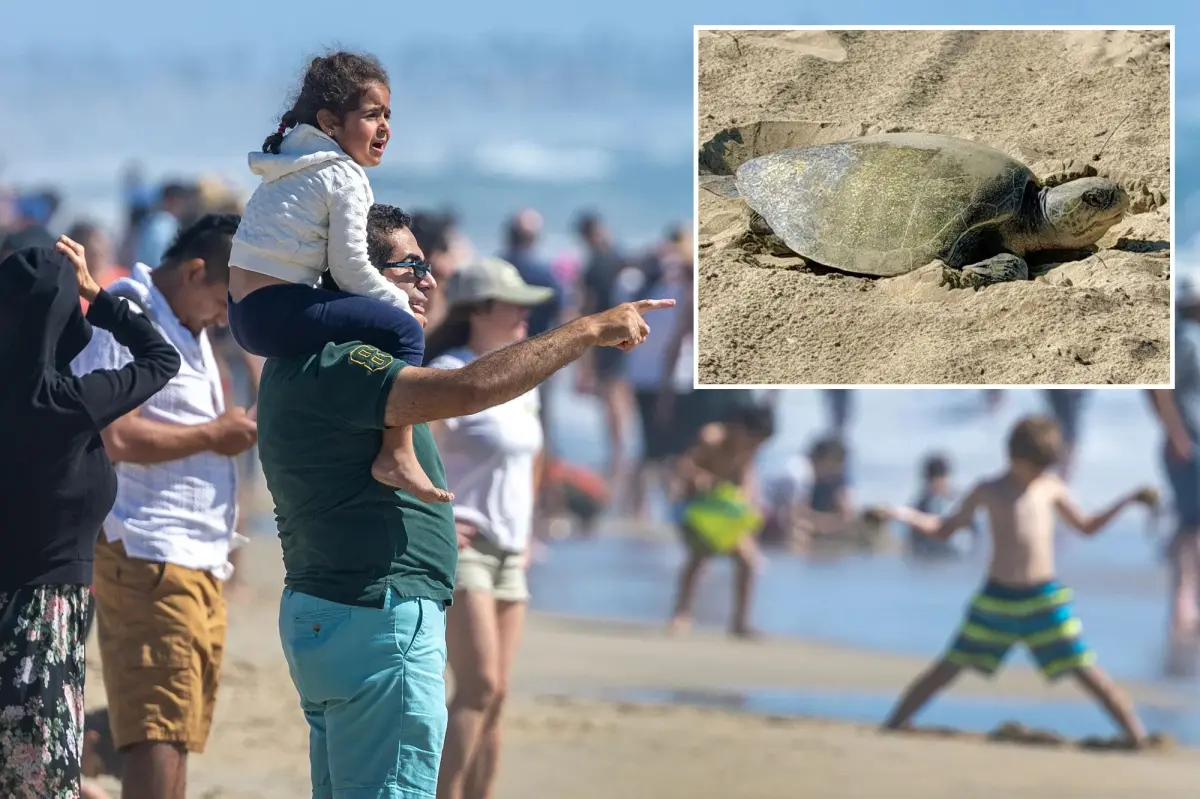
Two endangered sea turtles have created an unexpected dilemma for Huntington Beach, where nearly 1,400 people have signed an online petition calling for the Pacific Airshow to be canceled or postponed.
The dispute involves two olive ridley turtles that recently nested along the Orange County coast.
NOAA and the California Department of Fish and Wildlife have confirmed that the nests belong to separate turtles. Their arrival marks the first recorded natural nesting by any sea turtle species on the U.S. West Coast.
One turtle laid its nest near Surfside and Seal Beach in mid-September.
Three days later, on Sept. 19, a second olive ridley deposited eggs near the Huntington Beach Pier.
The nests now face the Pacific Airshow, scheduled for Oct. 2 through Oct. 4—during the heart of their incubation period. Olive ridley eggs generally require 45 to 60 days to hatch.
The timing has raised concerns about how the nests will fare when airshow crowds converge on the beach.
One nest is located near the pier in a prime viewing area expected to draw particularly heavy foot traffic throughout the weekend.
The potential risks extend beyond visitors getting too close to the protected site.
Advocates worry that the intense noise and ground vibrations produced by high-performance military jets could affect the developing eggs. However, the impact of low-frequency vibrations on reptile embryos buried in loose sand remains largely unstudied on the West Coast.
Wildlife officials are taking precautions. NOAA, the U.S. Fish and Wildlife Service, and state and local partners have fenced off the nesting areas, installed warning signs, and started round-the-clock monitoring.
Despite those measures, the airshow is still scheduled to proceed.
Organizers and city officials are modifying the event’s ground operations by moving some pedestrian routes, vendor booths, and attractions farther from the protected areas. The flight schedule, however, remains unchanged.
The petition cannot by itself compel the city to cancel the event. Any decision to cancel, relocate, or postpone the airshow would require coordination among Huntington Beach and the federal and state agencies charged with protecting the endangered turtles.
The unusual conflict began after experts initially thought a single turtle had created both nests. Further analysis of the animals’ body shapes and distinctive shell patterns confirmed that two separate turtles were involved.
Wildlife officials are continuing to monitor the coastline for signs that additional turtles may come ashore.