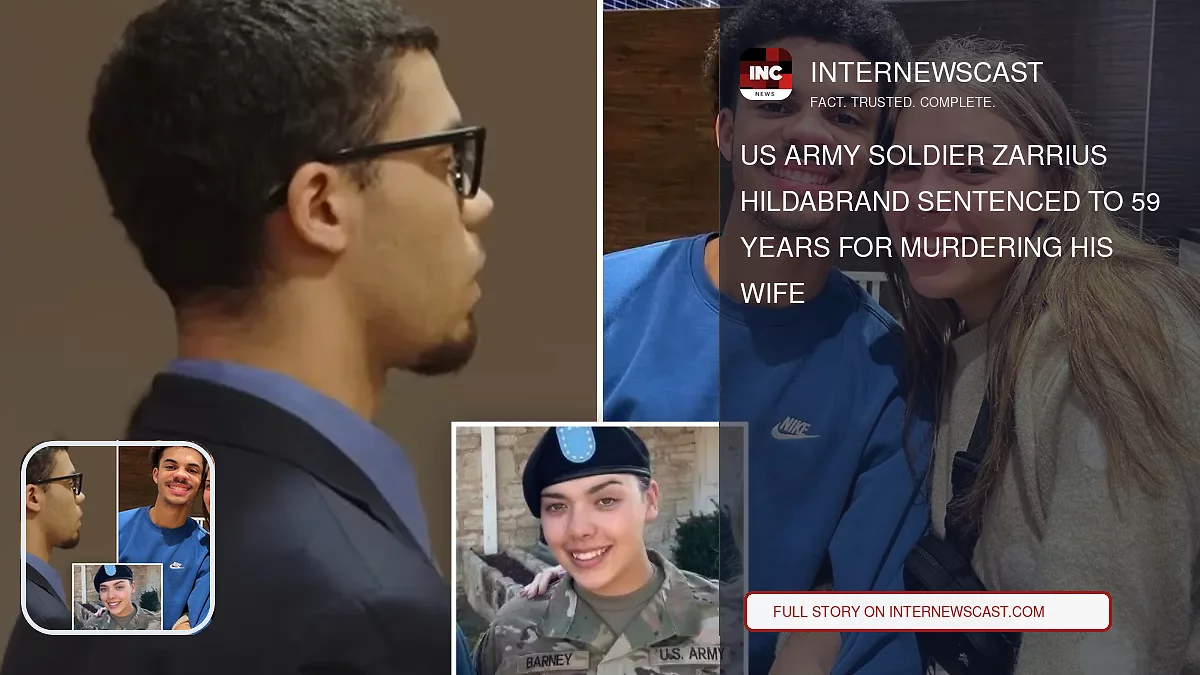

A US Army soldier who murdered his 21-year-old wife, then joined her distraught relatives in searching for her while knowing she was dead, has been sentenced to 59 years behind bars. The judge condemned his conduct, saying he showed concern for “anyone other than himself.”
Zarrius Hildabrand, 24, received the sentence Friday in Anchorage, Alaska, after being found guilty of killing his wife of seven months, Saria Barney Hildabrand, 21, and attempting to conceal the crime.
Hildabrand was convicted in June over the August 2023 shooting, which happened only hours after his 21st birthday celebrations. The fatal argument began when Saria confronted him about infidelity—an accusation he later acknowledged was true.
After the shooting, Hildabrand purchased cleaning supplies and placed his wife’s body inside a storm drain, according to the Alaska Department of Law.
He went on to report Saria missing and took part in efforts to locate her, even though he knew she had been killed. At trial, his attorneys also argued that she had taken her own life.
Hildabrand was stationed at Joint Base Elmendorf-Richardson with the 11th Airborne Division. He was convicted of second-degree murder and tampering with evidence. Judge Peter Ramgren said the killing was carried out “intentionally” and described Hildabrand’s actions as “abhorrent.”
The judge also pointed to what he called Hildabrand’s “apparent lack of remorse,” saying the soldier “never seemed to show concern for anyone other than himself” after the murder.
Hildabrand’s 59-year sentence includes 55 years for the second-degree murder conviction.
He was also handed consecutive two-year terms for evidence tampering, along with an additional 25-year sentence.
He must serve at least two-thirds of the sentence before he can be considered for parole.
Saria was shot and killed during the early morning hours of Aug. 6, 2023, after the couple returned home from an evening out with friends.
The group had visited Dave & Buster’s and planned to continue to a nightclub. Hildabrand was refused entry, however, after a bouncer believed he was intoxicated.
The friends eventually went their separate ways, while Hildabrand and Saria returned to their Anchorage apartment. An argument followed, ending in the fatal shooting.
DISCOVER MORE: Microsoft Exec Jared Bridegan’s Ambush Killer Convicted
During proceedings, Hildabrand attempted to portray himself as someone who had merely discovered his wife’s body in bed after she had suffered a gunshot wound.
“The first thing I was afraid of was having no recollection of the night before, and just not knowing what happened,” he told the court.
“I was afraid I was gonna lose my family; I was afraid that I was gonna go to jail for something that I had no recollection of. Just, there’s so many unknowns and I immediately assumed the worst.”
Kenneth Gallagher, from the Alaska State Medical Examiner Office, testified that Saria died from a “penetrating, indeterminate range gunshot wound.” Investigators also found blood covering the mattress.
While testifying, Hildabrand appeared to acknowledge that he had tampered with evidence. He said he bought hydrogen peroxide to clean the “surrounding areas and mattress.”
“The plan was to hide the body of my wife and then clean up the blood off the mattress and the surrounding area,” he said.
Describing his state of mind, Hildabrand said: “I just didn’t know what to feel… I just knew that the next day was going to be rough – because I had to hide my wife’s body and then clean up the surrounding area in our bedroom.”
Hildabrand admitted to buying a 96-gallon garbage can from Lowes – which he admitted he bought to help move his wife’s body.
He dumped his wife’s body in a 15 to 20 foot storm drain – and she was found in water around two feet deep by emergency crews some five days after her death.
Brittany Dunlop, prosecuting, said Hildabrand “callously disposed” his wife’s body – and “perpetuated a lie about her being missing.”
The callous hubby posted desperate appeals on Facebook and “walked around for hours” searching for his wife, according to his victim’s mom Meredith Barney.
Hildabrand used his wife’s phone to message her work colleagues – around eight hours after the murder – to say she wouldn’t be turning in for work.
Then he went on a late night drive at around 10 p.m. on Aug. 5 as he started to “worry about his wife” before formally reporting her missing the following day – some 30 hours after she was killed.
Hildabrand told cops he waited to file a missing persons report because he thought she would appear.
EXPLORE MORE: Homeless Man Accused of Attempted Murder in Brutal Head Stabbing Incident


