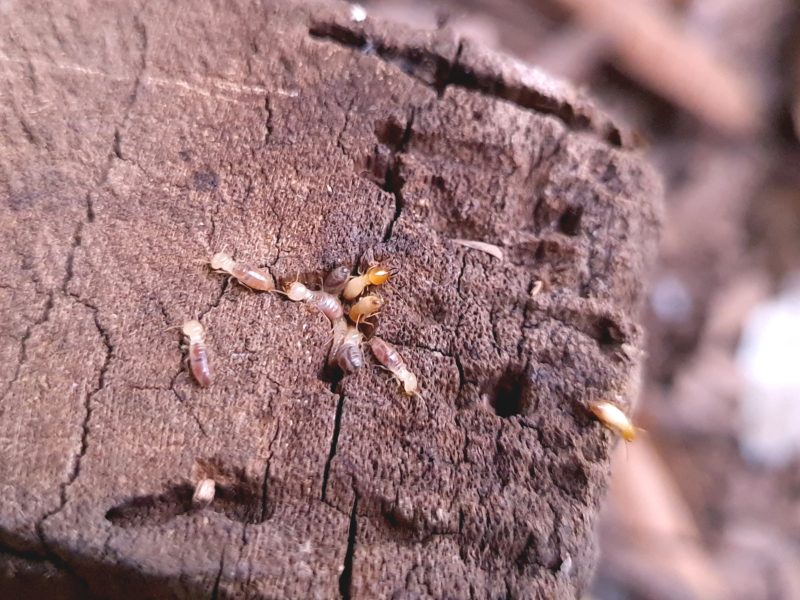


FORT LAUDERDALE, Fla. (WFLA) — Researchers at the University of Florida Institute of Food and Agricultural Sciences have unveiled a study verifying that hybrid termite colonies are now present in South Florida.
The research, which appears in the journal Proceedings of the Royal Society B, highlights that two highly destructive and invasive termite species, the Formosan subterranean termites and Asian subterranean termites, are not only living together but also interbreeding.
The study reveals that these termite species have a tendency to create very large colonies, and once mature, the winged termites may venture out to locate a mate and become a new nest’s king and queen.
Suspicions about their ability to breed began about 10 years ago when Thomas Chouvenc, associate professor of urban entomology at the UF/IFAS Fort Lauderdale Research and Education Center, said that they observed males and females from both species exhibiting interspecies courtship behaviors.
“This was unexpected, and it raised red flags about the possibility of hybrid populations forming in the field,” said Chouvenc.
In 2021, Chouvenc reported his team had begun collecting winged termites in the Fort Lauderdale area that didn’t match the shape or form of either termite species, prompting them to ramp up monitoring.
“At first, I could not believe it, as I was hoping to never find it,” said Chouvenc. “Since then, we have confirmed the presence of hybrid swarms every year since 2021, including in April 2025.”
Genetic testing confirmed the new species to be samples of hybrid termites, sharing half of their genes with each of the two species.
With this discovery, scientists warn that the repercussions of a new invasive termite species could extend far beyond Florida, which is a hotspot for the spread of invasive termites via private boats.
“This may be a Florida story now, but it likely won’t stay just in Florida. Give it time,” Chauvenc warned.
The hybridization process has likely been underway for a decade and is impossible to stop. However, scientists say that understanding the biology of this new termite species, and its weaknesses, could help improve pest management and foster better solutions as time goes on.