
Thomas Jefferson once captured the value of a free press in a line that still echoes: ‘Were it left to me to decide whether we should have a government without newspapers, or newspapers without a government, I should not hesitate a moment to prefer the latter.’
The Albanese government, however, appears to have landed on a very 21st-century alternative: media outlets underwritten, quietly and indirectly, by the state. This is separate from the more than $1.5billion a year Canberra already directs to the ABC and SBS.
Labor’s newly established $74.4million Journalism Assistance Fund is being sold as a way to support public interest journalism, strengthen media diversity and improve the financial sustainability of Australian newsrooms.
In practice, it looks less like bold media reform and more like a lesson in how taxpayer money can be used to shore up the dominant players already sitting at the centre of the industry.
Meta’s decision not to renew commercial agreements reportedly worth about $70million a year laid bare the vulnerability of Australia’s media business model. It also exposed the limits of the News Media Bargaining Code, which has failed to guarantee lasting payments from Big Tech.
Labor’s answer now involves asking taxpayers to cover part of the newsroom wage bill while the government tries to build yet another bargaining framework.
That is not visionary industry policy. It is a publicly funded — and deeply imperfect — Band-Aid.
Only Canberra could design a media “diversity” scheme in which the biggest payments flow to the most established media conglomerates. Nine, including the former Fairfax newspapers, Seven, now part of Southern Cross Media, and Australian Community Media received more than 40 per cent of the funding. Nine alone landed $16.1million through two grants, while Seven secured $11.3million.

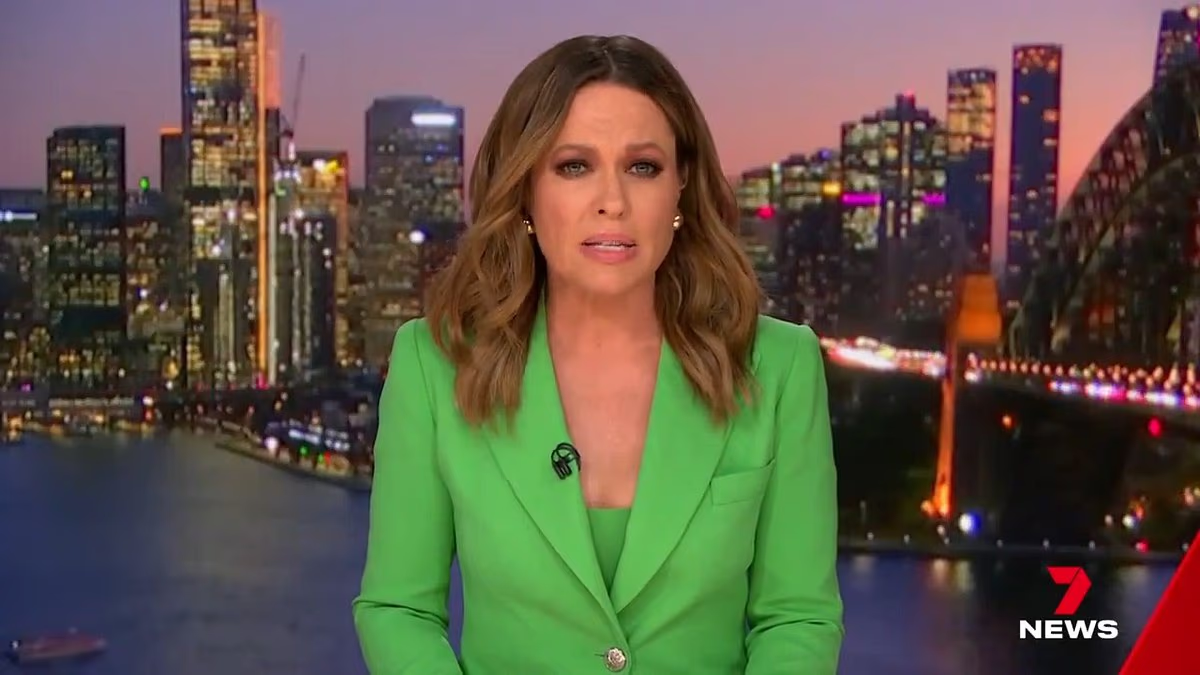
Only Canberra could devise a ‘diversity’ program in which the largest cheques go to the most entrenched media conglomerates – including Seven, now part of Southern Cross Media. (Seven’s Angela Cox is pictured)
The justification for intervention is familiar: advertising revenue has collapsed, technology companies have cannibalised income, newsrooms have been stripped bare and local courts and councils are going largely unscrutinised. That’s all despite enormous funding for the public broadcasters.
But the gravity of the commercial media’s crisis makes the incompetence of Labor’s response unforgivable.
Despite the government’s own policy framework warning against entrenching incumbents, the fund was administered with the sophistication of a pub raffle. It was first come, first served.
Applications were assessed for eligibility in the order received until the money ran out. The fund was fully subscribed within four weeks, more than four months before its advertised closing date.
The formula was spectacularly crude: $13,000 a year for every eligible full-time journalist already employed.
No new positions were required, no additional reporting was mandated, no proof was needed that a single job was actually at risk or even saved.
The supposed $7.5million ceiling for handouts to each organisation was rendered largely meaningless because it applied to each ABN rather than each corporate group. Nine received separate grants through Nine Entertainment and Fairfax Media. Seven collected funding through three different entities.
It’s the kind of taxpayer-funded rort these media entities usually enjoy exposing, except this time they are the beneficiaries.

‘Nine provided the perfect punchline. Its $16.1million allocation became public in the same week it announced approximately 30 editorial redundancies across its metropolitan publishing operations,’ PVO writes. (Nine’s Sarah Abo is pictured)
The scheme rewards corporate scale, subsidises existing payrolls and asks almost nothing in return beyond maintaining the qualifying headcount and filing reports.
Nine provided the perfect punchline. Its $16.1million allocation became public in the same week it announced approximately 30 editorial redundancies across its metropolitan publishing operations.
The spectacle exposes the absurdity of the scheme: a program sold as keeping journalists employed is paying millions to a company simultaneously cutting jobs. Nor does the fund make journalism sustainable, it just makes existing payrolls temporarily cheaper.
Nothing in the terms of acceptance requires recipients to build subscriptions, develop new revenue sources, enter underserviced markets or produce a credible plan for surviving without government assistance.
When the payments cease in March 2028, the underlying commercial rot will remain. At best, the subsidy postpones redundancies. At worst, it creates a funding cliff that will inevitably trigger an industry campaign to make temporary government assistance permanent.
The deeper danger here is the damage this arrangement does to public trust.
The media exists to scrutinise the government. The government is now partially paying the wage bills of the organisations performing that scrutiny.
There is no evidence that a minister has purchased a favourable headline or that an editor has softened coverage in return for funding. None is required to recognise the institutional problem. Even if every editor behaves impeccably, the appearance of dependence is corrosive.
Labor’s own media policy framework acknowledges that government support can become a source of influence over journalism. Yet the fund’s disclosure rules are comically backward.
Recipients aren’t required to prominently disclose their taxpayer support. Disclosure is effectively optional. If a publisher chooses to mention the funding, the government mandates specific wording assuring readers that it doesn’t influence content.
The financial relationship capable of creating suspicion can remain hidden, but the government’s reassurance of purity is compulsory.

‘Jefferson wanted newspapers without government. Labor prefers making them quietly dependent on the state,’ writes Daily Mail political editor Peter van Onselen
Which makes now a fine time to disclose that here at the Daily Mail we didn’t apply for or receive anything. Because our parent company is based in the UK, we were ineligible, as was the case for News Corp (US-based) and The Guardian.
Expecting readers to trawl through the GrantConnect database to discover which media companies receive government support is an insult to transparency, especially when those same organisations routinely demand complete disclosure from politicians and businesses.
Many beneficiaries have displayed remarkably little enthusiasm for publicising their own grants. Surprise, surprise!
Any public funding for journalism should be directed towards genuinely endangered services and additional reporting that would not otherwise exist. Applications should be assessed by an independent body, and funding should be capped by corporate group rather than ABN.
The irony that this government is clamping down on tax structures such as trusts but allowed the big end of the media town to double-and-triple-dip into this grant program shouldn’t be lost on anyone.
Recipients should be required to show how temporary assistance will produce long-term viability. One of the smaller players that received $120,000 in funding has already closed down. Most importantly, every grant should carry a permanent and prominent masthead-level disclosure.
Labor’s Journalism Assistance Fund has delivered neither media diversity nor sustainability. It has strengthened established players and postponed the industry’s financial reckoning.
Jefferson wanted newspapers without government. Labor prefers making them quietly dependent on the state.
Peter van Onselen is the foundation chair of journalism at The University of Western Australia