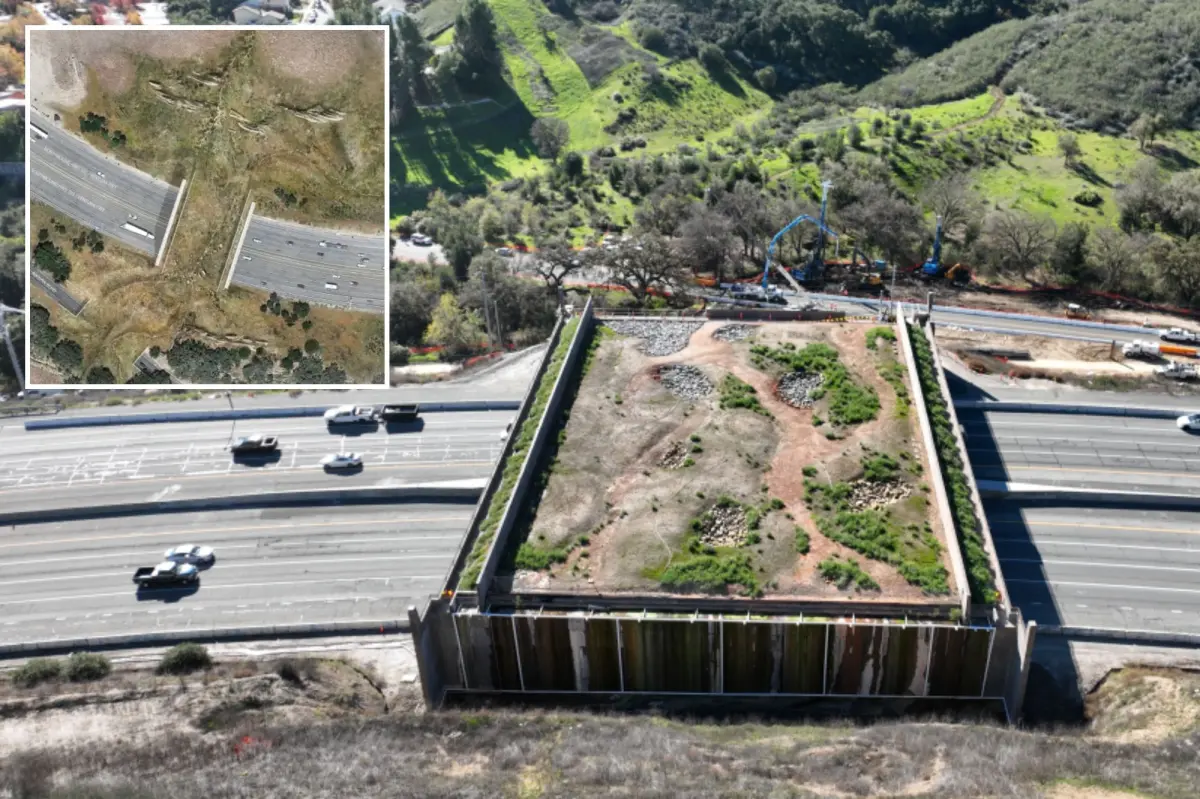

As California prepares to open a long-awaited wildlife bridge, researchers are working to understand how animals respond to the crossing. Tracking collars will collect physiological data that could offer clues about whether the animals feel calm, stressed or unaffected as they use the structure.
The $114 million Wallis Annenberg Wildlife Crossing is scheduled to open over the 101 Freeway on Dec. 2. The project is designed to reconnect mountain lions, bears and other wildlife with habitat that has been separated by the heavily traveled highway.
At a news conference Thursday, officials said selected animals would be fitted with “biologging tags.” The devices can record heart rate, body temperature and GPS location, giving scientists a detailed look at how wildlife moves through and responds to the crossing.
“We’ll be able to see not just how the animals move near the crossing, but how they are physiologically affected,” said Seth Riley, chief wildlife ecologist for the Santa Monica Mountains National Recreation Area.
Researchers hope the information will reveal how animals approach, use and move away from the bridge.
“Are they happy to go up on there and their heart rate doesn’t change, or what is it like to be near the freeway? That will be a new kind of data that we’re interested in,” Riley said.
The tagging effort has already begun with deer, while mountain lions are expected to be included next, according to officials.
Beth Pratt, president of the Wildlife Crossing Fund, said the project represents a long-term effort to protect wildlife and prevent the isolated Santa Monica Mountains mountain lion population from disappearing.
“The crossing is about the next century of wildlife preservation in the Santa Monica Mountains. It’s about the mountain lion population not going extinct,” she said.
Built with a concrete base, the bridge will stretch 210 feet long and 174 feet wide when it opens.
The project gained momentum after the death of P-22, the mountain lion known as the “Hollywood Lion.” The animal became famous after being photographed near the Hollywood sign in 2012, but later suffered fatal injuries while attempting to cross the 101 Freeway.
When Gov. Gavin Newsom joined the groundbreaking ceremony in 2022, he said California had committed $54 million to the project. He later said an additional $10 million would be needed to finish the crossing, with philanthropists also helping fund the work.
By 2025, the projected cost had climbed to $92 million and was later expected to reach as much as $114 million. Taxpayers have contributed $77 million to the wildlife crossing so far.