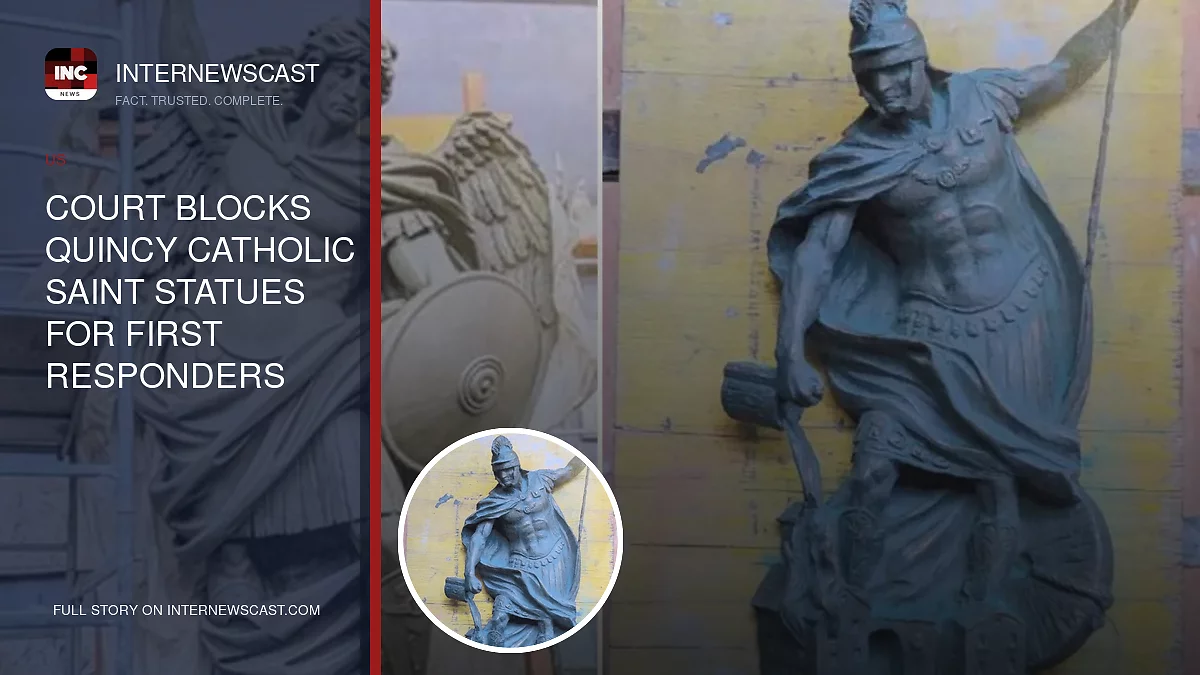

Massachusetts’ top court has stopped the city of Quincy from placing two large Catholic saint statues outside its new public safety headquarters, finding that the display could be viewed as an official endorsement of a particular faith.
In an Aug. 20 decision, the court upheld an October 2025 lower court order that temporarily barred the city from installing two 10-foot monuments depicting St. Michael the Archangel, widely regarded as the patron saint of police officers, and St. Florian, the patron saint of firefighters.
The Becket Fund for Religious Liberty, which is representing Quincy in the case, told Fox News Digital that the dispute is far from finished.
“This ruling is disappointing but is only preliminary,” Joe Davis, senior counsel at Becket and lead attorney for the city of Quincy, told Fox News Digital. “Quincy chose these statues to honor the courage and sacrifice of its firefighters and police.
“The city should not have to hide public art simply because some people may think of religion when they see it. As the court noted today, this is not the final word for these statues, and we will continue defending Quincy’s right to honor its heroes.”
Opponents of the plan argue that displaying religious figures at the entrance of a government facility would run afoul of the Massachusetts Constitution’s requirements for religious neutrality.
The legal fight began after The Patriot Ledger reported that Quincy intended to install the two statues outside the city’s newly built public safety headquarters.
The statues were created by an Italian sculptor and selected by Quincy Mayor Thomas Koch.
According to court documents, Koch said he did not pick the statues to advertise religion but to “honor, inspire and encourage our First Responders” as well as “boost morale” and “ensure [first responders’] lifesaving work would remain maximally effective.”
Critics of the statues said the plan had not been publicly disclosed during the building approval process and raised constitutional concerns.
The legal battle started in May 2025, when faith groups and taxpayers sued the City of Quincy and Koch in Norfolk Superior Court, saying the intended installation of the statues outside the city’s new public safety headquarters violated the Massachusetts Constitution’s protections on religious neutrality.
The plaintiffs are represented by the ACLU of Massachusetts, the national ACLU, Americans United for Separation of Church and State, the Freedom From Religion Foundation and Cloherty & Steinberg LLP.

The ACLU of Massachusetts wrote in its brief, “The statues, whose imagery is drawn directly from Catholic iconography, lack a predominantly secular purpose. The primary effect of permanently installing two new, oversized, overtly religious statues as the sole adornments on the City’s public safety building is to advance religion.”
The National Fraternal Order of Police and Massachusetts Fraternal Order of Police, however, said in a brief that St. Michael is revered by people of various faiths, not just Christians.
“First responders of all stripes, religious creeds, and political affiliations — and not just Catholics or Christians — cherish both saints for their symbolic importance to the profession,” the brief states.
In a statement to Fox News Digital, Koch, the mayor of Quincy, said, “Quincy’s firefighters and police put their lives on the line for this city every day, and these statues were chosen to honor their bravery, service and sacrifice.
“This decision is disappointing, but it is preliminary, and we will continue to fight for the ability to commemorate our first responders as the law permits.”
In a statement, Jessie Rossman, legal director at the ACLU of Massachusetts, said, “Here in Massachusetts, our state constitution is clear: The government must remain neutral in matters of religion and must not elevate one faith above others. With today’s landmark ruling, the Supreme Judicial Court affirms those principles, which are the essential foundation of a pluralistic society where people of all faiths and no faith can flourish.
“As Quincy residents and taxpayers, our clients believe that installing these plainly religious statues would undermine those ideals,” Rossman added. “We are proud to represent these courageous plaintiffs, and we look forward to continuing to litigate the merits of this case in Superior Court.”