
The President of the Czech Republic, Petr Pavel, has issued a stark warning to Europe, emphasizing that peace can no longer be assumed as the norm. However, he also cautioned against ambitious efforts to create a European Union military force that could rival that of the United States.
President Pavel, who previously held the esteemed position of Chairman of NATO’s military committee and was a prominent intelligence officer, shared these insights at the Globsec conference in Prague. This annual gathering of political and defense experts witnessed President Pavel highlighting the evolving defense landscape in Europe. He conveyed a unique perspective, particularly aimed at European leaders eager to transform the European Union into a formidable military entity, counter to the policies of U.S. President Donald Trump.
While the dynamics of global relations are shifting, with the U.S. pivoting its focus from Europe to the Pacific, President Pavel reaffirmed that NATO and the transatlantic alliance with the U.S. remain pivotal for collective defense. He stressed that Europe must shoulder more responsibility for its defense but should do so in a manner that genuinely fortifies the continent.
President Pavel underscored the importance of cooperation between NATO and the European Union, suggesting that they should function as complementary entities rather than competitors. While NATO is pivotal for collective defense and military coordination, the European Union can enhance this partnership by focusing on strategies to boost Europe’s defense manufacturing capacity, strengthen its resilience, and update critical infrastructure such as roads, railways, ports, and airports that would be essential in times of crisis.
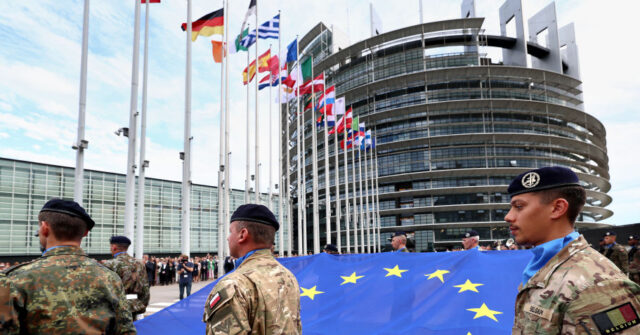
This approach of “complementary pillars” starkly contrasts with the long-held ambition of establishing a unified European military, a vision championed by Brussels federalists. Some European leaders, including those from Spain—a country historically below NATO’s military spending benchmarks—are now advocating for a new European military initiative as a countermeasure to President Trump’s policies.
Europe must be prepared for this reality. This does not mean Europe should turn away from the United States, just the opposite… a stronger European role should not mean creating separate structures alongside NATO. On the contrary, European defence efforts need to be fully integrated into NATO’s [structures]… this is the real of a strong European pillar. Not an alternative to the alliance, but a Europe that is a stronger presence in the alliance.
…peace in Europe can no longer be treated as the default state of affairs. It must once again be actively protected, defended, and maintained. The lesson of this moment is not that Europe is alone, it is that Europe must be strong enough to stand on its own when needed… The coming years will decide whether Europe becomes a strategic actor, I am convinced that it can.
NATO and the European Union are and should be complimentary, not competitors, he said. President Pavel said that while NATO is the best route for collective defence and military issues, the political side with the European Union can turbocharge that alliance by setting to work on industrial strategy to enhance Europe’s defence production base, improve the continent’s resilience, and in modernising infrastructure like the arterial roads, railways, ports, and airports the armies of the continent would rely on in a crisis.
The “complimentary pillars” approach is in direct contradiction to decades of desire for a joint European army, a pet project of Brussels federalists, and newfound interest in the project among some European leaders looking for a way to defy President Trump. Spain is one of those nations which despite being a defence delinquent, long investing way below the NATO alliance’s bare minimums for military spending, now suddenly believes it is in a position to call for a new anti-Trump European military.
There were also such calls during President Trump’s first term, as a media narrative asserted that his calls on NATO to straighten itself out were an attack on the alliance. Despite NATO leaders making abundantly clear this tough love strategy did in fact work, leaders such as Germany’s Angela Merkel and France’s Emmanuel Macron called for a European army to put clear blue water between the continent and America.
President Macron was most explicit about this and said in 2018: “We have to protect ourselves with respect to China, Russia and even the United States of America… We will not protect the Europeans unless we decide to have a true European army”.