
DOJ moves to strip citizenship from 17 people accused of hiding disturbing crimes

The Justice Department revealed on Monday its plans to strip citizenship from 17 people accused of fraudulently gaining their naturalized status in the United States.

These individuals, hailing from 13 different nations, face allegations of engaging in severe criminal activities, including child sexual abuse, drug trafficking, and significant financial fraud.

Most of the accused allegedly misled authorities during their naturalization process by falsely asserting that they had no undisclosed criminal history. This deception, according to officials, indicates a failure to meet the federal legal requirement of demonstrating “good moral character” necessary for U.S. citizenship.

“U.S. citizenship is a privilege,” Acting Attorney General Todd Blanche stated, “and under President Trump’s decisive leadership, the Justice Department is committed to a zero-tolerance approach to any misuse of this process.”

A banner featuring President Donald Trump graces the front of the U.S. Department of Justice building in Washington, D.C., captured on February 20, 2026. (Drew Angerer/AFP/Getty Images)
Markwayne Mullin, Secretary of the Department of Homeland Security, echoed this sentiment, emphasizing, “American citizenship must be earned with integrity. Breaking our laws and deceiving during immigration proceedings results in losing this privilege.”

According to the release, the accused individuals are overwhelmingly middle-aged to senior adults, ranging in age from 39 to 69, and originate from 13 countries across the globe.

Nine were from the Caribbean and North America, including Cuba, Haiti, Jamaica, the Dominican Republic, Trinidad and Tobago and Mexico. Two were from Colombia in South America. One was from former Yugoslavia in Europe. Three were from Asia, including India, China and the Philippines, and two were from Africa, including Somalia and the Congo.

Officials said many of the applicants were asked under oath whether they had ever committed a crime for which they had not yet been arrested. According to authorities, many of the individuals allegedly provided false statements during their interviews, enabling their applications to be approved.

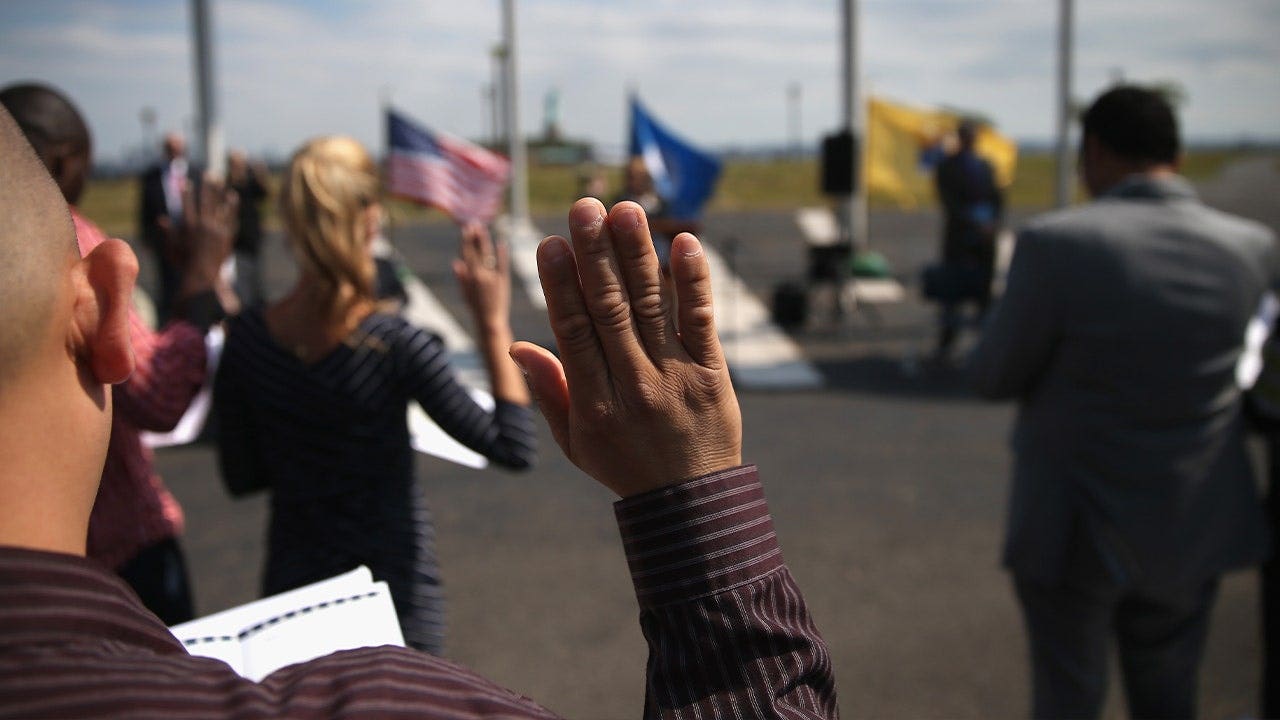
Immigrants take the oath of citizenship to the United States during a naturalization ceremony at Liberty State Park on Sept. 19, 2014, in Jersey City, New Jersey. (John Moore/Getty Images)

The most common alleged offense among the accused is child sexual abuse. Six of the 17 individuals — roughly 35% — were identified in connection with child sex crimes, including statutory rape and the receipt of explicit images involving minors.

One notable case involved a Roman Catholic priest who allegedly used his position of trust to groom and abuse a child.

U.S. Department of Justice logo on a podium at a press conference

The U.S. Department of Justice logo is displayed on a podium before a press conference at the Justice Department in Washington on May 6, 2025. (Julia Demaree Nikhinson/AP Photo)

The fraud cases also involved large-scale, multi-million-dollar schemes.

One case allegedly involved $54 million in securities and wire fraud. Another centered on $36.7 million in fraudulent claims billed to Blue Cross Blue Shield through fake physical therapy clinics. In a separate case, an individual was accused of using inherited funds tied to a Colombian drug cartel to finance real estate transactions, while another defendant was also accused of stealing millions from a Florida tribal casino.

Several individuals allegedly fabricated their identities in an effort to circumvent the immigration system, the Justice Department said. Four individuals are accused of using false names, misrepresenting marital status to U.S. citizens, or reapplying multiple times under entirely different identities after previous denials.

One woman allegedly adopted a false name after being denied in 1995. Authorities said she was ultimately identified after the government digitized old paper fingerprint records, which linked her current identity to a prior, rejected application.

–>

Leave a Reply

Your email address will not be published. Required fields are marked *