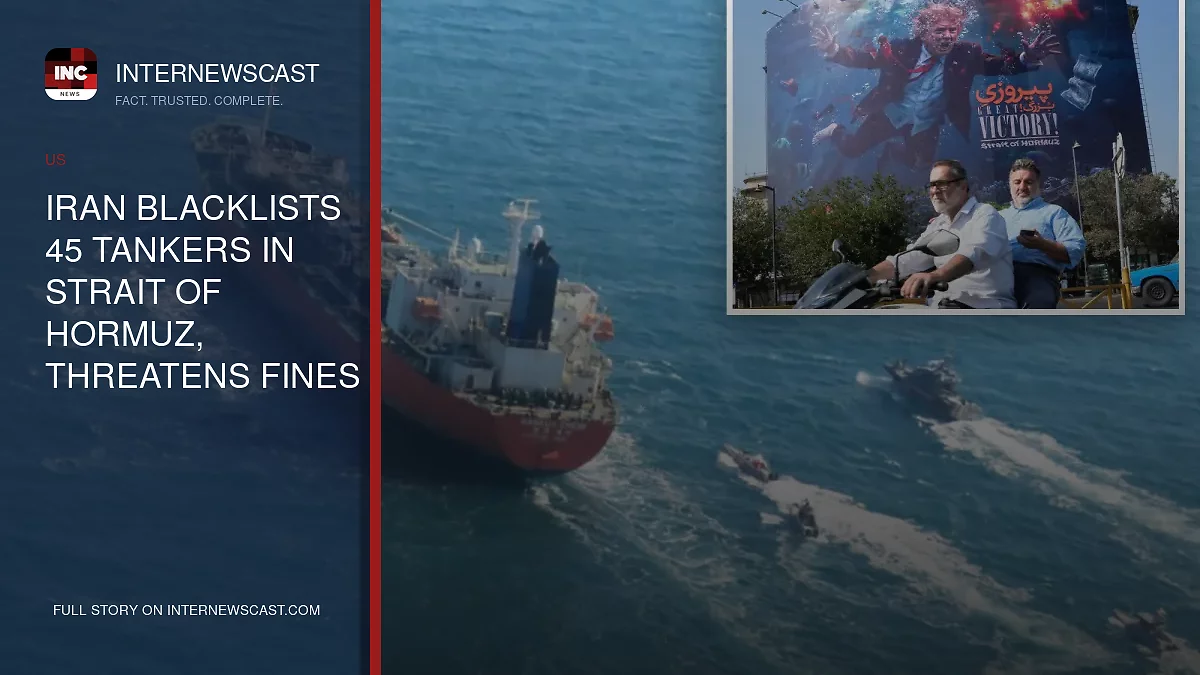

Iran has placed 45 tankers on a blacklist, alleging the vessels breached its rules while passing through the strategically vital Strait of Hormuz and warning that repeat violations could bring fines or the seizure of cargo.
In a post on X on Sunday, the Persian Gulf Strait Authority said the targeted ships may face penalties ranging from monetary fines to detention, with cargo such as crude oil and liquefied natural gas potentially subject to confiscation.
Tehran’s newly established authority overseeing the key waterway also cautioned that any ships providing support to the blacklisted vessels could face consequences of their own.
Among the vessels named were ships linked to the United Arab Emirates’ ADNOC Logistics and Shipping, ADNOC subsidiary Navig8 Tankers, and Saudi Arabia’s national shipping company, Bahri.
Iran’s warning came shortly after Treasury Secretary Scott Bessent said Friday that Tehran would soon be hit with what he described as the “toughest sanctions in history,” measures he claimed could “collapse the regime.”
Bessent escalated the rhetoric again Sunday on X, writing: “We are now entering the endgame. At dawn begins an economic D-Day — the single greatest financial offensive ever marshaled against an adversary.”
According to Reuters, the US Treasury is preparing to announce which companies or organizations could be exposed to secondary sanctions for continuing to conduct business with Iran.
Together, the moves are designed to intensify pressure on Iran’s economy, which had already been struggling with elevated inflation before the war.
Bessent and other Cabinet officials are hopeful the economic pressures will help bring an end to the six-month conflict with the US.
Iran has promised “crushing, punishing and devastating” consequences in response to potential sanctions, claiming any other nations that support the economic penalties will be assisting in an “act of war” against Tehran.
The US has maintained a naval blockade since a Memorandum of Understanding with Iran fell apart in early July, hampering Tehran’s oil exports while ships from other nations have been allowed to pass through the strait.
There’ve been just 16 ships exiting the critical oil chokepoint in the past 24 hours, compared with more than 100 before President Trump started the war on Feb. 28.
Still, Energy Secretary Chris Wright said on X last week, “7-day average of oil leaving the Strait is over 8 million barrels a day. Make no mistake, thanks to the U.S. Navy, oil is flowing through the Strait of Hormuz.”
Roughly 20% of the world’s seaborne oil has typically entered and exited the strait.
Even some Iranian officials have also signaled publicly that the war is nearing an end.
“The war must come to an end at some point,” Iranian President Masoud Pezeshkian said in a speech Friday, according to Tehran-based state media. “It is better that we demonstrate our strength and dignity today and tell the world that we have won and that we are ending the war.”
“No matter how much military power we have, if people are hungry and we do not have financial circulation and economic growth, we will not endure,” added Iranian Parliament Speaker Mohammad Bagher Ghalibaf in other remarks reported by Iranian state media.
“As someone who has experienced war, [I] understand the true value of peace,” Ghalibaf also said.
Bessent is prepared to announce the new economic actions at 1 p.m. ET on Monday.