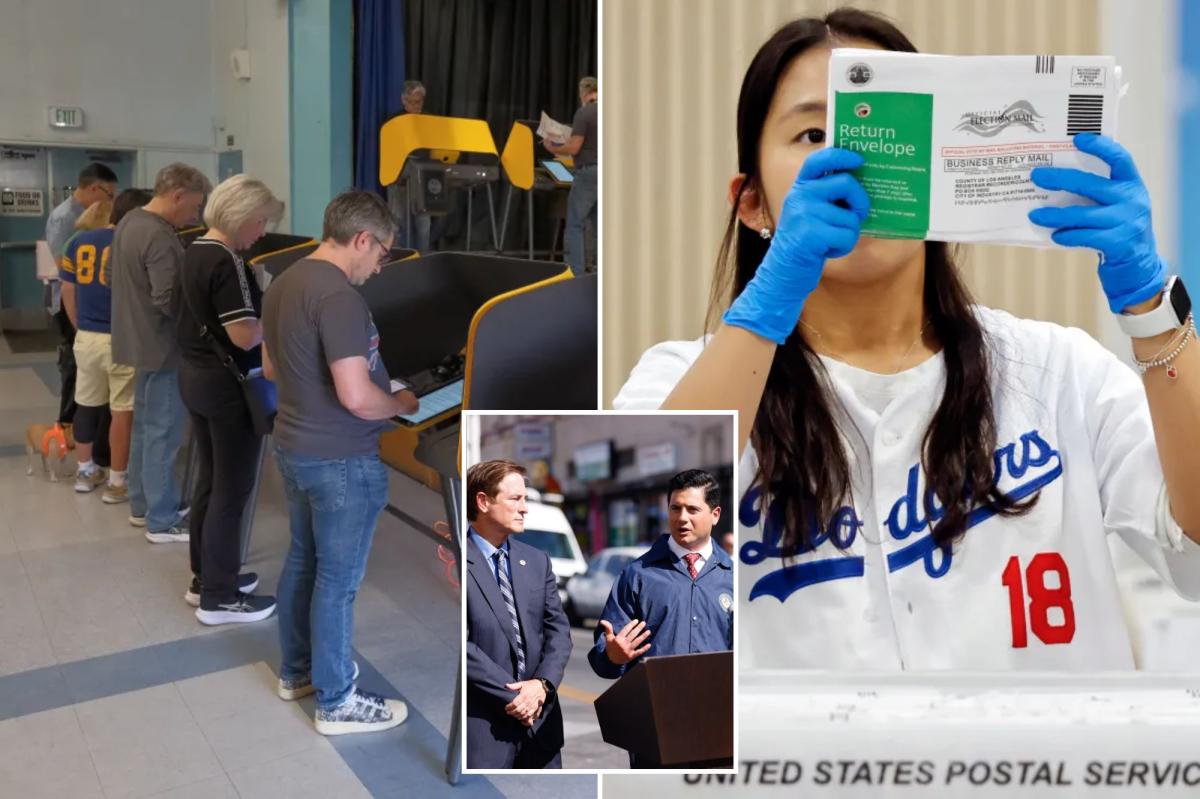


California is currently resisting a federal audit of its voter registration lists as the Trump administration intensifies its scrutiny of local election processes.
Bill Essayli, the leading federal prosecutor in Los Angeles, announced on Sunday that his office is seeking to examine the state’s electoral system. This initiative follows growing concerns about a noticeable increase in last-minute votes favoring Democratic candidates.
“California permits first-time voters to register using identification forms that would likely surprise many Americans,” Essayli stated in a Sunday post on X. He highlighted examples such as health club membership cards, employee ID cards, credit or debit cards, prescription labels, and insurance cards.
He explained that these types of identification are allowed under specific California regulations when a voter does not provide a driver’s license or Social Security number during the registration process.
“Our office believes this policy warrants a more thorough examination,” Essayli wrote. “If California truly aims to foster trust in its elections, it should be transparent with its records rather than seeking to keep them hidden. What are they trying to conceal?”
Essayli further expressed concerns regarding the accuracy of California’s voter rolls, questioning the effectiveness of the state in purging records of deceased individuals, those who have relocated, and people convicted of disqualifying felonies.
“On top of that, California allows third parties to collect and turn in ballots on voters’ behalf (a practice known as ballot harvesting) with few restrictions,” he wrote. “This makes it difficult to track who actually received, completed, and submitted each ballot.”
The federal government has been seeking access to California’s statewide voter registration list for more than a year as part of a review of the state’s compliance with federal election laws.
Essayli’s post was shared with a copy August 2025 letter from the DOJ’s Civil Rights Division to California Secretary of State Shirley Weber, where federal officials requested the state’s voter registration list to evaluate compliance with maintenance requirements under the National Voter Registration Act and the Help America Vote Act.
The letter argued federal law grants the attorney general authority to obtain election records and conduct an independent review of voter registration systems.
“California cannot limit the Justice Department’s access to mere inspection of the requested voter registration records,” the department led by Harmeet Dhilon wrote.
“The Justice Department is entitled to a full and complete copy of those records in the form in which California maintains them.”
Federal officials further requested copies of all voter registration applications submitted between Dec. 1, 2023, and July 1, 2025, and argued that federal election laws preempt state privacy restrictions that California has cited in refusing to provide the records.
Essayli said the dispute is now before the Ninth Circuit Court of Appeals.
California law requires voters to provide a California driver’s license number, state identification number or the last four digits of a Social Security number when registering. If an applicant does not have those forms of identification, election officials may assign a unique identifying number to validate the registration.
The state’s regulations also contain a broad list of acceptable identification documents for first-time federal election voters who must verify their identity under the federal Help America Vote Act.
State regulations direct election officials to interpret identification requirements liberally and resolve doubts in favor of allowing eligible voters to cast regular ballots.
“I think it’s right for the state attorney general — if it’s a Democrat or Republican — to push back on the federal administration to try to, um, you know, attack their elections in that way,” pollster and Democratic election expert Paul Mitchell told The Post.
The state has decline an audit of its voter roles by the federal government.
Critics of the fraud allegations say California’s election system contains multiple layers of verification designed to prevent ineligible voting.
“The conspiracy theorists like to conflate that everybody in California, non-citizens can get a driver’s license. But there’s a different driver’s license for a non-citizen than for a citizen. And the DMV knows whether you’re a citizen or not,” Mitchell said.
He said provisional ballots serve as a safeguard when questions arise about a voter’s registration or eligibility. Rather than being counted immediately, the ballots are held by county election officials while they verify the voter’s information. The ballot is counted only if officials determine the person was eligible to vote and did not cast another ballot elsewhere.
“You would be committing a crime, you’d face five years in jail, and you’d face losing your visa,” he said, noting that even provisional ballot voters must attest that they are U.S. citizens and face penalties if found guilty of lying.
The claims have reignited debate over voter fraud in California, despite the absence of evidence of widespread fraud in the state’s elections.
The controversy comes as ballots cast on June 2 primary still continue to be counted, with several closely watched races for governor and mayor remaining in flux.
In some contests, Republican and conservative candidates who appeared ahead on election night have seen their leads diminish as additional mail-in and provisional ballots are counted, prompting renewed speculation from critics of California’s vote-counting process.
Mitchell also pushed back on claims that California’s lengthy vote-counting process is evidence of fraud.
He said Republican candidates often perform better in the earliest returns because their supporters tend to return ballots sooner. As additional mail ballots are processed in heavily Democratic areas such as Los Angeles County, later results can shift toward Democratic candidates.
Mitchell argued those changes reflect the order in which ballots are received and counted rather than wrongdoing.
Los Angeles County Registrar-Recorder/County Clerk Dean Logan also defended the integrity of California’s election system and rejected allegations that fraud is occurring during the counting process.
“No evidence,” Logan said when asked about claims of cheating.
“I think what we’re seeing, unfortunately, is carrying out of a narrative that has become the gameplay in national politics in the United States, and that is to prior to the vote count being completed, take shots at the process, so if the outcome turns out different than what you want, you don’t accept that, you challenge the process. The reality is this is the way elections have been designed in California,” Logan said.
Logan said voting patterns and registration demographics largely explain why later-counted ballots can favor Democratic candidates.
“I think you have to look at the demographics of the county and you have to look at the registered voter statistics in L.A. County and in California in general. The Democratic registration rate is significantly higher than Republican. The second largest group of voters are people who don’t identify with a party at all. So I’ll leave the speculation of the campaign dynamics to political commentators, but logic follows,” he added.
Logan said voter confidence in the system is reflected in how ballots are submitted.
“The majority of L.A. County voters turn their ballots in at those drop boxes, and I think that itself is an indication that they’re confident that that process is gonna work and work correctly,” he said.