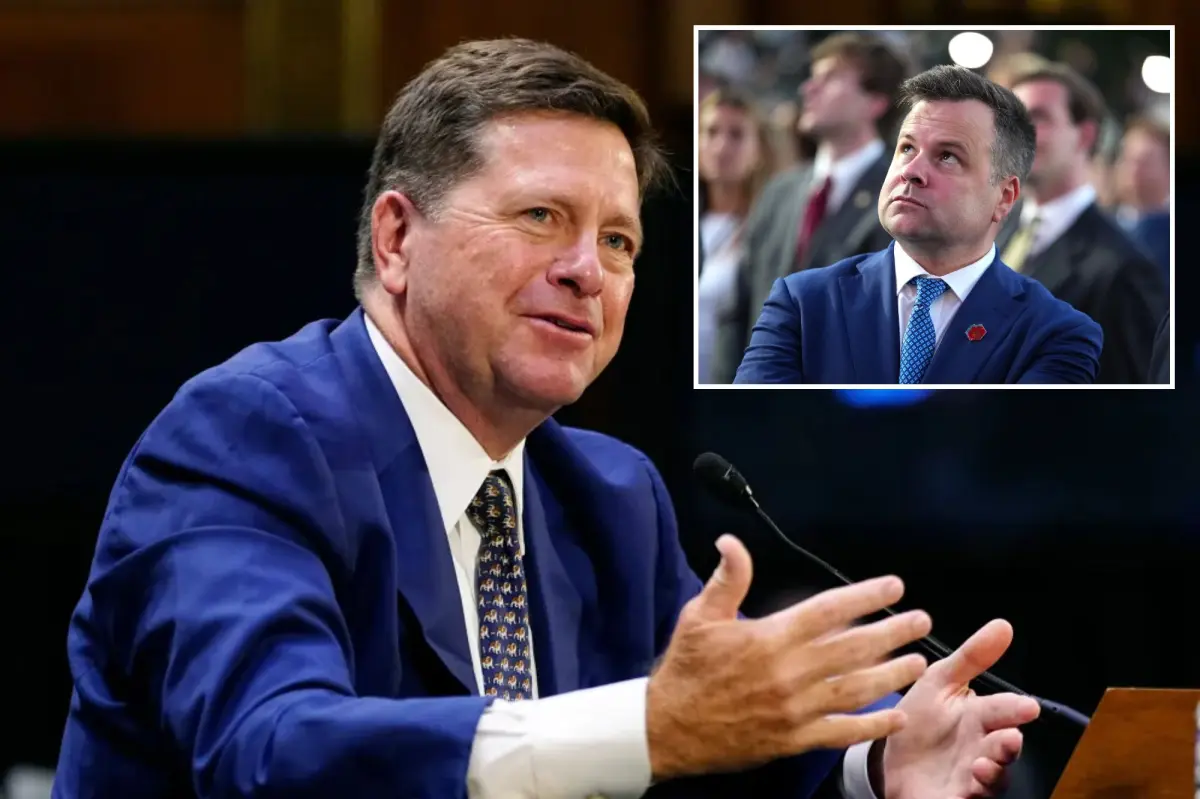

Jay Clayton’s Senate confirmation hearing on Wednesday unfolded with clear bipartisan impatience, as lawmakers moved quickly to put a permanent intelligence chief in place — and bring the current acting arrangement to an end.
Clayton, the US attorney for the Southern District of New York, had previously seen his confirmation hearing called off at President Trump’s request. The delay allowed Trump to temporarily place Bill Pulte, who leads the Federal Housing Finance Agency, in a role that gives access to some of the nation’s most sensitive intelligence.
Across party lines, senators signaled that Clayton was their preferred choice over Pulte.
Senate Intelligence Committee Vice Chairman Mark Warner said he was “anxious to get a permanent DNI” confirmed and move beyond Pulte’s tenure, describing the acting official as among the least qualified figures imaginable for the job because he has no national security background.
“The DNI has literally access to all our nation’s secrets — things that are limited only to the Gang of Eight here in Congress — and I will hope that you will treat this sensitive information with the kind of respect and security it deserves,” Warner told Clayton.
Clayton framed his Wall Street experience as an asset in confronting adversaries such as China and Russia. He told senators that today’s intelligence challenges extend far beyond traditional military threats, missiles and covert missions, reaching into financial warfare, global supply chains, sanctions policy, energy markets and artificial intelligence.
Follow The Post’s live coverage of President Trump and national politics for the latest news and analysis
Clayton’s initial confirmation hearing in June was postponed after Trump unexpectedly halted the process, irritating senators by leaving Pulte in the acting role while insisting that the chamber first approve Clayton’s successor as US attorney for the Southern District of New York.
Now his nomination is on the glide path to the Senate floor with a likely confirmation vote before senators’ August break.
While Clayton also lacks a traditional intelligence background, the former SEC chairman still leaned into his resumé as his chief qualification, pointing to his experience “leading and improving large organizations.”
He also noted his role as US attorney granted him “significant national security experience, including in matters involving foreign terrorist organizations, counterespionage, money laundering, bribery and the abuse of our communications platforms to create and sow distrust.”
“We interact with US intelligence community and counterterrorism officials continuously on dozens of important national security matters,” Clayton added.
Unlike Pulte, whose lack of intelligence experience became a central criticism of his tenure, Clayton sought to turn his outsider status into his greatest asset — arguing that his background tracking money flows, financial crimes and economic pressure campaigns gives him a different lens on modern threats.
Clayton argued that America’s intelligence agencies must expand their focus beyond traditional battlefields and better understand how global events hit Americans through markets, energy prices and the broader economy.
“I do believe that the economic effects of various events should be more a part of intelligence assessments because markets move immediately, markets react, and then people react to markets,” Clayton told the Senate Intelligence Committee.
“The most interesting thing today for all of us is the price of oil,” he added. “Understanding the dynamics around the current and the long-term price of energy … is an essential part of any intelligence assessment.”
He further told the panel that national security and market integrity have effectively become the same thing, and that understanding the economic fallout of world events — from oil prices to Chinese market manipulation — should be central to what America’s spy agencies deliver to policymakers.
The argument amounted to Clayton’s clearest case for why a former Wall Street regulator and financial crimes prosecutor belongs atop the nation’s intelligence apparatus: that America’s next major conflicts may be fought as much through markets and technology as through military power.
Instead of emphasizing covert operations or espionage, Clayton argued that his experience tracking financial crimes, sanctions, markets and international money flows would help the intelligence community better understand how conflicts abroad affect Americans at home — including what they pay at the gas pump.
He also framed economic competition with adversaries like China as a national security fight, arguing that intelligence agencies must better understand how Beijing uses trade, technology and financial leverage to advance its interests.
Clayton placed AI alongside economic warfare as one of the defining challenges facing the intelligence community, arguing that America’s spies must adapt to a world where adversaries can use emerging technology to accelerate influence campaigns, cyber operations and information warfare.
“AI is a game changer,” Clayton said. “AI is not only an opportunity, but a threat. When something’s both an opportunity and a threat, you better get your arms around it.”
The nominee also argued that economic competition with rivals such as China should increasingly be viewed through a national security lens, pointing to restrictions on advanced semiconductor exports as evidence that economic policy and intelligence are becoming intertwined.
“We wouldn’t be restricting those chips if it were just a commercial issue,” he said. “It is a national security issue.”
Clayton further warned that adversaries such as Iran are increasingly using cryptocurrencies and other digital financial platforms to move money outside the traditional banking system, saying those financial networks deserve greater scrutiny from US intelligence agencies.