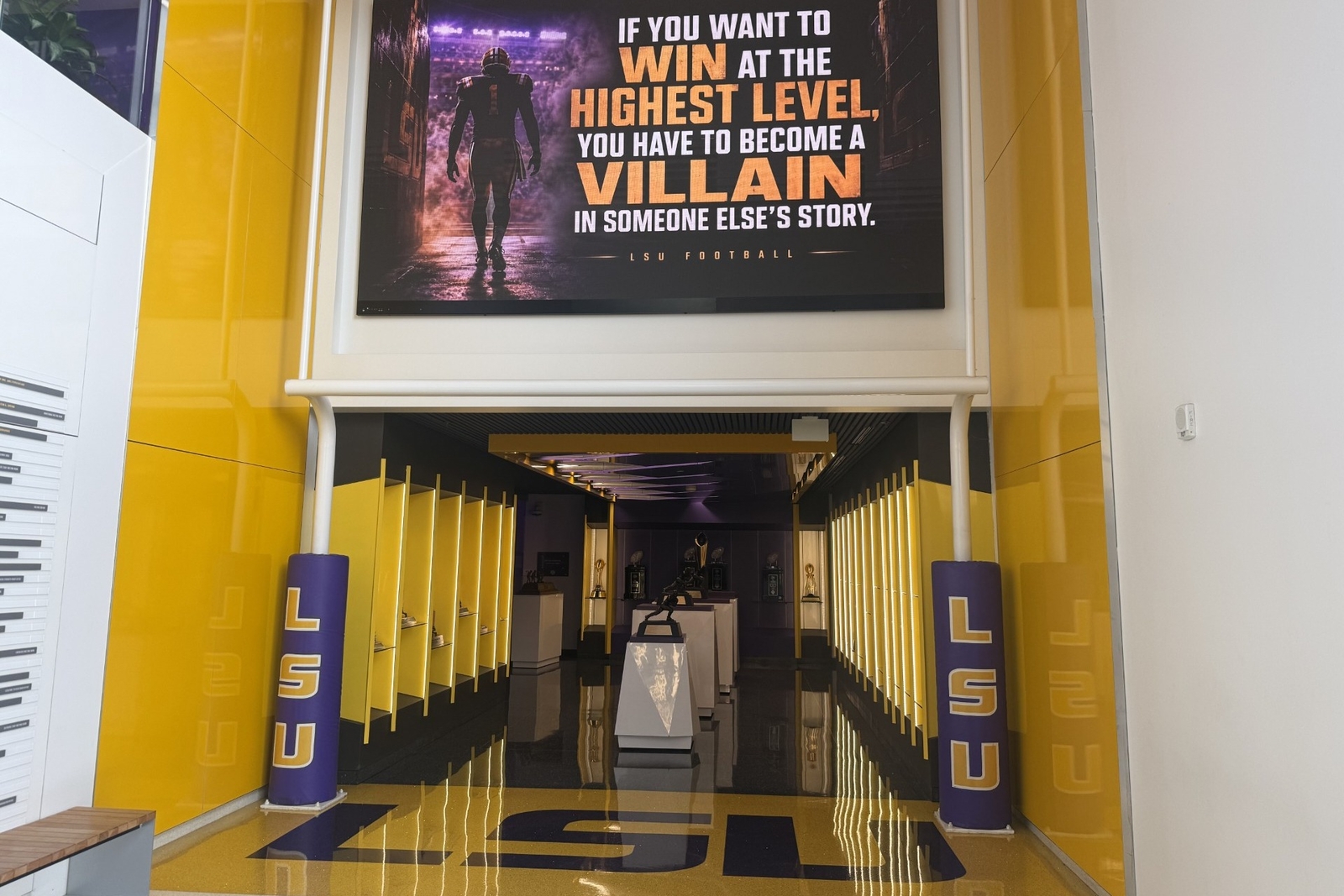

The SEC took legal action against LSU on Thursday, filing a federal lawsuit in U.S. District Court in Alabama that accuses the university of violating the conference’s First Amendment right to expressive association by disregarding league rules barring former NFL players from signing with and competing for member schools.
The complaint names LSU, the LSU board of supervisors, university president Wade Rousse, athletics director Verge Ausberry and football coach Lane Kiffin as defendants. It was filed as SEC commissioner Greg Sankey and others were appearing in a separate state-court injunction hearing in Baton Rouge, Louisiana.
News of the federal filing surfaced during Sankey’s testimony, when an attorney for the plaintiffs referenced the new lawsuit. The disclosure quickly rippled through the crowded courtroom, where many in attendance appeared unaware of the development until that moment.
In its federal complaint, the SEC argued that its nearly century-long stability depends on member schools and their coaches following a shared rulebook. The league pointed specifically to its “Professionalism Rules,” longstanding provisions that prohibit athletes who have entered a professional draft, signed professional contracts or appeared on a professional team roster from returning to college competition.
The conference said those rules rest on a central principle: college sports are intended for students pursuing an education while representing their universities. According to the SEC, the restrictions help protect competitive balance, preserve roster opportunities for high school recruits and current college athletes, and maintain a clear line between collegiate and professional sports.
The SEC is seeking both preliminary and permanent injunctions that would stop the defendants from, in the league’s view, forcing the conference to associate with conduct that conflicts with its stated mission. It also asks the court to bar LSU and the other defendants from deterring, coercing, preventing or punishing the conference for exercising its First Amendment rights.
At the center of the SEC’s argument is its claim that the separation between amateur and professional athletes is essential to how the conference is organized and governed.
The lawsuit alleges that LSU officials carried out a “deliberate and coordinated campaign” to recruit professional athletes for the Tigers’ 2026-27 football season, including players who had signed NFL contracts with the Cleveland Browns, New Orleans Saints and Tampa Bay Buccaneers. The SEC further claims that reports indicate at least two such players are already on campus and practicing with LSU, and that the defendants intend to add them to the official football roster and allow them to play in the upcoming season.
The SEC’s lawsuit notes that every one of its members — including LSU — affirmed that “individuals who choose to leave college athletics, sign professional playing contracts, and compete professionally should not then be permitted to return to college competition.”
The lawsuit says that LSU, through Rousse, voted in favor of the SEC issuing a statement on Aug. 25, in which the league affirmed its longstanding rules prohibiting SEC teams from having professional athletes on their rosters.
“Despite the SEC’s longstanding rules prohibiting professional athletes from returning to college athletics, Defendants saw this as an opportunity to be exploited,” the SEC’s lawsuit said.
The conference alleges its “organizational purpose and core values” are being undermined by LSU.
“The SEC brings this action to vindicate its First Amendment right of expressive association, i.e. its right not to be forced to associate its competitions, brand, and championships with conduct that it has expressly condemned since the SEC’s founding. The SEC also seeks declaratory and injunctive relief to vindicate the SEC’s right to disassociate from conduct that directly undermines the SEC’s organizational purpose and core values.”
Louisiana state court Judge William Jorden ruled Friday that the SEC and Sankey are not allowed to punish member schools if they play a college football player who returns to campus after signing a contract with NFL teams this summer.
Jorden’s ruling prohibits the SEC from enforcing a rule it affirmed last week, which threatens schools with stiff penalties for using former NFL players, including a half-season suspension for coaches, a fine that matches 50% of the sport’s annual budget and revocation of league voting rights.
The SEC took action after former Ole Miss tight end Dae’Quan Wright and defensive tackle Zxavian Harris announced plans to join their former coach, Lane Kiffin, at LSU after leaving NFL training camps.
The judge had previously issued a temporary restraining order, which prohibits the NCAA from declaring Wright and Harris ineligible under its new five-for-five rule.
“Today, the SEC is a sixteen-member association,” the SEC lawsuit said. “The Presidents and Chancellors of the SEC’s member institutions have governed together across generations, operating under a set of shared rules that have shaped the athletic and educational paths of thousands of student-athletes and provided the competitive integrity and fair competition necessary for the SEC to thrive.
“Those rules are not fine print. They are the governing framework that keeps college sports unique, protects opportunities for high school and college student-athletes, and preserves competitive equity and fair competition.”
ESPN’s Pete Thamel contributed to this story.
Copyright © 2026 ESPN Internet Ventures. All rights reserved.